Mostrar 827 resultados

Descrição arquivística
827 resultados com objetos digitais Mostrar resultados com objetos digitais
MCPP/GM/3/1/1921/14 · Item · 8 June 1921
Parte de College Personal Papers and Biographical Information

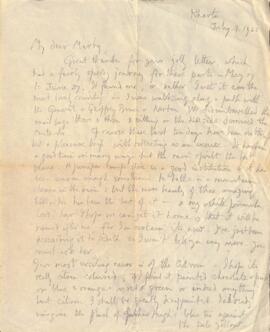
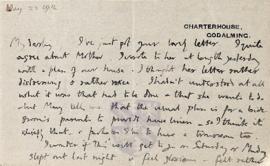
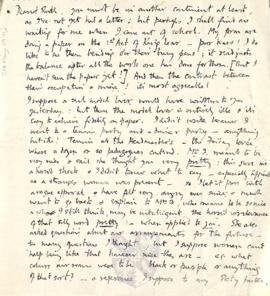
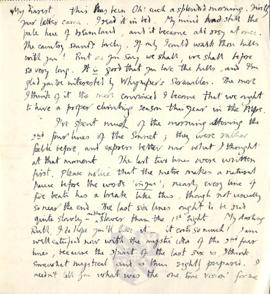
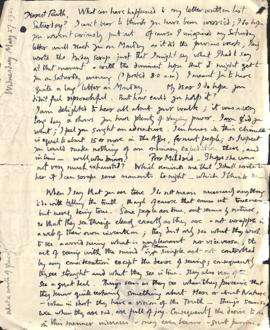
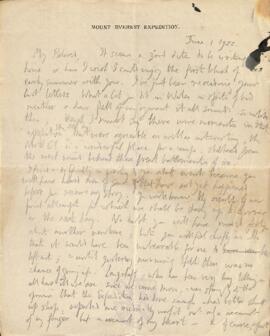
Letter to Ruth Mallory, written from ‘Kampa Dzong’ on ‘Mount Everest Expedition’ Letterhead

Brief Description
Dr Kellas had been buried. Raeburn was declared unfit and had returned to Sikkim and so there was no-one left with experience of climbing in the Himalayas. Describes Bullock, Wheeler and Herron and outlines their plans. Talks about the food they eat. Describes his first view of Everest from 100 miles away.

Detailed Summary
Dr Kellas had been buried in sight of the three great peaks he had climbed Pahonri [Pauhunri], Kinchenjan [Kinchenjhau] and Chomiomo [Chomo Yummo]. Raeburn had been pronounced unfit to proceed and Wollaston had taken him to a place in Sikkim to recover. Wollaston had then returned to reach Tinki Dzong. This was a disaster as they were are now left without anyone who had experience in the Himalayas. Morshead had limited experience and Mallory had criticisms of Raeburn. They planned to see the N.E. side of Everest and hoped to see the N.W. side to solve a big problem of topography. He was still hopeful of attacking Everest that year with Bullock and Morshead, but that goal seemed a very long way off. Evaluates Bullock, Wheeler, and Herron. Kampa Dzong had been pleasant change. They had supplemented their food with sheep, gazelle, gammon, goose, fish, and half-cooked vegetables. Hoped to find eggs at their high elevation of about 15,000 ft.

He was feeling extraordinarily fit and was much moved by the prospect of a nearer approach to Everest. He describes his first view of the mountain from 100 miles away, ‘It is colossal even at this distance - a great blunty pointed snow peak…with a much steeper north face than people have made out’. He thinks that the N.W. side of the mountain, facing the Arun river, up which the monsoon cloud came had the bigger snowfall. He describes the landscape of the Arun valley and that he was sorry they wouldn’t see the east side of the mountain.

[Letter continues later] - It had been a jolly day. He now had a better mule after giving his up to Raeburn. He and Bullock were surveying the country.

Letter from George to Ruth Mallory, 9 June 1921
MCPP/GM/3/1/1921/15 · Item · 9 June 1921
Parte de College Personal Papers and Biographical Information

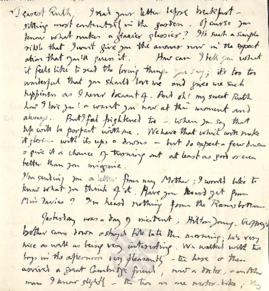
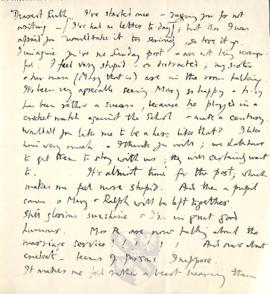
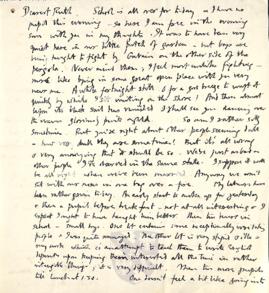
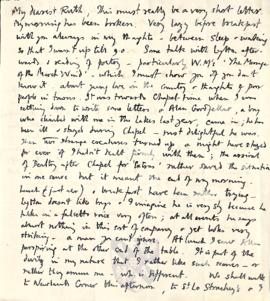
Letter to Ruth Mallory, written from Trenkye [Tinki] Dzong, on ‘Mount Everest Expedition’ Letterhead

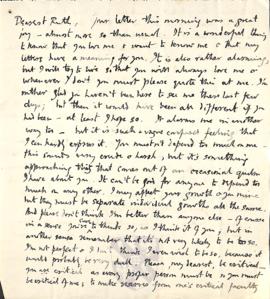
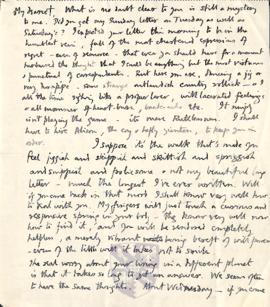
Responds to contents in her letters from 6-10 May mentioning the Hodges, Clare, Bridget’s son, Mary Ann and Stephen. He was feeling happier. He had been nailing the porter's boots. He had planned a two day expedition with Bullock to climb up to about 20,000 ft and see the N. E. face of Everest and had avoided telling Howard-Bury. Morshead had now joined the group. Describes a hill walk and a fragrant flower which he enclosed in the letter hoping it still had some of its scent.

He planned to take photos of the mountain range as they were now in a country which no European had previously visited. The rest of the party were quite cheerful. The food provisions were not proving expensive. Tells her not to be hopeless about the expedition as they may yet do very well. He would think of her on her birthday tomorrow.

Letter from George to Ruth Mallory, 15-22 June 1921
MCPP/GM/3/1/1921/16 · Item · 15, 20, 22 June 1921
Parte de College Personal Papers and Biographical Information

Letter to Ruth Mallory written on ‘Mount Everest Expedition’ letterhead

Brief Summary
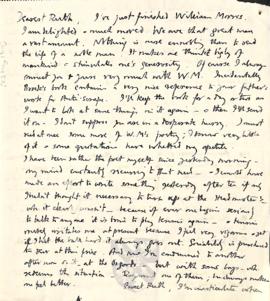
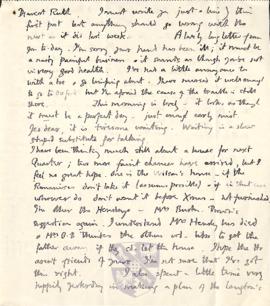
Describes their continued trek, the food, the views of Everest, and taking photos.

Detailed Summary
15 June - Left early from Trenkye [Tinki]. Had climbed and taken photos, was disappointed by mist blocking the views of the mountains, and joined with Morshead and his surveyors. Morshead was outwalking him as neither Guy [Bullock] or him were feeling well. Next day they followed the river, were entertained by the brother of the Phari Dzongpen [governor], complained of the curious food. On following day's march he rode ahead with Bullock, following the river whose course was unmapped.

20 June - They forded a river, entering the southward valley Arun proper, between the Sikkim peaks and Makalu. They were penetrating a secret as no European had been there before. They continued their march and he looked westward from Kampa Dzong seeing that Makalu and Everest had peeped over the top in the distance. Complains of the cloud coverage. They were in suspense waiting for a good view of Everest when ‘suddenly our eyes caught a glint of snow through the clouds and gradually, very gradually…visions of the great mountain sides and glaciers and ridges…appeared through the floating rifts and had meaning for us…for we had seen the whole mountain-range… until incredibly higher in the sky than imagination had ventured to dream, the top of Everest itself appeared. We knew it to be Everest’. Describes the shape of Everest and the connecting cols dividing the great mountain from its neighbours. They were reunited with the porters and the greater party who were shivering in their tents, while sunset brought views of Everest to the south.

22 June - It was a great joy to see Everest and he had taken photos. Everest had become more than a fantastic vision, it haunted his mind.

Discusses photography and problems with a telephotographic lens. He had taken a photo of camp. Describes fording the Arun River with Bullock, a sudden immersion, the fear of quicksand, and manoeuvring their beasts up a sand cliff, which was far from easy. He describes the view, mentioning Makalu, the Arun gorge, Tinki Dzong, the North of Everest, the steep ascent during the sunset, and seeing some animal tracks. He and Bullock had struggled with their ponies.

[Letter continues in the evening] - gives facts about his reconnaissance trip with Bullock, and how when fording the river his pony was nearly drowned, he lost his mackintosh cape and waterlogged his glasses. He had a glorious view of Everest and was very pleased with his physical condition. He had a plan to explore the N.W. faces of the mountain with Bullock and 10 porters. He was worried about the monsoon. They had stayed in an old Chinese fort. Wollaston re-joined the group, but they were still waiting for the mail and he hoped to get another letter from her. The photographs were developed and he was greatly delighted that 5 rolls of his taken with a small kodak were very successful. Wet days were expected and he intended to fix a base camp and a further high camp at about 20,000 ft.

Letter from George to Ruth Mallory, 28 June 1921
MCPP/GM/3/1/1921/17 · Item · 28 June 1921
Parte de College Personal Papers and Biographical Information

Letter to Ruth Mallory, written from '1st Base Camp under Everest’ on ‘Mount Everest Expedition’ Letterhead

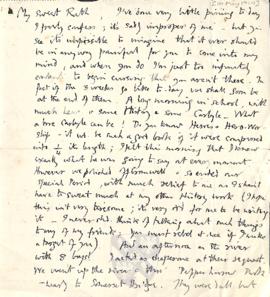
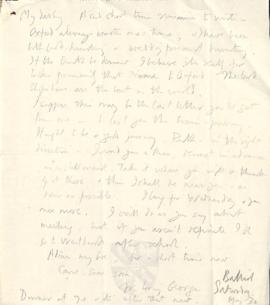
He had been busy finishing despatches to Howard-Bury. Describes the journey across the plain with 18 porters, being purposely mislead, and a miscommunication. The second day’s journey was uneventful, and he had climbed with Bullock.

Describes the following morning’s first view of Everest. They were not completely cut off from civilisation as there was a monastery nearby. Supplies were bought up for the monks and they could arrange to get fuel there.

He gives a detailed description of the previous day’s first mountaineering expedition, with Bullock and five porters, mentioning crossing glaciers, pinnacles over 50 ft high, and having to cut steps which was good training but tiring. They discovered a camping ground and had two good wettings in ideal bathing places. He was feeling more tired than he had ever felt in the Alps but was pleased with himself from a physical point of view.

He explains plans for the next day’s advanced camp. 'I can’t tell you how it possesses me and what a prospect it is. And the beauty of it all!’.

He had received another letter from her and was sorry about her troubles. Wishes she was lying where Guy Bullock was so he could kiss her.

Letter from George to Ruth Mallory, 6 July 1921
MCPP/GM/3/1/1921/19 · Item · 6 July 1921
Parte de College Personal Papers and Biographical Information

Letter to Ruth Mallory, written on ‘Mount Everest Expedition’ Letterhead [first page missing, reference to a hand drawn map in the surviving letter which may have been on the first page]

Brief Summary
Outlines plans for reconnaissance with Bullock including setting up an advanced camp. Describes Everest. Had taken photos of Everest with Bullock. Howard-Bury and Herron had arrived at Base Camp. Had been cutting steps. Climbed to what they believed was the 2nd highest peak ever climbed (23,500ft). The tent and bedding were uncomfortable and it was cold. Describes what he wears to keep warm.

Detailed Summary
They planned to explore westwards to the W.N.W. cwm and refers to a hand drawn map [missing]. They planned to make advanced camp with Mummery tents where only two peaks had been mapped or observed before. They had to explore eastward for a view of the great east arete of Everest. He describes the general shape of Everest assessing the possibilities of climbing it - in the south was a fierce rock arete, the snow col, the west cwm, the summit ridge, the east face had steep hanging glaciers and from a distant view looked impossible. Describes the East and North aretes and concludes that the approach to the col from the west looked bad and they would have to explore the other side. The N.W. arete looked very formidable with much steep rock about 23,000 ft. Unless the face on the other side provided easy ways to turn the difficulties they didn't have much hope here. The west face had very steep rocks towards the summit.

Everest was immeasurably bigger and higher than any mountain he had seen in the Alps. From a mountaineer’s point of view no more appalling sight could be imagined. He reports on the reconnaissance so far and of establishing the camp. He followed a clean stream and wanted to go further in their search for water and then saw a little lake’. They crossed a glacier the next day [again referencing a map, perhaps on the missing first page]. He had an interesting expedition with Bullock and the porters. It was remarkable that the descent was always very tiring.

The next day he tried to get high up on a ridge and take photos with Bullock, reaching their maximum heights. He had been cutting steps at 21,000 ft. The following day's plans were interrupted when they received news that Howard-Bury and Heron had arrived at Base Camp. They had enjoyed a pleasant slack day and made plans to select a main camp location. He and Bullock took photographs of Everest and some of its neighbours. He describes the challenges of climbing, and cutting steps in the ice. They reached the top registering 23,500 ft. They thought this was he second highest peak which had been climbed. He refers to the climbing records of [Tom] Longstaff and the Duke of Abruzzi. When they were better acclimatised and could start from a higher camp they would be able to go a great deal higher.

[The letter continues later] - All the driving power came from him. The tent was cramped, the bedding was uncomfortable and the evenings were cold. Describes his clothing in detail. He kept warm enough. He was looking forward to the trek back to Darjeeling and drawing nearer to her. He was not depressed as it was an exhilarating life on the whole and he was wonderfully fit. There would be something to be told even if they didn't climb Everest, which he didn't think they would.

Letter from George to Ruth Mallory, 12 July 1921
MCPP/GM/3/1/1921/20 · Item · 12 July 1921
Parte de College Personal Papers and Biographical Information

Letter to Ruth Mallory, written from 2nd Advanced Camp on ‘Mount Everest Expedition’ Letterhead

Brief Summary
1st Advanced Base Camp had become a dump for stores. He was strong but Bullock was tired. They had taken photos and cut steps. It was cold, ground hard and stoves didn't work very well. Lists food eaten.

Detailed Summary
They had been having a rather hard time with bad weather and nothing done in the way of reconnaissance and 1st Advanced Base Camp had become a dump for stores. They had had a late start that day and misjudged the crossing of a glacier, which gave the porters practice cutting steps but cost more time and cloud coverage spoiled their views of the W.N.W. cwm. They would try again early tomorrow if it was fine.

He was still going strong but Bullock was tired. Hoped Bullock would get properly fit before long. Their specially adapted high-climbing Primus stoves were useless and they would have to adapt at higher camps. They were at nearly 19,000 ft, the nights were cold and the ground was like iron but the views of the peaks to the west of Everest were glorious. They were currently on a good shelf above the N. [North] bank and had taken photographs in the clearing light last evening.

They planned to start on the way to Tingri the next morning. His first night at 2nd Advanced Camp was miserable with only two Mummery tents and no cook to look after them. He had been struggling with the Primus stoves and a substance called Kampite but they had excellent tinned food, listing Davies Oxford Sausages, sliced bacon, porridge, potatoes. They again had their cook, who in spite of his dirty hands, was rather a treasure.

Next morning he planned to take a selected 4 porters and the sirdar [sardar]. The ground was hard to sleep on but he made himself comfortable enough with his bed socks. Sometimes he was appalled by the mere length of the undertaking and wished it could be shorter.

Letter from George to Ruth Mallory, 13-20 July 1921
MCPP/GM/3/1/1921/22 · Item · 13-15, 18, 20 July 1921
Parte de College Personal Papers and Biographical Information

Letter to Ruth Mallory, written on ‘Mount Everest Expedition’ Letterhead [First page is missing]

Brief Summary
Exploring and taking photographs with Bullock. Outlines plans for reconnaisance which he anticipated would take a week to day days but had been hampered by a shortage of rations and the weather which was crucial for the success of the expedition. Hoped to ascend a high peak of 23,000ft. They planned to start final campaign by mid August and be returning to Darjeeling by mid September. A route to the west was impassible so they abandoned it and made plans to explore to the east.

Detailed Summary
14 July - He and Bullock started late (6am) to explore the glacier to the west and southwest and after a fine morning he had stayed to take photographs. Refers to a hand drawn map [possibly on the missing first page]. He got one or two good photographs while Bullock looked along a glacier for a south west pass into Nepal.

15 July - He started early (2.30am) and got up the small peak by 5.30am. The clear dawn and the mountain views were indescribably wonderful. Everest itself blocked out all sun and the cwm remained a cold dark hollow behind the brightly lit snows. He took photos all round. They knew about the shape and position of the cwm but it remained to be explored. They didn't know how it ran up the col between Everest and the peak to the south. They would have to get into it and some way up it. They planned to force a way over the col and down into the cwm, taking Mummery tents. Arrangements had gone wrong and they were short of rations. There were no hopes of the weather tomorrow - it was too warm; the snow didn't lie.

18 July - The right weather was essential foor the success of the expedition. Complains of idle days. He anticipated a desolating experience in the Mummery tents. They aimed to finish the reconnaissance of the west side of the mountain which was very unlikely to offer a possibility of ascent. Then they would concentrate on the north-west aretes. He estimated a week or ten day’s reconnaissance and the ascent of a high peak (over 23,000 ft) which he was very keen to accomplish. Made plans to move down to the new Headquarters and hoped to start on a final campaign by the middle of August. He planned to have failed or succeeded by the middle of September at the latest, and then head to Darjeeling. Plans subject to the weather. .

20 July - They failed to get into the great cwm because it is unapproachable. This finished their reconnaissance on the west side. He must get down to Base Camp that day. He was organising an expedition to the east which ought to be very interesting. Howard-Bury would be moving on 24 July to join his new Base Camp in a valley to the east.

Letter from George to Ruth Mallory, 22-31 July 1921
MCPP/GM/3/1/1921/23 · Item · 22, 28, 31 July 1921
Parte de College Personal Papers and Biographical Information

Letter to Ruth Mallory, written from 1st Base Camp, Rongbuk Glacier on ‘Mount Everest Expedition’ Letterhead

Brief Summary
Was disappointed that all the photographs he had taken had not come out. Will go back to their old camps to re take them. Longs for home. Liked walking round camp collecting flowers. Had been having bad weather. Had enjoyed beautiful views from their highest camp. Had called one of the mountains 'Mount Clare' after their daughter. Describes their explorations and other members of the group.

Detailed Summary
Had received three of her letters and was pleased she liked his parcel from Colombo. All the photographs he had with the ¼ plate had not come out [He had put the plates in the wrong way round and blamed instructions given to him by Heron]. He had taken enormous trouble setting up the photographs, many of them were taken at sunrise from places neither he nor anyone else may go again. Was determined to go back to one of their old camps so he could replace the photographs. He had hoped to show them on a future lecture tour and to her. The weather was bad, but they were much more comfortable in their eighty-pound tent.

He was sorry he hadn't been sharing enough of his feelings with her [in her letter Ruth had asked him to share more] but he had been occupied with what they had to do. He longed for home but remained cheerful even though the moments of real enjoyment were rare. He liked walking round camp collecting flowers but the bad weather stopped him. They had to stay in the tents due to the bad weather and he played piquet with Bullock to pass the time.

He had greatly enjoyed their highest camp the night before their attempt on the W. cwm because of the beautiful views. One mountain in particular was singularly lovely and he called it Mount Clare [the name of his eldest daughter. Mount Clare is now called Pumori, meaning 'mountain daughter']. They had done very little climbing and it was a slow and tiresome business crossing the glacier.

The mountains were rather unfriendly compared to the scenery of the Alps. They hadn't seen a tree in Tibet!

Comments on the contents of her letters.

28 July - Woke up to snow on the ground at Base Camp and the weather clearing. He lead a march with six porters and two mummery tents going up about 3,000 ft from Base Camp. Then raced down to join Bullock half an hour short of 2nd Advanced Camp. Passed a comfortable night, though it was freezing. His alarm clock failed to go off, and later they set out in the moonlight, Bullock with two porters up into the N. cwm and him with two others to the little peak. There was a blanket of cloud a few hundred feet above their heads but they went on and he was able to get a clear view for about 30 seconds of Mount Clare [Pumori]. He was able to take ten photographs, and some of Everest, predicting they would turn out well. He had photographed the West Peak feeling that he had repaired a good detail of the damage [referencing his earlier photography mishaps].

Changing weather and thunderstorms had made them abandon their plan due to thick snow. He and Bullock were later reunited with Howard-Bury’s party. Wheeler arrived later the same evening after making his photographic surveys to the west. Wheeler had been doing much of what they had done but alone. It was rather silly that they couldn’t have joined forces. After three days trekking they had arrived at Kharta and the new Expedition Base Camp. He describes the changing scenery, coming down to Cholo.

They were nearer to the Arun Valley and had crossed two passes and were sleeping near clear bubbling streams. Seeing the snow mountains had been full of interest but to see things grow again had been a real joy. Describes a sweet mountain valley and the flowers saying he might have been in the Highlands. Describes camping and being delighted by a particular flower that especially reminding him of her. They were in the Arun Valley before it went down into a narrow and fearsome gorge to Nepal and India. He planned four days’ rest.

31 July - Mail had arrived and he was busy printing photographs which were more successful. He was enjoying the quiet days but at the same time was looking forward to the next stage of their reconnaissance. They planned to follow a big glacier stream which he presumed came from Everest. The great question was the approach to the North col and feasible line of attack. He hoped to find it easier.

He hoped some of the others would join them as it had been disappointing to see so little of Wollaston and Morshead. Shares his current feelings towards Bullock. Refers to poor Wollaston and Raeburn’s absence for medical reasons and that they had no further news about him.

[Postscript] - he enclosed a few earlier photos.

Letter from George to Ruth Mallory, 9 August 1921
MCPP/GM/3/1/1921/24 · Item · 9 August 1921
Parte de College Personal Papers and Biographical Information

Letter to Ruth Mallory, written on ‘Mount Everest Expedition’ Letterhead

Brief Summary
Describes his and Bullock's reconnaisance. Initial misunderstanding about he two Chomolingas. Describes troubles with rations, taking photographs and the landscape and flowers.

Detailed Summary
There would be reports in The Times about the expedition which had been extraordinarily exciting and interesting in the last week. Their idea was to follow a great valley north of Everest where they saw the pass of their desire between Everest and the first peak to the North, but after three days travelling in the clouds they found they were cut off from the north col by an impassable barrier. They were disappointed. They were retracing their steps and this misadventure was part of the reconnaissance.

Describes their first day’s march, getting rations at a village, and being told by locals that the way to Chomolungma [Tibetan name for Everest] was to the left but they soon made disconcerting observations that they were not going the correct way. On the second days march they went up 4,000 ft seeing lovely flowers, two pretty lakes and grazing ground for yaks.

Then headed south west but from Kharta their direction should have been due west. Their local guide told them there were two Chomolungas, they guessed the other was Makalu. Explained they wanted to go to the one which was to the right. On the following morning's march there was a steep valley bed, a stream, a rickety bridge, lovely meadows, the end of a glacier, and a steep hillside running up to a tremendous cliff. They were following a valley from Makalu to Everest.

Reports on rain, Tibetan tents, and feeling baffled as they wanted to be to the north of the east or north east ridge. There was another valley running east and west ending in the col between Everest and the North Peak.

They saw the great east face of Everest and assessed that all the lower slopes were impossible from a climber’s point of view. Describes the east ridge and landscape. The following day they pushed on toward an advance camp to about 18,000 ft in poor weather.

Woke on 7 August to a cloudless starry sky. Describes the colours of the mountains. The whole range of peaks far exceeded any mountain scenery that he ever saw before.

He waited to take photos at sunrise and if they didn't come out well he would cry. Their objective was to get up a pass and a big glacier that blocked their view to the north col. Had a hurried breakfast, took more photographs and pushed toward the third peak from the east ridge of Everest.

They could see clearly that Everest joined other peaks and wanted to see more. Bullock thought the next section would prove impossible and it was stiff work. Whilst the party lay down and slept he took photographs and examined the north peak. As the desired view was still hidden he took two volunteers to the top with him. It was only a matter of 500 ft, but the snow was very deep and lying at a terribly steep angle and they had a struggle. They got to the summit of that peak and he could see a high snow cwm under the north east face of Everest. The next objective was to find the outlet.

The next day’s march would take them through an undiscovered country. For the first time he was not feeling perfectly well. The glands of his throat and most of the muscles were affected but that could be nothing to do with the exertions of climbing.

There had been trouble about the porters' rations. Wollaston and Morshead were at Kharta and Wheeler was not expected for another fortnight. Describes the flowers he had recently seen and thought they might be a new discovery. Was disappointed when Howard-Bury told him Wollaston had made an earlier discovery.

Was sorry he couldn't share his photographs with her. The bad ones were hardly worth sending and Howard-Bury had sent some photos home to the Royal Geographical Society. Suggests she find a way of seeing them there.

Letter from George to Ruth Mallory, 11-18 August 1921
MCPP/GM/3/1/1921/25 · Item · 11-18 August 1921
Parte de College Personal Papers and Biographical Information

Letter to Ruth Mallory, written on ‘Mount Everest Expedition’ Letterhead [two pages missing]

Brief Summary
Had been feeling weak with a sore throat and Bullock had continued to search for the valley without him. Morshead had joined him in camp after Bullock had left. Bullock sent message that he was on wrong track. Next day feeling better so he and Morshead set out to join up with Bullock. Continued their search for a route taking photographs on the way. Had to send back to base camp for more rations but there was a shortage.

Detailed Summary

[Letter starts on page ‘3’] - Three days march to a new mountain base camp. [Aug 11 written in the margin]. Hoped he was feeling fitter as he had been feeling abdominally weak and had a sore throat.

13 August [written in the margin] - Bullock had gone on alone to find the valley. It was a depressing moment after all his work to reconnoitre Everest as it seemed like he would miss the climax. He was sorry he had to hand over the responsibility of deciding the line of assault. On the same morning that Bullock left, the surprise arrival of Morshead brought companionship. That evening he had received a chit from Bullock saying that the valley he was following ended too soon in a high pass. He was on the wrong track.

14 August - He was feeling stronger and went with Morshead to follow Bullock up the valley. They were lucky with the weather and were able to see both Everest and the North Peak. The topography was difficult to make out but there was a continuous way from the valley to the high snow col which they had seen the other day from their peak (21,500 ft) and it was possible to advance. He thought this was the right way to Everest.

15 August - They trekked through the valley with their lighter tents and met Bullock’s party at the valley junction. Due to bad weather they could see nothing of what lay in front of them and came to a stop short of the point he had wanted to reach. Snow was falling and there was cloud cover.

16 August [written in the margin] - They had proceeded up a stony hillside to the ridge above them for a better view. They followed the ridge to a summit of 20,500 ft or 1,700 ft above their camp. There was a splendid view point from where they could see where they should go. They had paused for nearly an hour taking photos in all directions. He describes their decent nearly a thousand feet and of crossing a crevasse. They had been in clouds for two hours and could see nothing. He was feeling far from well with a headache and he was inclined to go no further which was shared by the rest of the party. He went down the glacier and completed a valuable piece of reconnaissance by finding the shortest way back to camp. They had a late night. Rations had to be summoned from base camp. Two sahibs and three porters with two days supplies were sent to reach their snow col and look over into the cwm of the N.W. of Everest to see the glacier running down northward and follow it wherever it might go and thus solve the mystery of its exit.

17 August - The porters returned from the base camp and told them there were no rations there. He suspected some trickery on Gyalzen’s part. They established a higher camp on a shelf under an ice cliff (19,900 ft). Snow continued into the evening. The porters returned from base camp before dark with barely a day’s supplies and so they had to abandon their plans of going down the unknown glacier. Morshead’s men were able to spare enough food for one porter, so they took young Nimya [Nyima] Sherpa and sent the others back down.

18 August - Made preparations for an early start but were held up by Morehead’s cook. They wore their snowshoes to cross a glacier by the last of the moonlight and despite the lingering mist they could see the peaks and steer on a solid mountain side. After dawn it was difficult to see and impossible to make out the snow surfaces and the ascents and descents were equally unexpected. Crevasses forced them to the right until they were confronted by the icefall and had to climb rocks covered with 2 or 3 inches of snow and cold to the fingers but not difficult to climb. While they breakfasted the mist thickened and they went on about 9.20 am with Bullock leading. The heat returned like a furnace. He had been able to maintain an even rhythm even on the steeper parts by exhaling and inhaling once for each step but now he had to proceed rather differently. Describes how he paced himself with his breathing on the steeper slopes and the difficulty of walking in snowshoes, once causing him to ‘capsize completely’. They reached the col and he describes what he could see through the mist.

[Letter ends, no sign off].

Letter from George to Ruth Mallory, 12-14 August 1921
MCPP/GM/3/1/1921/27 · Item · 12-14 August 1921
Parte de College Personal Papers and Biographical Information

Letter to Ruth Mallory, written on ‘Mount Everest Expedition’ Letterhead

Brief Summary
Asks if she wants a holiday with him on his way home. Makes suggestions as to where they could meet, when, and how they would pay for it. Outlines an idea to return with Nyima (one of the porters) who would live with them as a servant. He had fallen ill with sore glands and throat and Bullock had to continue the reconnaisance without him but was unsuccesful. Morshead joined him in camp and as he felt better they joined Bullock.

Detailed Summary
Says he has two projects to discuss. First is whether she would like a holiday with him on his way home. Suggests meeting in Rome or Marseilles, and perhaps touring Provence and walking with rucksacks to Bordeaux. Or they could go to Tours, Chartres or Paris. Then suggests the two could meet in Gibraltar and tour Spain together and take a ship back from Lisbon. Then mentions the Riviera and staying with the Busey’s or would she enjoy Italy more. Asks her to make the plans and says his dates are quite uncertain.

He hopes to get to Darjeeling by 1 October but says there may be delays. He wants to spend two-three weeks in India. She should come supplied with information as he would know nothing about the trains in Europe. If they go to Spain or Italy she must be responsible for the language. Makes suggestions as to who she should contact to make arrangements. Wants to spend some of their £500 War Savings Certificate on giving her a really lovely holiday. Discusses the logistics of train tickets and advises her to consider the relative prices in different countries. She must telegraph him via Bullock in Darjeeling to let him know in what town he should meet her. Gives more detailed instructions and discusses the clothing he may need. He will wire her the date of his departure from India and the name of the ship so she can find out the date of his arrival.

The second project is his idea to bring back one of the expedition porters as a servant. He describes the hypothetical scenario at length detailing the duties in the house he would undertake and asking how he would fit in with the other servants. He suggests Nimya [Nyima] a boy of about 18 who had a perfect temperament and was one of the most helpful people he had ever seen. Details potential wages, dietary requirements, transportation costs. He would have to come for at least two years and then probably return to India. Wonders if he would be happy and whether the other servants would like him. Describes his appearance.

[Letter continues later] - Says he has become ill at a critical moment after a two day trek with sore glands and throat and it wasn’t worth the risk of going up the valley as he must save himself for the big attack. Bullock had gone on alone and sent a chit reporting that the valley didn’t lead to the north col, but ended in a col between two peaks 23,800 and 23,400 N.N.E. of Everest. He was cheered by the arrival of Morshead.

14 August - Feeling better so he went with Morshead up the same valley as Bullock which was very interesting. He planned to camp and reconnoitre. He and Morshead were out for 8 hrs and he had gone to bed as soon as they came back and was no worse. He was tremendously excited as the day after tomorrow they may have their line of attack fixed and if they did it would be a very good one because they would be able to get a very long way without camping on ice.

MCPP/GM/3/1/1921/28 · Item · 22 August 1921
Parte de College Personal Papers and Biographical Information

Letter to Ruth Mallory, written on ‘Mount Everest Expedition’ Letterhead

Brief Summary
Pleased with his photographs and hopes to make some money giving lectures on his return home. He had been unwell and stayed in camp when Bullock had gone on alone but was unable to find a way through the valley. Morshead had arrived and the next day he el better so they joined up with Bullock. Describes their clims, camps and troubles with rations. They were successful in finding the route to the North Col and therefore the route to the summit.

Detailed Summary
He was pleased with his photography efforts and printing which would make excellent slides for lectures. Asks her to keep the prints very carefully. He had written to Hinks suggesting he should give some lectures during the winter. He would let the Committee consider the financial arrangements. Asks her if she would like an American tour. They had received no English mail since 21 July [one month prior] and wonders if floods in Tibet had caused the delay. Says he was no longer in poor health and suspects he had tonsilitis.

Bullock had gone off alone reconnoitring and Morshead had arrived the same morning. He had received a chit from Bullock explaining that the valley would not lead to Everest. He spent the day in bed feeling weak, but the next morning was feeling much stronger. Describes his walk up the first valley to the left with Morshead. He didn’t expect to find a valley leading directly to the north col at the foot of the ridge they wanted to climb. He judged they might find a good way to Everest in that direction.

15 August - Continued trekking with Bullock, met the porters, brought down the tents, and took them a long way up the valley which he and Morshead had reconnoitred. There were complications in the march which caused delays and they ending up short of where he wanted to be with no view of their way. They had an uncomfortable camp perched on a stony hillside with snow falling persistently all evening.

16 August - They followed the ridge above them to the top of a small peak (20,500 ft) which was a 1,700 ft rise in an hour an a quarter. They had a good view point and had a clear hour for photography. They had vague hopes of reaching their objective which was a distant snow col in direct line with the north peak, but then had to descend nearly 1,000 ft and it was bad going over a big glacier. There was thick mist all round them and he felt very, tired with a nasty headache. As it was clearly hopeless they turned back. They reached camp late and it was snowing persistently but they knew where they wanted to go and how to get there.

17 August - A very hesitating move with much discussion of what they might and might not do. The rationing arrangement had broken down badly and they were short of food. He blamed it on the incompetence of the sirdar [sardar] at their base camp. They decided to go on next day with only one porter and sent the rest down to the camp below. They hoped to reach their snow col while the snow was still hard but it was a dim hope because they knew fresh snow had fallen and it was always difficult to estimate how much. They needed their snowshoes despite them being heavy on a long march and having to lift a considerable amount of snow on the snowshoe and it being worse for the leader than anyone following.

They reached the col where there were snow covered rocks above the icefall. It was not an agreeable way of passing time. For most of the time they were enveloped in a thin mist which obscured the view and made, one world of snow and sky.

Morshead, who knew the hottest heat of the plains in India, had said that he had never felt any heat so intolerable as this. They continued plodding on and needed a tremendous and continually conscious effort of the lungs. Up the steep final slopes he found it necessary to stop and breath as hard as he could for a short space in order to gain sufficient energy to push up a few more steps. Bullock and the porter had struggled on behind him and Morshead fell out near the top but re-joined them on the col. The clouds hid the peaks when they got there but the expedition had been a success. As they suspected there was a glacier running north from a cwm under the north east face of Everest. He wished it had been possible to follow it down and find out the secret of its exit. He describes the head of the glacier and that across it lay their way, across easy snow up the other side of the cwm where the approach to the north col, the long wished for goal, could not be difficult nor even long.

As they came down his thoughts were full of this prospect and this success. He didn't know when he had allowed himself so much enjoyment from a personal achievement. This success brought their reconnaissance to an end as they had found the way and they were now planning the attack.

These thoughts were needed during the hours that followed to stimulate the mind as it was the most dismal of processions. Morshead had been cooked going up to the col and later was in a state of collapse. The porters had all left their high camp, leaving three tents standing but they were cold and without provisions so they continued to the base. When daylight failed they missed their way and were compelled to make an arduous ascent up a steep rough hillside. A faint misty moonlight made it possible to step from boulder to boulder but Morshead was compelled to rest at frequent intervals. They continued until 2 am. He came in as fit and strong as ever after a long day in the hills and ate a hearty meal in my dry warm sleeping slack before lying down for untroubled sleep.

He organisation the camps and fuel supply before they went down to the expedition base at Kharta and waited on the weather while organising their push to the summit. He had been told that the monsoon should break at the end of the month and a fine spell should set in with September. [Bad weather ultimately delayed any progress for almost a month].

He was happy and full of the object in front of him although there were many times when his mind was full of her and home.

The expedition was short of candles and a little oil lamp constructed out of a vaseline pot was his light.

Letter from George to Ruth Mallory, 1 September 1921
MCPP/GM/3/1/1921/29 · Item · 1 September 1921
Parte de College Personal Papers and Biographical Information

Letter to Ruth Mallory, written from Mountain Base Camp on ‘Mount Everest Expedition’ Letterhead

Brief Summary
The weather had kept them at advanced camp and he had spent the time taking and developing photographs. Describes Kharta and the movements of other members of the party. Had fallen out with Howard-Bury especially over stores. Was getting on better with Bullock and liked Morshead. Was hoping the weather would clear as every day reduced the opportunities for attempt on summit. Was missing her and the children. In the postscript he asks her to buy him a suit.

Detailed Summary
He had received no news of her for five weeks and her last letter took six weeks to reach him. He had no news to report as the weather had kept them at advanced camp. He had been passing the time with photography and was pleased with the photos he had taken. To print successfully took a lot of time and care and he had been learning about ‘telephotography’ which was useful as well as interesting but the science of it was very complicated. He describes the correct exposures to apply to snow subjects expressing his frustration that he had to wait for the clouds.

There was soft weather at Kharta but it was not a good place to live. Describes the activities in the sahib’s kitchen and living at very close quarters. The men were dusty and hardly clean, and he and Bullock had shared a small tent where there was no room to make comfortable arrangements. Howard-Bury and Wollaston were going southward, leaving them four with Heron and Morshead. Three days before they left Wheeler replaced Heron. He can’t get over his dislike of Howard-Bury. They had argued about stores. He and Bullock were providing meat and tea for the porters out of their own money as Howard-Bury would allow them nothing outside their base rations.

They were at 17,500 ft which felt very cold after Kharta. He felt more happy than usual that evening as he had been getting on better with Bullock. That day they had been talking together much more friendly and cheerful than usual. He liked Morshead who was a considerate, unselfish, and helpful sort of person, and says Morshead and Wheeler would come together to use the camp for surveying and Wheeler would try and help them in their work at the same time. He thought Wheeler would find it difficult. He didn't look fit and wouldn't be trained to the extent of him and Bullock. Howard-Bury and Wollaston were coming up too and intended to get as high as they could, at least to their North Col camp.

It was getting dark and they were very short of candles. Morshead had an oil hurricane lamp and in the tent they had a miserable little oil dip which filled the air with smoky fumes. Wonders how many more damp sunless days they would have to wait through before the weather cleared. Every day delayed his meeting her again and decreased their chance of climbing the mountain by shortening the days and increasing the cold nights. There was to be an Everest show in the Queens Hall on 20 December - a very small affair with royalty present. He expected Howard-Bury to lecture, and hoped they would ask him to tell the mountain story.

He was missing the children and hadn't realised before how much they were part of his life. Asks her to tell them he was thinking of them and loved them and wonders what he might bring them home from the East mentioning the bazaar in Calcutta. He hoped to spend a couple of nights there on the way back and also to break the journey through to Bombay seeing several of the show places on the way. He had gone off his idea of returning to England with Nimya [Nyima] to be their servant. Asks if any of his friends ever think of him.

[Postscript] - 2 September - asks her to choose him a really tidy town suit from ‘Bran and Pike’ and to have it ready for trying on by the time he is home.

Letter from George to Ruth Mallory, 15 September 1921
MCPP/GM/3/1/1921/30 · Item · 15-17 September 1921
Parte de College Personal Papers and Biographical Information

Letter to Ruth Mallory, written on ‘Mount Everest Expedition’ Letterhead

Brief Summary
Responds to news in her letters. They had been in the same camp for two weeks. He had spent some of the time at the advanced camp climbing with Bullock. Snow had put an end to their climbs and Howard-Bury had ordered them to leave camp and return to the lower one. Bullock carried a pink umbrella on the marches. Didn't think much of Howard-Bury's official accounts of their climbs. Describes other members of the party and their physical fitmess. Was still hoping to attempt to summit but it would depend on the weather.

Detailed Summary
They had received two mail deliveries and everyone in camp spent a long time silently reading their letters. He responds to news in her letter mentioning Bob Morgan, photos of the children, the Keynes, O’Malley, the Fletchers, the Brocks, the Trews [?], and thanks her for being very diligent about circulating his news. He feared his letters had been very dull but had been writing partly for himself as a record which he otherwise wouldn't have made.

He had received a letter from Avie and David who had both enjoyed their visits to Ruth and he had enjoyed hearing about her from them. He had also heard from his mother and father who were very happy after visiting her. His father seemed to be greatly impressed by John [their son]. Mentions Miss Walround, Edith Stopford, the Reads, and that it was nice to hear that Geoffrey Young was anxious to hear his news. Was delighted by photos of the children. Asks in detail about the state of the garden, her upcoming plans, and whether she is going to Westbrook [Ruth's father’s house].

They were still in the same place as over a fortnight ago. Describes working on the upper camp (1st Advanced at 20,000 ft) with supplies, attempting to stay up there, trekking with Bullock and of pitching a tent in the usual snowstorm. Describes the fine granular snow of high altitudes. After a good night’s sleep he had woken to see the roof of his tent hanging inwards and a white world outside and conditions for climbing were entirely hopeless.

He had a Kodak camera to take snapshots of the porters and their snow-bound camp and a quarter-plate to take photos of the mountains. Spent the morning sitting on a rock taking six photographs before a porter arrived bearing a chit from Howard-Bury who had nothing more to say than to urge the obvious. After a debate with Bullock they had packed up the tents, covered the stores and prepared to go down to Howard-Bury’s camp. Bullock had a pink umbrella which he invariably carried on the march.

He had told her little of the movements of the others as he trusted she would have been informed by Howard-Bury’s articles. These were not very informative and he wasn't impressed by them.

They were all together for the first time since Kampa Dzong. Raeburn on his arrival was almost a broken and heart-breaking figure, and when Howard-Bury and Wollaston arrived on 6 September they sketched over some difficulties about stores and had settled down quite amicably. Wollaston was a rather solitary bird who was always jolly and friendly to talk with, but he had the impression that he was more tired of the expedition than the rest of them.

He was happy but thought the month was too late already for their great venture and they would have to face great cold. Feared his hopes and plans for seeing something of India on the way back wouldn't be possible.

The interest remained for him and he felt that when they returned to Darjeeling he wouldn’t leave without regret. He’d like to undertake a few other ascents, less ambitious but perhaps more delightful. He was looking forward to seeing her again.

Wheeler had been taking photographs and Morshead had been keeping him company. There was a shortage of tents due to Raeburn’s unexpected arrival, so Morshead had slept in the tent with Bullock and himself [Mallory]. It was a disorderly but happy arrangement. Wheeler came in to eat with them while the rest had their meals round a table in a pukka mess tent. There was plenty of talk and good cheer but he still thought Wheeler was not a fit man. He Morshead and Bullock made a good trio. Heron had arrived yesterday as cheerful and good natured as ever and he promised him a bit of rock from the summit of Everest.

17 September [letter continues] - the weather had changed and they had woken to find the sky clear and remaining clear. The day before he had enjoyed a good walk with Morshead and Bullock and were rewarded with a beautiful view of Everest. That day he, Morshead and Howard-Bury had ascended a snow peak on the boundary ridge and seen a glorious view. He could see Kangchenjunga [third highest mountain in the world] and all the higher mountains to the East. Makalu straight opposite across the valley was gigantic and Everest at the head of the valley was very fine too. The snow was not melting as it should; above 20,000 ft or so it was powdery under a thin crust and it was impossible to get along without snowshoes, and fears they’ll have to pack up at once if the snow didn't melt properly on the glacier. Morshead was going badly and he [Mallory] was feeling the height a good deal. Altogether his hopes were about zero.

He had been thinking about the children and asked her to kiss them and show them the lozenges below [see drawings at the bottom of the letter] which were meant for special birthday kisses. Tomorrow they were going up again so he was busy.

Letter from George to Ruth Mallory, 29 September 1921
MCPP/GM/3/1/1921/31 · Item · 29 September 1921
Parte de College Personal Papers and Biographical Information

Letter to Ruth Mallory, written on ‘Mount Everest Expedition’ Letterhead

Writes in the midst of packing and arrangements. He was disappointed that the end was so much tamer than he had hoped.

He carried the whole party on his shoulders to the end and they were turned back by a wind in which no man could live for an hour. He had plenty of reserve and could have carried on another 2,000 ft with ease had the conditions been favourable. They had established the way to the summit for anyone who cared to try the highest adventure and he didn't much regret having failed to beat the record as they could have done easily enough had fortune favoured them.

He and Bullock planned to tavel together to Lachen, in Sikkim, where Bullock hoped to meet his wife. He would then travel on to Darjeeling alone and expected to be there about the 20th.

Letter from George to Ruth Mallory, 20 October 1921
MCPP/GM/3/1/1921/32 · Item · 20 October 1921
Parte de College Personal Papers and Biographical Information

Letter to Ruth Mallory, written from Benares, on ‘Mount Everest Expedition’ Letterhead

He was delighted she was coming to meet him. He had just missed the English Mail at Darjeeling, and hoped to get the mail at Agra. Had been sightseeing and was suffering with a chill similar to the one he had in August but with rheumatic legs rather than a swollen gland and sore throat. His legs were quite painful most of yesterday and today he could barely walk. He was looking at silks in Benares and had hardly bought anything but he had one or two patterns for her to see.

He supposes the last letter she had received from him had been written from Kharta or Everest. He was travelling towards her pretty busily, and there was a lot to tell. He had hoped to have an account of their last days on Everest but it had worked out so badly that he didn't want to send it but would show her when they meet at Marseilles.

Had a very gay time for the few days he was in Darjeeling. Explains Poojah when everyone takes a holiday. Had been to a fancy dress ball and a garden party. Describes the hotel veranda he was sitting on and writing from calling it an enormous house which stands among its shade giving trees like a rajah’s palace in a park. The hotel lacked fans and electric light but was clean enough. He was lead to expect the journey would be intolerable but he had only one change after leaving the mountain railway and a carriage to himself for almost 32 hrs.

Letter from George to Ruth Mallory, 7 March 1922
MCPP/GM/3/1/1922/1 · Item · 7 March 1922
Parte de College Personal Papers and Biographical Information

Letter to Ruth Mallory, from the S.S. Caledonia [P. & O. S. N. Co. Letterhead]

Brief Summary
Life on board ship - pass times of sport and reading. Finch demonstrated oxygen apparatus. Opinion of colleagues.

Detailed Summary
Describes daily life on board. Members of the expedition party were happy smiling company with plenty of easy conversation.

Every morning George Finch gave a demonstration of the oxygen apparatus and they practised adjusting the valves.

Describes the old ship and his cabin in a smelly corner. He had finished Keynes’s book, mentions exercise and shares thoughts on his colleagues. Deck tennis had so far provided some amusement – Wakefield and Somervell were both keen. Finch rigged up punch-ball and was behaving very well so far. He was liking the bunch very well and not least Noel who has done quite a lot of lonely wandering and is reserved and interesting about his experiences. He had written an article for the Blackie Encyclopaedia which he doubted was what they wanted but said the important thing was that they should send a cheque for £10.

The following day they were due in Port Said. He planned to send the letter from there along with the book Night and Day, asking her to try and read it. Asks if there was a big gap now he had gone and hoped she could put away the loneliness as she had the children with her. He hated the fact they weren't together. He had been thinking again about going to America and she must go with him if he did.

He had a photograph of her and of the children with him and asks that if anyone takes new ones then she should send them on to him.

Letter from George to Ruth Mallory, March 1922
MCPP/GM/3/1/1922/2 · Item · March 1922
Parte de College Personal Papers and Biographical Information

Letter to Ruth Mallory, from the S.S. Caledonia [P. & O. S. N. Co. Letterhead]

Brief Summary
Life on board ship. Opinion on use of oxygen. Opinion of colleagues. Watched porpoises.

Detailed Summary
They were all getting along happily enough. There was a good deal of scientific discussion around the subject of breathing oxygen. Wakefield was somewhat distrustful of the whole affair and sometimes irritated by Finch who was dogmatic in his statements. In this company he was amused by Finch. Was much intrigued by the shape of his head which seemed to go out at the sides where it ought to go up. He was a fanatical character and didn't laugh easily. He greatly enjoyed his oxygen class.

The oxygen drill was being abandoned and so they would hear less on the subject, which was extremely interesting and Finch had been very competent about it. Refers to a full page hand drawing by Somervell, entitled ‘Homeward Bound' [included on the next page of the letter] which showed an unfortunate man whose apparatus had broken and so he was forced to go down taking the oxygen straight from the bottle.

At his first meeting with Strutt, which took place at the Alpine Club, he thought him a dry, stiff solider but he was rather a chatterbox and quite entertaining though never profound. He describes Strutt’s diplomatic role with a mission to Denikin’s army [Russian Lt. Gen Anton Denikin] and an Austrian prince and was High Commissioner in Danzig or some big town in the Baltic. Over one affair Curzon tried to get him court marshalled as a traitor to his country so he concluded he must be a good man.

He had enjoyed good talk, especially with Noel who he particularly liked. The Everest film should be worth £15,000 for foreign rights alone, which gave him some hope that there would be generous terms to the lectures.

Further describes life on the ship, the warm weather and the sunset. The bugle sounded warning them to dress for dinner. He had to go and bathe as he had been playing deck cricket. He slept with a fan in his cabin and thought how romantic a voyage could be if one was lazy enough. If she were there he would take quite a lot of interest in the phosphorescence of the water, the dolphins, whales, sharks, the flying fishes, and all the rest.

[Continues next morning] - previous night he had watched porpoises in the sea which kept pace with them. His porthole and door had closed overnight so the fan was just churning round the same old air and it was very stuffy.

She was very brave about his going away and she wouldn't be dull without him. He will have to wait a long time to hear news from her and wonders if they will still be in Darjeeling when the mail arrives. Many supplies were still on their way notably the oxygen cylinders.

Letter from George to Ruth Mallory, 16 March 1922
MCPP/GM/3/1/1922/3 · Item · 16 March 1922
Parte de College Personal Papers and Biographical Information

Letter to Ruth Mallory, from the S.S. Caledonia [P. & O. S. N. Co. Letterhead]

Brief Summary
Been inoculated against typhoid so couldn't do exercise. Discusses book by Baudouin. Refers to Ghandi's arrest and strikes.

Detailed Summary
Nearing end of voyage and he had rather enjoyed myself. He had been rising early and sitting alone in the early sun. He was inoculated against typhoid two days ago and so was debarred from such activities as Max Mullers, ‘My System’, skipping and running because they were too painful. He was wearing the old khaki silk shirt she gave him and mended the other day, my shorts, and a pair of gym shoes.

Wants more seasoned silence and collected meditation. Gives a detailed criticism of Baudouin’s book, discussing the law of reversed effort and its potential application to children. He was going to send her the book and suggests she carefully read the part about the practices of auto-suggestion and suggests they practice this with Clare [daughter] to help with her little troubles of competitiveness with other children. Was also sending her back The Revision of the Peace Treaty which was well worth reading - one could skip some of the figures.

He expected to be in Bombay the next morning and refers to Ghandi’s arrest. They had heard in Aden of a general strike on the railways. He missed seeing the papers. Comments on the Curzon affair.

It had been a fortnight since he had left and he supposed the flowers were blooming in their garden at home. Asks her to report on specific plants to him and mentions Clutton-Brock and Beagly. His next letter would be from Darjeeling and should be more interesting, though he didn't expect there would be much time for writing.

Letter from George to Ruth Mallory, 21 March 1922
MCPP/GM/3/1/1922/4 · Item · 21 March 1922
Parte de College Personal Papers and Biographical Information

Letter to Ruth Mallory, from Chevremont Darjeeling.

Brief Summary
Journey across India from Bombay to Calcutta and the Darjeeling. Norton in hospital. Plans to travel onward. Finch and Crawford to stay behind and wait for delayed oxygen cylinders. Looking forward to seeing flowers in Sikkim.

Detailed Summary
Journey across India passed well enough. Describes the heat, dust, dry plains, and that about half the trees were green, either a sombre green or the brightest imaginable sort. There was much that was worth seeing but they were glad to get to Calcutta.

Their baggage weighed 2 ¼ tons plus a lot of personnel in the train and they paid over 600 rupees to Calcutta and 150 more for handling at Bombay. They were met in Calcutta by the A + N Stores agent who did everything for them. The stores and railway fares cost about £200 from Bombay to Darjeeling.

Norton was in hospital in Calcutta with bad piles after riding but it was not necessary to operate. Norton planned to go with them to join Strutt but he hoped that Norton would be persuaded to join them later.

They next travelled in a rail motor which was a much cleaner ride than the train. They got to near Darjeeling quicker than expected and met Bruce coming up the road in a car who made great cheer at seeing them. The country looked very different now to how he had left it being much browner due to the weather being particularly dry which he thought was a good thing for them.

Immense quantities of stores were on their way to or already at Phari. It was possible to save a march to Kalimpong, which was the second stage on the journey the year before, as they were going by a special train, a journey of 5 to 6 hrs to Kalimpong which they could do quite easily in a day.

After Kalimpong they planned to split into two parties. He would be in the first party going to Phari. Then an advance party of about 8 of them (himself, G. Bruce, Strutt, Longstaff, Wakefield, and Noel) would go onwards taking a limited amount of stores with them while the rest would follow gradually behind. Finch was staying with Crawford to bring the oxygen when it arrived [the cylinders hadn't yet reached Calcutta].

He was looking forward to seeing the earlier flowers in Sikkim [he was here about a month earlier in the year then he was in 1921] and details magnolias in full bloom. He compares the expedition leaders Howard-Bury (1921) and the current leader General Bruce and says he read the proofs of Howard-Bury’s chapters coming up from Calcutta which were worse than he had expected. Morshead would also be joining the expedition which he was very glad about [Mallory and Morshead were the only two returning from the 1921 Everest Reconnaissance Expedition].

Realises Ruth may be in Wales and sends his best wishes to the party.

Letter from George to Ruth Mallory, 27-28 March 1922
MCPP/GM/3/1/1922/5 · Item · 27-28 March 1922
Parte de College Personal Papers and Biographical Information

Letter to Ruth Mallory, from 'Kalimpong’.

Brief Summary
Split into 2 groups. Plan to beat height record without using oxygen. Training by Finch on use of oxygen. 40 men selected which wasn't enough. Travelled by train up the Teesta Valley. Finch and Crawford left behind to wait for delayed oxygen cylinders. Description of flowers.

Detailed Summary
They had split into two parties with himself in the first group and travelled to Phari following the previous year’s march. General Bruce had wanted to travel all together with 300 animals. Describes Bruce and the management of the advance party moving stores, fixing camps, and he expected to share his opinion about the condition of the snow when the time came. During the expedition they planned that a party of three would try to beat the height record without using oxygen. They had been provisionally selected - Morshead, Norton, and young Bruce.

Finch was insisting on oxygen training and had declared that a man should have a fortnight’s training with the apparatus and that unless he had it he wouldn’t be responsible for anyone’s safety when using it. Thinks two days would be ample training. If this rule held good the three he named were excluded from the possibility of getting to the top with oxygen, because there wouldn’t be a fortnight to spare for training them. He didn’t expect the plan would work out exactly according to intention as he thought General Bruce wouldn’t be rigid on the matter.

There were only 40 porters in the party which was quite inadequate. They were good men selected from 150 Nepalese and among them were 14 who had climbed with him the previous year. He reckoned they would have to make about four journeys to the North Col and two journeys up from there to 25,000 ft which he thought was asking too much. Bruce had been short on time and couldn’t gather more men worth taking or equip them. He planned to save them as much as possible on the journey and possibly gather a few Tibetans.

He was enjoying the venture hugely as it wa the jolliest of parties and everything was well arranged. General Bruce, Wakefield, Strutt, Noel and himself were going down to Siliguri while, ‘young Bruce’ had gone ahead to look after the luggage. He had returned after dinning in the station to find their beds already set up and arranged with mosquito nets which he thought was the proper way to travel, although the net wasn’t very effective and he was bitten and had to use iodine and prophylactic quinine. He hoped to escape fever.

They had travelled up the Teesta Valley to railhead with General Bruce putting his head out of the window most of the time, brimming over with joy and waving his handkerchief at passers-by, and Noel had used his cinema apparatus [film camera]. He describes the heat, and of arranging stores before going up to Teesta Bridge. From there the General walked up about 4,000 ft.

They came round by train to save 300 rupees but the rest preferred to start early that morning motoring out from Darjeeling about 8 miles and then walking. His companions from there would be Bruce, Norton, Longstaff, and Noel. Finch remained behind at Darjeeling with Crawford to bring the oxygen. They would probably be about 10 days behind them which he felt was rather hard luck for them. That night he was sharing a room with Longstaff and he thought they would get on together very nicely.

He would describe his time in Darjeeling, but it would be largely of idleness. He had been walking with Wakefield, Norton, and Somervell but the mountains were not at their best. Describes specific flowers and their glorious colours, but thinks they were not as loveable as English blossoms. Everything seemed to be in waiting for the first rain showers. He did not expect to see as many flowers in Sikkim until they came to the rhododendron zone.

He had ordered Curtis to give her a book which should be useful in identifying wild flowers and thought perhaps she could collect some flowers with Clare.

Letter from George to Ruth Mallory, 1 April 1922
MCPP/GM/3/1/1922/6 · Item · 1 April 1922
Parte de College Personal Papers and Biographical Information

Letter to Ruth Mallory from 'Gnatong’

He had been stupefied by a cold and the repetition of last’s year’s march was not as exciting as the new sensation of seeing Sikkim. The landscape was disappointing and not at its best as no rain had yet fallen, the sense of bursting growth was absent. The previous day should have been the day of rhododendrons but only a few of the lower ones were out and the magnolias were disappointing as there were only white ones. However it was an enjoyable journey and everyone was cheerful and happy, particularly General Bruce. It was exhilarating to feel the high clean air again and to sleep above 12,000 ft and except for some cold and cough lingering he felt fit enough. Longstaff wasn’t fit yesterday and had a bad headache.

He kept company with Noel, who was filming and taking photographs and who was very pleased with a film of him bathing.

The air was quite clear as they were above the valley haze. He planned to start early the next day and get up a peak and see what should be an amazing view of the Sikkim mountains, Kangchenjunga.

He thinks of her and home and wishes they could meet once a month so he could hear her tell him about everything.

Letter from George to Ruth Mallory, 6-8 April 1922
MCPP/GM/3/1/1922/7 · Item · 6-8 April 1922
Parte de College Personal Papers and Biographical Information

Letter to Ruth Mallory, from Phari.

Brief Summary
Details journey. Had a cold. Was in charge of climbing equipment. Had helped Noel develop photos and cinema films. Was awaiting new boots. Low opinion of Howard-Bury's book about the 1921 Reconnaissance expedition. Opinion of Wakefield and Strutt. Glad to have received money from RGS.

Detailed Summary
He had received two of her letters and was now in bed, alone in a 40 lb tent after having stayed in a bungalow, which was made to hold four and there were eleven of them. There was an inch of snow on the ground outside but he was warm in his sleeping bag and well wrapped in his lamb’s wool jacket.

Tibet was less disagreeable than he expected. When they entered the plains there was no fierce wind and the sun was warm, and the night air was no colder than it was nearly two months later the previous year. He was surprised to experience a friendly feeling towards this bleak country on seeing it again. He still had the cold with which he had left Darjeeling. He felt the height a bit at Gnatong after the 10,000 ft rise and none of them were at their best there, but coming up again after the two days at Yatung (9,500 ft) was exhilarating.

They had a busy day sorting stores and it was his job to look after all the climbing equipment. They had about 900 packages so it was not easy to lay hands on any particular one. He was able to help Noel with developing photos, some of which were very good and had also helped with the cinema films. He describes Noel’s camera equipment and developing process in detail.

[7 April] - English mail had arrived and he had received a copy of the Manchester Guardian Weekly, but had not got the shoes that were promised. He was wearing out his climbing boots so had written to Farrar to hurry them up. The second lot of proofs of the Everest book had arrived containing the end of Howard-Bury’s story which was worse if possible than the second part. There were quite a number of remarks pointing to their weaknesses and he provides specific examples of what Howard-Bury wrote involving Wheeler, himself and Morshead, and Bullock, without mentioning the ultimate success of their expedition. On the larger issues of the reconnaissance he had not been unfair to him but he didn’t like sharing a book with that sort of man. Asks her to subscribe to a Press Cutting Agency as he would like to see the reviews.

He was going to postpone giving a complete account of the various members of the party as he hoped that may come out in degrees. They all got along very nicely with the possible exception of Wakefield. Despite having some criticisms Wakefield was a really good man. Strutt was much too easily put off by petty discomforts and he doubted if he would turn out to be a helpful person, although he did get on with him very well. Norton was one of the best. Morshead was naturally more his friend than anyone.

It was extraordinarily difficult to settle down and write at length with so much bustle going on and continual interruptions and he had wasted some part of the morning taking photos. He liked her letter very much and provides responses to the topics in her letter, mentioning Stuart Wilson, concerns for Clare, and is sorry that Clara isn’t back with her yet to cook.

[8th April] - glad the Royal Geographic Society had paid a debt. Had heard that the lectures brought in £1800 which was more than expected and he hoped there would be some more for him as £400 was too small a share.

Refers to her account that Avie [his sister] was unwell and that she had taken in Molly, Mrs Smart and Drew. Sends his love to her family, the Clutton-Brocks, and the Fletchers.

Letter from George to Ruth Mallory, 12 April 1922
MCPP/GM/3/1/1922/8 · Item · 12 April 1922
Parte de College Personal Papers and Biographical Information

Letter to Ruth Mallory, from ‘Kampa Dzong’

Brief Summary
Had planned shortcut but went further south by mistake. Very cold and tired. Warm start next day but then a bitter wind. All felt affects of marching at altitude. Next camp was 3-4 miles from Ta Tsang, warmer night. Warmer next day, bathed in a stream. Country was beautiful. Been reading Balzac’s Le Cure de Tours. Hair cut very short. Describes what he was wearing.

Detailed Summary
Too much repetition of experiences. Real difference was that it was earlier in the season than the previous year. Planned to take a short cut involving four marches instead of six with 100 animals, while 20 yaks and donkeys took the longer journey but this depended on the grazing available. Morshead had gone to fix the gaming ground. About 5 miles from Phari they diverged from last year’s course and mistakenly went further south. It was bitterly cold but they following the transport to some place the mule-men knew of. Halted in the afternoon with many of the men demoralised. Just about got the tents up to provide some shelter for those who had been knocked out by cold and fatigue. Some sort of a meal was produced before they turned in. He went to look at the animals standing in untidy rows with the snow lying on their backs. The mule-men were squatting round in a circle behind some sort of shelter cheerful and contented. A little later he heard the jangling of animals bells and saw through the tent door some bullocks which had started late, following a figure in his Tibetan garment hitched up round the waist and red Tibetan boots.

They had a cheerful start. He preferred riding mules over ponies. He was the only one to have secured a mule at Phari and they had mostly been ridden by the men servants and Gurkha orderlies. He had brought a saddle and bridle and his beast was shared among four of them, though it was too cold to ride unless he was nearly exhausted. On the second march, they halted at a pass for a mild tiffin. The sun was warm and they were out of the wind. Coming onto another desolate plane the wind caught them. It was a more trying march than any of last year’s although they did very well under the circumstances. Norton organised a hot meal and he had shared an 80 lb tent with Strutt and Morshead. The march had been too long for this stage in proceedings. May not feel the altitude when they were doing nothing but they had all felt it on the march of 22 miles between 16,000 and 17,000 ft. The effect on him was stupidity and his head was invaded by a slight headache and a dull torpor.

The camp was in an attractive spot 3 or 4 miles from Ta Tsang [town] where they had camped the previous year. They had to rest so had a whole day of idleness. The night was warmer. The temperature had been down to zero the night before.

The next 20 miles did not seem too long and Kampa Dzong seemed to have a milder climate but the west wind had been strong and quite cold. The yaks were expected to arrive and then they would be off again following the old stages.

His letter was not a very cheerful account. They had a warm day and he enjoyed bathing before breakfast in the little stream. The country was often beautiful, more beautiful than last year. Believed there was more moisture in the atmosphere and more colour in the landscape. The view from the dzong [fort] above the camp of the two arms of the plain stretched away to the snow mountains [the Gyanka Range - Everest beyond was not visible]. Made him feel that Tibet after all was somehow friendly.

Had been reading Balzac’s Le Cure de Tours. Morshead’s servant, who accompanied him again this year cut his hair with clippers so he had very little left.

Had been writing the letter in the mess tent for the sake of a high chair and a table for his ink pot. Describes the clothes he was wearing - silk and wool underclothes, a flannel shirt, a sleeved waistcoat, my lambskin coat, a Burberry coat overall – below plus fours and two pairs of stockings under sheepskin boots. He was just sufficiently warm except in the fingertips which touch the paper.

Postscript: He was still very fit in spite of fresh cold at Phari.

Letter from George to Ruth Mallory, 18 April 1922
MCPP/GM/3/1/1922/9 · Item · 18 April 1922
Parte de College Personal Papers and Biographical Information

Letter from to Ruth Mallory, from ‘Tinkeye Dzong’.

Brief Summary
Delayed because Longstaff had been unwell. Photographed Gyanka mountains with Morshead and Somervell but it was cloudy. Finch gave oxygen demonstrations. Details of evening routine. No thought had been put into how they were to carry oxygen cylinders up and down. Outlined their plans for camps when they reached Everest.

Detailed Summary
Wonders what she is climbing with their good friends at Pen y Pass and is annoyed that he won’t know for a long time due to the time it takes for the mail to reach them.

Their journey had passed happily enough in warmer weather but they had to stay a second day because Longstaff was unwell. Thought Longstaff was ‘alarmingly frail’ but looked better today. He liked Longstaff very much but he didn’t have the physique for this job although he did carry it all through with his tremendous spirit.

The repetition of aesthetic experiences was not very stimulating. The march in sun and wind and the camp had a somnolent effect and he felt too much like an animal. However these two days had been full enough.

He had gone on a little expedition with Morshead and Somervell to photograph the Gyanka mountains but the clouds had spoilt the plan which was a disappointment and after the previous four days which had been marvellously clear (could distinguish details on Everest with the naked eye from Kampa Dzong over 100 miles away). He put on an amusing show when teaching the porters how to use the rope by tumbling down a little slope and pretending to fall into crevasses. He walked nearly an hour to visit some rocks where they had a strenuous little climb.

Finch gave oxygen demonstrations after tea largely for the benefit of the novices which showed up several weaknesses which had developed in the apparatus which they had used for practice on board the S.S. Caledonia. It could be adjusted but showed how many chances were against its working perfectly.

The evening routine consisted of dinner which was always an early meal (not later than 7pm) and they usually sat talking until 8.30pm when the party began to break up and he was usually in bed by 9pm or soon after. He was trying to learn a little Gurkali - enough to get on in some simple fashion with the porters, a matter which may be of some importance when they come to fix a camp on the North Col.

They talked a lot about the organisation for climbing Everest. General Bruce was under orders to try the oxygen but it was an interesting result of the haste in which the expedition had been equipped that no calculations had been made as to how they were to carry the whole weight of the oxygen cylinders and apparatus (8-900 lbs) up and down. He and Longstaff had been going into the question of organisation as General Bruce wanted to be ready with a plan when they fixed the base near the Rongbuk Glacier. From his past experience Longstaff knew more about this sort of thing than anyone else and he was very glad to find they were in agreement.

Thought it would take a fortnight to establish a camp on the North Col (my mid May) which would leave a month for operations. That sounded good but it would take another fortnight to get the oxygen to the North Col and they would also have to consider the next stage to a camp at about 25,000 ft. Thought the main trouble was a shortage of men to take supplies up to the different camps. They would also be hampered by insufficient tents and sleeping sacks and wouldn’t be able to leave them in the established camps and would have to carry the sleeping sacks at lease up and down. Didn’t want her to pass on this criticism of the equipment as he thought it had been remarkably well done.

Thinks he may have provided details which she would find difficult to follow. He wasn’t pessimistic. He wouldn’t write much more as the ink was trying to freeze. The party was getting on very well but he found Finch rather tiresome as he was always talking about science as practiced in his laboratory or about photography.

Letter from George to Ruth Mallory, 26 April 1922
MCPP/GM/3/1/1922/10 · Item · 26 April 1922
Parte de College Personal Papers and Biographical Information

Letter to Ruth Mallory, from ‘Shekkar Dzong’.

Brief Summary
Storm had covered them in dust inside and outside their tents. Describes morning routine. Enjoyed much of the country. Somervell, Norton and Longstaff liked Tibet. Outlines plans for camps at Everest. Delayed so attempted to climb most northerly peak in Gyanka Nampa range. Description of attempt. On return to camp they then had 18 mile march. First view of Everest. Detailed description of a monastery they visited en route.

Detailed Summary
A violent wind had blown fine dust into the tent and everyone and everything was covered with it. Dust was by far the worst of their discomforts at present. This was the second whole day of inactivity but tomorrow they would be marching again and would soon be in the mountain valley where dust wouldn’t blow. Still hadn’t received any mail.

Daily routine - started in crisp sunny air about 7.30am or 8am at the latest. Weather was warmer and the sun very hot until evening. Usually started with a walk for a good stretch, and then joined about six others for tiffin (cheese and biscuits and chocolate). There was an enormous mess tent which preceded them and was waiting at the end of their day’s march providing shelter which he thought was a good arrangement. Strutt’s voice could be heard in each new place cursing.

He enjoyed much of the county on seeing it again. There were only signs of green things though it was spring but the hillsides were often highly coloured with red and orange. Somervell, Norton, and Longstaff also liked Tibet’.

Planned to go to the first base camp made by him and Bullock in the previous year in four days and on the fifth day to take the yaks on as far as they could up the right bank of the Rongbuk glacier. Presumed this would be beyond the comfortable pace of their second base camp, which was ¼ hr below the glacier. This plan would mean an uncomfortable camp but it would ease the marches higher up, so that if their base was near the junction of the East Rongbuk stream with the main glacier three early stages should take them to the North Col. He didn’t think everyone would find them easy. They planned that the first operation from base camp would be to fix the exact positions of two camps between the base and the North Col and determine the best line up the East Rongbuk Glacier – Strutt, Longstaff, Morshead, and Norton would make up a reconnaissance party for that purpose.

Delayed at Gyanka Nampa [mountain range] (two marches before Tinkeye [Tinki]) so he and Somervell planned to climb the most northerly peak of the Gyanka range (20,490 ft). Finch and Wakefield joined them. It was a considerable distance from their camp at Gyanka and more than 7,000 ft above so it was necessary to take light tents about 5 hrs walk up towards the mountain. Somervell made quite a good sketch. They marched for nearly two hours in the dark. He, Finch, Wakefield, and Somervell shared a Whymper tent, lying head to tail across it. He was sleeping in the door and a wind blew in and it was bitterly cold. They left soon after 4am next morning but Finch was mountain sick and couldn’t continue. He and Somervell had a good climb but it got too late so they had to turn back only 500 ft from the summit. Got back very tired and headachey at 1pm and were at Gyanka at 4.30pm. Somervell had more trouble with the wind and felt the height more than he did but he liked him as a climbing companion. He was a thoughtful sensible person and quite perfectly modest, although that wasn’t his first impression when he and Herbert met him on the Matterhorn.

On returning to Gyanka they had to face the unpleasant prospect of an 18 mile march including fording a river and crossing a sandy plain where there were quicksands for the unwary and bad walking on the dunes. It was nearly 5pm before they set out and after 5 miles they had to leave one of the ponies. Then realise they couldn’t reach the ford before dark. He knew the path to the ford. Approaching it they saw some lights, presumably from Tibetan fires. Near the ford they were hailed by a Tibetan who crossed the river to meet them and them and carried him across. A few minutes later they came to the lights and found their own people in a comfortable camp with a hot dinner for them.

Next morning they had a clear view of Everest which was ‘...more wonderful even than I remembered and all the party were delighted by it - which of course appealed to my proprietary feelings’.

He had spent most of that morning in the monastery which fascinated him from an architectural point of view. It had deeply shaded little courts at a hundred different levels and mysterious interiors. Describes monastery in more detail. The temple was ‘even more amazing’ with an alter with half a dozen life-size Buddhas and up in the roof another enormous, gilded Buddha.
He thought that the next time he would write they would be established at the Rongbuk base camp. Still had received no mail and he wanted to hear from her very much. ‘I think of you most when I get to bed at night and summon up your image and want you near me’.

[Postscript] - ‘I don’t think this letter is worth circulating’.

Letter from George to Ruth Mallory, 2 May 1922
MCPP/GM/3/1/1922/11 · Item · 2 May 1922
Parte de College Personal Papers and Biographical Information

Letter to Ruth Mallory, from ‘Rongbuk Base Camp’.

He could hear General Bruce dictating his report on their progress in a loud voice while Morris took it down on a typewriter.

They had failed to establish the basecamp at the required point and were now at his old 2nd base camp just below the foot of the glacier. It was a very good place but three more camps would be necessary between there and the North Col whereas they had hoped to manage with two. However with the aid of some Tibetans and a few yaks they hoped to get what they wanted up to the East Rongbuk Stream during the next few days and to use this dump as a sleeping place for journeys up but not for journeys down. He thought that on the whole it was a satisfactory result and there would be great advantages in bringing back everyone for rest at this place rather than higher up.

He had been writing his diary notes for the last few days and would send them to her in the next mail. The differences in the frozen county now from his remembrances of it were 'most striking' and everyone was duly impressed by Everest. The weather was unsettled but he expected many perfect days before the monsoon set in. They would be warm in this camp and not too cold higher up. Everyone was well and cheerful.

He had to go and arrange stores to go up.

Letter from George to Ruth Mallory, 10 May 1922
MCPP/GM/3/1/1922/12 · Item · 10 May 1922
Parte de College Personal Papers and Biographical Information

Letter to Ruth Mallory, from ‘Rongbuk Base Camp’

Brief Summary
Change of plans. He and Somervell to go to No. 3 Camp. Longstaff ill.

Detailed Summary
Was distressed to hear she was ill and hopes she’ll be able to take a planned trip to Wales.

The Tibetan porters had suddenly deserted and so the whole problem of fixing the camp was altered. General Bruce’s new plan was for Mallory and Somervell to go straight to No. 3 Camp (the one below the North Col) and cut steps up to the col, establish a camp and then get as high up the mountain as they can. He thought this would be a tremendous undertaking at this stage.

Was sending her pages from his diary which would explain some of their plans though not quite up to date. The reconnaissance party had found a good route to No. 3 Camp. This was located about where the 21,000 contour hits the North peak, on good moraines at the corner and only about an hour before the slopes leading up to the col. Strutt, Morshead, and Norton came back yesterday but Longstaff, who wasn’t well spent the night at No. 1 Camp and was due to come down that day on a stretcher. Feared he had strained his heart, and also had some throat trouble.

Is sorry he can’t write a better letter when hers are full of love. Wants to show how much he thinks of her and wants her with him to talk to. Is content that she is at home and he has her and the children to return to which makes a happy background to his life here.
Most of his news is in the diary. Feels Somervell to be his very good friend. Young Bruce was also coming up with them to No. 3 Camp. He had been very fit and cheerful. His tummy was slightly out of order today, has little doubt it will be better. Still hadn’t received any new shoes by the mail.

[Postscript up the side margin] - Asks her to tell his Mother that he had been prevented from dealing with the mail and consequently from writing to her. Asks her to thank Clare and Berry for their letters.

Letter from George to Ruth Mallory, 15 May 1922
MCPP/GM/3/1/1922/13 · Item · 15 May 1922
Parte de College Personal Papers and Biographical Information

Letter to Ruth Mallory, from ‘Camp III’.

Brief Summary
Description of his and Somervell's recconnaisance to find a route from the North Col to Everest.

Detailed Summary
It was 7.30 am on a bright and almost windless morning and he was sitting on a box outside of the tent awaiting breakfast - tea had just come. Still freezing in the shade but the sun was trying to be warm. Explains why he was up so early and that they had eaten their evening meal early for the sake of their cook, and had been lying in the tent ever since. He and Somervell had slept well.

He had The Spirit of Man, a volume of Shakespeare and a pack of cards so there was no real difficulty about passing the time agreeably. He had found Will’s pamphlet from last mail in his pocket. Gives his thoughts on it.

On 10th they left Base Camp and slept at Camp I and on the two succeeding days came on to Camp III quite easily. Most of the porters were to go straight back to No. 1 Camp, rest for a day, and then bring up more loads again. They were expected that day. Two porters and a cook had remained with them. First objective was to establish a route to the North Col. Did this on 13th which was an interesting day. Problem was to get up without cutting lots of steps in hard ice. All the lower part of last year’s route was ice. Hard work to make a staircase and that route would have been unsatisfactory for porters as most were untrained. Instead they chose a route to the left, straight up to the point where they had to cross a very steep snow slope. Was very hard work with a lot of chipping and kicking of steps. One porter came with them (the other was sick). Took ice pegs and rope and the porter carried a Mummery tent, which was the first tent to reach the North Col. Almost midday when they reached the snow shelves below the edge. Wind was blowing up the snow and the great broken cubes of ice above them were wonderfully impressive. He and Somervell proceeded along the shelf intending to reach the lowest point of the col and look over the other side, just as he, Bullock, and Wheeler had last September.

They were roped together and afraid of the wind. Their way was blocked by a crevasse just too wide to jump. The main edge joining Everest to the North Peak was on the other side of this gap not more than 10 ft wide. There seemed to be a way to the left but a few moments later they were up against an obstacle not to be climbed without a ladder and there was no alternative. Faced the prospect of a longer job than anticipated they. They ate four sweet biscuits and some mint cake. Saw a gap where a steep ice slope came down from the North Peak. Continued along the shelf in that direction, turned the flank of an ice gendarme and were able to work up steep snow to the ridge and look out over the westward view. Everest was still to be traversed. The true North Col up on which the N. Arete of Everest springs up was at the south end of that ridge. The slopes on the west side were fearfully precipitous and they had to expect broken ground. They had to leap two crevasses in the first 50 yards. Then found it easy going and reached a minor snow summit. The view to the west was opening out and they sat down to look at it and for a time they completely forgot their quest. Started again and saw a clear way ahead, so they can get to Everest by way of the North Col. The distance of Chang La [North Col] from this camp was not as great as it appeared on the map or on a photo taken from Lhakpa La [high mountain pass] last year. The only trouble was the labour of getting up to the pass but this would be easier now the steps were prepared. They were back in camp about 5.30 pm, each with a bad height headache and too tired to eat a meal.

The porters arrived that day with Crawford, hopefully with enough rations to allow a party of them (8 to 12) to stay there. If so they planned to take a first lot of loads up to Chang La [North Col] tomorrow 16th. Rest on 17th, to Chang La [North Col] with 8 porters, and sleep there 19th, to the highest point we can get loads, say 25,000, with 3 or 4 loads on the 19th, porters returning here, others sleeping again at Chang La [North Col], and then on 20th or 21st up to their highest camp and on next day.

Letter from George to Ruth Mallory, 17 May 1922
MCPP/GM/3/1/1922/14 · Item · 17 May 1922
Parte de College Personal Papers and Biographical Information

Letter to Ruth Mallory from Camp 3.

Full Transcript

I write to you on the eve of our departure for the highest we can reach - just because I shall feel happier in case of difficulties to think that I have sent you a message of love. The difficulties will be such as we know in all human probability; our endurance and will to go on taking precautions are less known factors - but with such good people as these are I feel sure that we shall all be anxious to help each other and that after all, provided competent mountaineers is the great safeguard.

I have very good hopes with the coolies fit and cheerful that we shall establish a camp well above Chang La [North Col] the day after to-morrow- you realise I except that Norton and Morshead who came up the day I wrote to you last have joined S. [Somervell] and me, the four of us will be sleeping at the North Col to-morrow night and we hope about 25,000 the following night – and then!

I can’t say that I feel stronger for the days here (since the 12th) or weaker either for that matter. S [Somervell] says he went better up to Chang La [North Col] yesterday than on the 13th. Well it’s all on the knees of the gods and they are bare cold knees. We shan’t get to the top; if we reach the shoulder at 27400 it will be better than anyone here expects.

Dearest one, you must know that the spur to do my best is you and you again - in moments of depression or lack of confidence or overwhelming fatigue I want more than anything to prove worthy of you. All my love to you. Many kisses to Clare and Beridge, and John. Ever Your loving, George.