Showing 6765 results

Archivistische beschrijving
2165 results with digital objects Show results with digital objects
MCCA/MCGB/3/1/1 · Stuk · 24 January 1565
Part of College Archives

Statutes of the College.

Signed at the foot of each page by the Executors to Lord Audley's will - Lady Elizabeth Audley, Edward Lord North, Sir Thomas Pope, Thomas Barber, and Edmund Martyn.

On the first page is a copy of a letter from the Duke of Norfolk (Visitor) to the Master and Fellows, 24 January 1565.

Bill Cornish
MCCA/MCHR/1/CORNISH · Bestanddeel
Part of College Archives

File contains:

(1) Service sheet A Celebration of the Life of Professor Bill Cornish, held in Cripps Court 19 March 1999

(2) Two photographs (electronic)

George Mallory
MCCA/MCHR/1/MALLORY · Bestanddeel
Part of College Archives

Contains articles and copies of photographs about George Mallory:

Articles
(1) Article from Vanity Fair (No. 469), 'The Riddle of Everest' by Bryan Burrough, Sept 1999

(2) Press cutting from The Independent 'A Storm Rages in the Death Zone' by Jochem Hemmleb, 8 Oct 1999

(3) Press cutting from The Daily Mail about George Mallory by Jeffrey Archer, 14 March 2009

(4) Book review from The Financial Times of Into the Silence: The Great War, Mallory and the Conquest of Everest, by Wade Davies, November 2011

(5) Photocopy of an article from a newspaper about the auction of Mallory's ice axe, 2014

(6) Article from The Winchester College Record No. 117 'George Mallory and the Mystery of the Everest Compass*, May 2004

(7) ‘The 93-year-old- question. Were Mallory and Irvine the First Men on the Summit of Everest in 1924?'’, by Rupert Wilkey (9 Dec 2017)

(8) Article in the College Magazine 'The Unlikely Hero of Everest: The Other Side of George Mallory' by Dr Ronald Hyam, 2018

(9) Article from The Sunday Times about the 1921 expedition, 21 Oct 2018

(10) Article from the Daily Telegraph containing an interview with Ang Tsering Sherpa the last surviving member of the 1924 expedition, undated

Copies of Photographs
The Archive doesn't contain any original photographs although there are a number of copies in this file which can be used for reference.

Patrick Blackett
MCCA/MCHR/1/BLACKETT · Bestanddeel
Part of College Archives

Copy of a Royal Navy press release naming a new Testbed Ship XV Patrick Blackett

Guy Otter
MCCA/MCHR/1/OTTER · Bestanddeel
Part of College Archives

Copy of 'A Close and Friendly Alliance': Biology, Geology and the Great Barrier Reef Expedition of 1928-1929, by Tom Spencer, Barbara E. Brown, Sarah H. Hamylton and Roger F. McLean

Cyril Fox
MCCA/MCHR/1/FOX · Bestanddeel
Part of College Archives

(1) Copy of a photograph of Cyril Fox

(2) Copy of a Governing Body Minute of 16 Feb 1924 electing Fox to a Kingsley Bye-Fellowship for one year with a stipend of £50

(3) Copy of a Governing Body Minute of 20 Nov 1952 electing Sir Cyril Fox to an Honorary Fellowship

(4) Copy of Benson's Diary, vol. 173 (1924) in which he records suggesting giving Fox the Kingsley Bye Fellowship

(5) Copy of Benson's Diary, vol. 175 (1924) in which he is vexed Fox had accepted curatorship of the Irish Museum

(6) Copy of Benson's Diary, vol. 176 (1924) in which he records his meeting with Fox

(7) Copy of letter from Benson to Fox informing him of the decision of the Governing Body [original held at the National Library of Wales]

(8) Copy of Admission to Bye Fellowship, 24 Feb 1924 [original held at the National Library of Wales]

Rudyard Kipling
MCCA/MCHR/1/KIPLING · Bestanddeel
Part of College Archives

Contains documents and photocopies about Rudyard Kipling:

(1) Typescript copy from his diaries of motor tours, taken between 1911-14 and 1920-1926 (originals held in the Macmillan Archive).

(2) Photocopies of the wills of Rudyard Kipling, Caroline Kipling (wife) and Elsie Bainbridge (daughter) (originals are held in the University of Sussex)

(3) Copy of the Pocket Edition of Kim, 1960 (the ‘Heatthen edition’)

(4) Copies of Magdalene College Occasional Papers:
Kipling and His 'Coll'
by Jeffery D. Lewins (No. 9)
The Kipling that Nobody Reads
by Thomas Pinney, (No. 19)
The Ramsay - Mrs Kipling Letters
by Jeffery D. Lewins (No. 25)
The Kipling Onetime Governess: Sylvia Thompson's Memoir
by Jeffery D. Lewins (No. 26).

Also:
The Kipling Journal
, June 2001;
Rudyard Kipling's IF - in Translation
, edited by Jeffrey Lewins, August 2001;
Kipling on Magdalene, Two Un-published Letters about his Honorary Fellowship
from the College Magazine, No. 41 1996-1997.

(5) Papers relating to the Kipling Centenary Conference held in Magdalene College, on 5-7 September 2001 to mark the centenary of the publication of Kim. Includes the programme, attendance list, and abstracts of papers given.

(6) Photocopy of a photograph of a plaque at the University of Cape Town

Sir John Gurdon
MCCA/MCHR/1/GURDON · Bestanddeel · 4 October 2023
Part of College Archives

Copy of the speech given by Sir Christopher Greenwood at the lunch to celebrate the 90th birthday of Sir John Gurdon.

MCCA/MCHR/1/ARBUTHNOT · Bestanddeel · November 2023
Part of College Archives

Copy of a talk about Major Sir Robert Dalrymple Arbuthnot, 9th Queen's Royal Lancers, Royal Armoured Corps, who died 30 June 1944 aged 24. He entered Magdalene College in October 1937 to study for the History Tripos. He joined up at the end of his second year and therefore did not complete his degree. The paper includes photographs. The talk was given by Mrs Roberta Matulja, Churchwarden, Nash and Boraston, South Shropshire.

C.S. Lewis
MCCA/MCHR/1/LEWIS · Bestanddeel
Part of College Archives

Contains secondary sources about C.S. Lewis.

Will Carter
MCCA/MCHR/1/CARTER · Bestanddeel
Part of College Archives

'The Type Designs of Will Carter' by Sebastian Carter, The Typophiles, New Series No. 32

James Lyne Beaumont James
MCCA/MCHR/1/JAMES · Bestanddeel
Part of College Archives

Text extracted from Dorothy James's account of the James Family, 1752-1952, covering James Lyne Beaumont James's time at Magdalene College, 1906-1910.

Francis Penrose
MCCA/MCHR/1/PENROSE · Bestanddeel
Part of College Archives

Contains:

(1) Photocopy of a letter from Penrose to Mr Pattrick enclosing a bill from Smith & Sons for an oven, 26 Feb 1884 [for the original letter see MCAD/1/2/LN/44]

(2) Photocopies of four letters from Penrose to Mr Pattrick concerning the design and building of a strongroom, 27 May, 22 Jun, 2 Jul, 5 Jul 1889 [for the original letters see MCAD/1/2/LN/61]

(2) Photocopies of two letters from Penrose to the Master about putting a window into the antechapel, 27 Jun and 7 Jul 1900 [for original letters see: MCAD/1/2/LN/42]

St Mary Magdalene Feast
MCCA/MCAD/14/3/1/6 · Deelreeks · 1938 - 2018
Part of College Archives

Menus for the Feast of St Mary Magdalene, held annually on her Feast Day, 22 July:

1927, 1929
1930 [list of attendees, seating plan, and notes on the arrangements for afternoon tea, Chapel, dinner, Chapel, breakfast]
1935 [held on 22-23 July - menu for dinner on 22 July and notes on the arrangements for afternoon tea, Chapel, dinner, Chapel, breakfast]
1938 [held on 21-22 July - list of attendees for 21-22 July; menu and seating plan for dinner on 21 July, and a seating plan for 22 July]
1939 [held 22-23 July - list of attendees and notes on the arrangements for afternoon tea, Chapel, dinner, Chapel, breakfast]
1946, 1947, 1949
1952, 1957
1961, 1967, 1968, 1969
1970, 1971, 1972, 1973, 1974
1980 [menu and seating plan]
1986,
1987 (2 copies)
1990
1993
1998 [menu and seating plan]
2000, 2002, 2004 - 2005 [menu and seating plan]
2006 [menu and seating plan (2 copies of each]
2008 [menu and seating plan]
2009
2010-2012 [menu and seating plan]
2013 [menu (2 copies), and seating plan]
2014 [menu (2 copies), and seating plan]
2015 [menu (2 copies), seating plan, and Evensong Service sheet]
2016 [menu, seating plan, and Evensong Service sheet]
2017 [menu and a list of attendees]
2018 [menu and seating plan]
2022 (2 copies)
2026

MCCA/MCAD/6/1/1 · Stuk · 1928
Part of College Archives

On the 500th anniversary of the foundation of the Monks' Hostel an appeal was launched to raise £60,000 to build 12 staircases, each with its separate sets of rooms, in the new court which the College planned to create by removing the shops facing Magdalene Street. Not enough money was raised from this appeal to allow for the design of the new court to be realised.

MCCA/MCAD/6/2/2 · Deelreeks
Part of College Archives

Menus from dinners held to commemorate benefactors to Magdalene College held annually in May.

Menus from:
1968
1969
1972
1999
2023
2026

Also a booklet (2014) which lists the main benefactors to the College over the years.

Cripps Dinners
MCCA/MCAD/6/2/3 · Deelreeks
Part of College Archives

Held annually on Ascension Day in May to commemorate the benefactor, Honorary Fellow and founder of the feast Sir Humphrey Cripps.

Menus for:
2003
2005 - 2007
2013 - 2018
2022 - 2023
2025

Seating plans for:
2013-2017
2022 (electronic only)

MCCA/MCAD/6/2/5 · Bestanddeel · c. 1995-2001
Part of College Archives

Colour photographs of a reception held at Kensington Palace. Attendees include the Duke of Gloucester, Sir John Gurdon (Master), Denis Murphy (Bursar), and Robert Cripps (benefactor).

MCPP/GM/3/1/1921/1 · Stuk · April 1921
Part of College Personal Papers

Letter to Ruth Mallory, written onboard the S. S. Sardinia, on his way to India to unite with the other members of the Mount Everest Expedition.

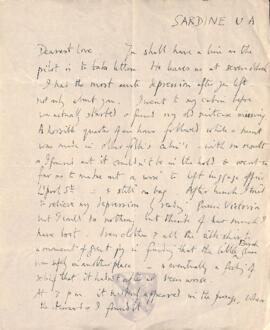
He had suffered from the most acute depression after she left, not just because of her leaving but because he had lost a suitcase. He was very relieved when it had been found. He had been reading Queen Victoria and talking to three of his fellow passengers. He describes the man sitting next to him in the smoking room and his clothing. The ship was rolling quite a bit.

MCPP/GM/3/1/1921/2 · Stuk · 9, 13, 15 April 1921
Part of College Personal Papers

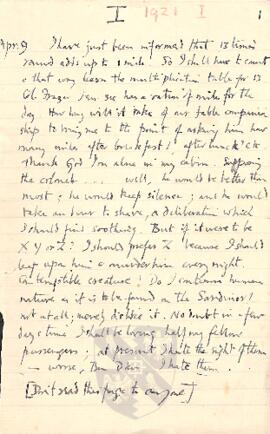
Pages from George Mallory's Diary, 9, 13, 15 April 1921, onboard the ship Sardine U A

Brief Summary
Covers daily life on board ship.

Detailed Summary

9 April - 13 times round the ship added up to 1 mile. Complains about other passengers and thanked god that he was alone in his cabin. Asks her not to send this page to anyone.

13 April - It was cold and they were passing Cape St. Vincent. He describes the deck, first class with only a third of the ship being reserved for first class folk, the smoking room [and bar], saloon, double staircase leading up from the dining room, and an upright piano. The smoking room had better company and he was most usually to be found there. His cabin was an escape from the windswept decks and fellow passengers. He describes the morning routine of the boat and what annoyed him, a nocturnal noise the boat made and it’s unchangingness despite the sea conditions. His cabin was his nest but wasn't a soothing place for sleep and compares it to his time in France [during the First World War]. His cabin was at its best in the afternoon when the passage was deserted and he could find a little peace.

15 April - He had found another retreat in the bows which was a part of the ship separate from the first class quarters. He desciribes the people that inhabited that space and how the place of the anchors could be used as a clothes line. Didn't like washed garments being publicly aired. The bows are a good place to sit where he could be alone. He describes approaching Cape St. Vincent and passing Gibraltar. The Mediterranean was like entering a world of pleasure. Saw Spain through clouds and had seen the African coast. Was surprised to be able to see snow mountains [the Atlas Mountains]. Thought they were off the coast of Tunis but would soon be out of sight of all land. Tomorrow they woudl be in Malta.

MCPP/GM/3/1/1921/3 · Stuk · 15 April 1921
Part of College Personal Papers

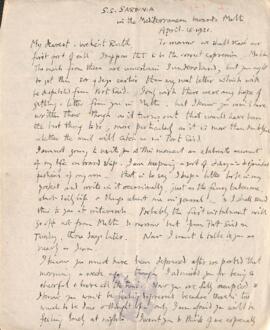
Letter to Ruth Mallory, written onboard the S.S. Sardinia, ‘in the Mediterranean towards Malta’

Brief Summary
He was keeping a diary with detailed descriptions about the people and events on board ship. He hadn't enjoyed the first few days and was missing her. Lists what he was reading. Describes fellow passengers.

Detailed Summary
Was concerned about when she would receive his letter and hoped he would receive a letter from her once he arrived in Malta but he has his doubts. He wasn't going to write an elaborate account of his life on board ship at the moment as he was keeping a sort of diary which he would send to her at intervals. [See: MCPP/GM/3/1/1921/2, 7 and 26].

She must have been depressed after they parted but he admired her for being so cheerful and brave all the time. Asks her to think of him especially at the times she gave John [their son] his bottle. He had found the first days on the boat utterly hateful and longed to have her with him. He supposes the Morgan children were with her at the Holt. Asks about the garden listing six garden chores which she or Cheeseman could do. It was turning out to be a dull letter.

He had finished Queen Victoria, most of which he greatly enjoyed, and was also reading Martin Chuzzlewit and Santayana. He had been working on his Book of Geoffrey but had made little progress and felt depressed about it. At dinner he sat between Colonel Frazer and a very undistinguished man called Holyake. He describes the Colonel and his conversational skills, the seating plan, and fellow guests at the table. The intellectual life on the boat was lacking and the best person to talk to was the Auxiliary man who had travelled in the East but he was a bore. There were no organised athletics and they had only managed a dance for about 4 couples to the accompaniment of a gramophone. Wished there was more activity. Describes the beauty of the sunlit Mediterranean, the slow pace of travel, and sitting in the bows alone watching the wide sea. They had seen Gibraltar at dawn, the Sierra Nevada later in the day and then the African coast. Describes seeing the Atlas range which contained several fine peaks and rock faces which carried plenty of snow and went up to 10,000 or even 11,000ft.

He anticipated spending six hours in Malta.

Postscript - Wanted to hear about her domestic arrangements and how she liked her companions.

MCPP/GM/3/1/1921/5 · Stuk · 25 April 1921
Part of College Personal Papers

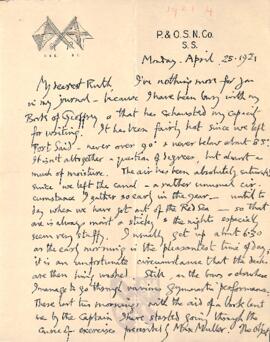
Letter to Ruth Mallory, written on board the S.S. Sardinia, on ‘P. & O.S.N. Co.’ letterhead

Brief Summary
Describes daily routine and exercise. Opinion of Port Said and Suez Canal.

Detailed Summary
It had been very hot since they had left Port Said and the air had been absolutely saturated until today when they had got out of the Red Sea. He was always moist and sticky and the nights especially seemed very stuffy.

Early morning was the most pleasant time of day. He had been doing gymnastic performances and a course of exercises prescribed by Muller. He tried to write before breakfast at 9am, and afterwards wrote in the smoking room. Before dinner at 7pm he pottered about with deck games. In the evening he generally played Bridge and had a stroll round the deck afterward. The time passed very easily and the only difficulty was getting sufficient sleep as it was too warm. The morning exercises were making a difference and he would arrive in India as fit as a fiddle. Doesn't think he will receive the mail delivered in Port Said at Aden and supposes he’ll receive mail at Darjeeling. If he could get out at Madras and take the train he could be in Darjeeling on the 9 May. They will soon arrive in Aden. Port Said was not in the least exciting and the Suez Canal was extremely dull. He had been bitten by mosquitos.

He couldn't send any Turkish Delight from Port Said because of some complication about a sugar duty.

MCPP/GM/3/1/1921/6 · Stuk · 2 May 1921
Part of College Personal Papers

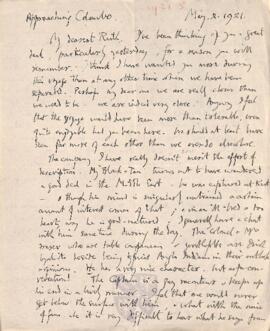
Letter to Ruth Mallory, written aboard the S.S. Sardinia, 'Approaching Colombo’

Brief Summary
Describes fellow passengers. Many on board had been ill. Describes the unquiet ocean. Recovered from a bad headache. They were approaching Colombo.

Detailed Summary
He had been thinking of her a great deal, particularly yesterday on the anniversary of their engagement. Wishes she had been on the voyage with him. He describes his fellow passengers including a ‘Black and Tan’ who worked in the Middle East, the Colonel and Mrs Frazer who were table companions, Mrs Vernon and two other ladies. There were also a number of unpleasant youths. Thought that the people in Second Class looked more interesting but there are obstacles preventing him making their acquaintance. Many on board, including the Captain, were ill but they were being cured with castor oil. He had mild symptoms and had been up in the night and had cut down on his consumption of food.

He had a sense of the nearness of disaster or danger as the sea was as deeply evil as it was attractive. The ocean was so calm at times so that you forgot the violence of which it was capable. He was interested in the contrast of the well behaved passengers on the boat and the ocean outside. It was a gloomy letter and he had not made much progress on his book Geoffrey. He was expecting it to be very hot at Colombo where they should arrive the next morning.

[letter continues later] - They were just reaching Colombo and he felt very cheerful after his splitting headache last night.

Diary Entries, 4 May 1921
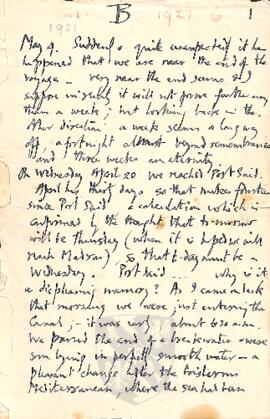
MCPP/GM/3/1/1921/7 · Stuk · 4 May 1921
Part of College Personal Papers

Brief Summary
Diary entry written on 4 May in which he describes recent events on board the S.S. Sardinia on the voyage from England to India. On 20 April they reached Port Said and travelled along the Suez Canal before entering the Red Sea and sailing towards India.

Detailed Summary
The Suez Canal was perfectly smooth which was a pleasant change after the boisterness Mediterranean. He was surprised to see ships prouder than them including a Japanese battleship. At Port Said the quayside was very smart and more like a sea-front than the sort of place where vessels were tied up in an English port with it’s background of warehouses. The scene was gay and impressive but did not make his heart rejoice. A few Egyptian men had a very graceful way of rowing - they stood up in the boat and faced the bows. He had spent two hours onshore at Port Said.

He had imagined the Suez Canal to be very big, about as wide as the Thames at Westminster, with a continuous stream of great ships moving in either direction, all under a blazing hot sun and deep blue sky between unbroken banks of yellow sand. But the canal wasn't very wide and there was a dull, almost grey atmosphere on the day they went through. He describes the housing along the banks of the Canal, as well as the landscape and towing path.

There were reminders of the recent war with a vast quantity of war material collected together in a camp which stretched several miles along the bank. There were signs of activity but the whole appearance of the vast dump was indescribably desolate.

He had been warned about the heat in the Red Sea. The weather was humid, the sky was overcast and the atmosphere very moist. He was surprised by the lowering and gloomy aspect of the clouds which the Captain said contained sand which was often blown to a great height and they were leaving a sand storm behind them which was a fortunate escape.

He could see small islands which rose very abruptly from the water. Their geological origin must be volcanic, they were very bare and rocky.

They spent three hours in Aden. The people there wore fewer clothes, especially the little boys of whom a great number approached him and his companion. On the verandah of a large hotel he saw a single man pulling on a rope which worked a ‘punkah’ [a series of rectangular sails about 4 ft x 2 ft hanging from a frame] with a flapping motion. It was a pleasure to walk a mile or so on land.

On entering the Indian Ocean the change was immediately perceptible. There was a long gentle swell and for six days the ship was heaving. The heat was mild as they approached Ceylon.

He saw monsoon clouds for the first time and expected bad weather. What particularly interested him in observing these clouds was the effect of the immense size in the whole arch of the sky which he compared to the Fenlands in England. The sky in the Indian Ocean was vaster than any he had seen at home.

They entered the harbour of Colombo which, unlike Port Said had an air of modesty. Long low red and yellow houses could be seen through the trees. Colombo, looked at from the harbour, was like a town that happened in a forest and from the inside it looked like a town lying in a garden.

He could see forests which were were moist and brilliant green. The various palm trees which predominated were garden rather than forest trees. He describes the trees, shrubs, and flowers he’s observed, mentioning Poinciana Regina, which flowered very freely with a cluster of brilliant scarlet blossoms, the temple tree, and a hibiscus, which was used as everybody’s garden hedge and had a large scarlet like flower. Many trees had red or yellow blooms and the air was laden with their heavy scent.

He spent an enjoyable time in Colombo with Captain Forbes. They met an acquaintance of Captain Forbes and drank brandy and ginger ale together before being joined by another Englishman.

He took a car to Mount Lavinia which was a moving experience as that was the first time he had seen the East.

He will write more about the East in another chapter. The S.S. Sardinia had to hurry up and get to Calcutta. No more economy of coal. Tomorrow they should be in Madras and on the 10th in Calcutta - five days sooner than the Captain estimated.

The diary entry ends as they were steaming up to the Bay of Bengal.