Mostrar 5083 resultados

Descrição arquivística
2080 resultados com objetos digitais Mostrar resultados com objetos digitais
Letter from George to Ruth Mallory, 21 May 1916
MCPP/GM/3/1/1916/20 · Item · 21 May 1916
Parte de College Personal Papers and Biographical Information

Letter to Ruth Mallory written from France

He had a new job acting as foreman in construction work using bricks and mortar a mile from the German line. This was because the previous foreman was taking the place of a young lieutenant at Brigade Headquarters who was on leave for the next 10 days. He couldn’t tell her how dangerous it would be as he didn’t know but he didn’t think she should be too anxious. He was being frank with her as he said he would. He thought he would like the work and that it would be an adventure.

[Postscript] – he was glad H. V. R. approved of his pamphlet and asks her to collect any news about that.

Letter from George to Ruth Mallory, 22 May 1916
MCPP/GM/3/1/1916/21 · Item · 22 May 1916
Parte de College Personal Papers and Biographical Information

Letter to Ruth Mallory written from France

They had chopped down the pear tree, white cherry tree and black cherry tree which filled him with the burning sense of sin, shame and horror.

Had been out with the working party last night and had carried six successive sandbags full of bricks on his back for half a mile of rough walking. The authorities were pressing them to hurry but they couldn't build very fast with one whole brick to every twenty fragments. The heat had been unbearably oppressive and he had welcomed the thunderstorm but he had skidded in the rain on the motorbike and broken the glass in his watch. Asks her to send any kind of cover for it.

They had cut the trees down to make room for two new gun positions. Asks her to thank Mother for the excellent pencil.

Letter from George to Ruth Mallory, 25 May 1916
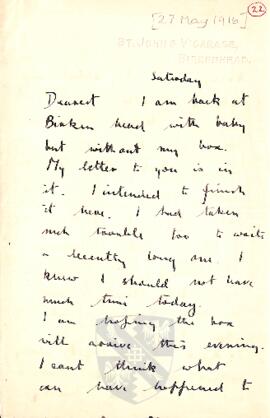
MCPP/GM/3/1/1916/22 · Item · 25 May 1916
Parte de College Personal Papers and Biographical Information

Letter to Ruth Mallory written from France

Acknowledges receipts of a batch of her letters and answers her questions – they encountered no submarines on the crossing, describes living arrangements which he shared with Bell, and his manservant who valets for him. Outlines the organisation within the battery with him and Bell alternating being on duty for a week at a time, and having special responsibility for one gun. Had continued working on the building project. Reassures her about the dangers of casual shelling. Had been complimented for setting a fine example to the men on the building works by visiting Generals. Had to clear a barn of straw. Asks her to send tea.

Letter from George to Ruth Mallory, 25 May 1916
MCPP/GM/3/1/1916/23 · Item · 25 May 1916
Parte de College Personal Papers and Biographical Information

Letter to Ruth Mallory written from France

Had been a long way on the motorbike on filthy roads to get equipment for the building project. Bought supplies of food but the lemon squash and a tin of fish paste had broken and made a mess in the box on the bike. Was asked to tea in the farmhouse on his way back and was making friends with Captain Matheson. He was on duty that night. Thanks her for the cake.

Letter from George to Ruth Mallory, 26 May 1916
MCPP/GM/3/1/1916/24 · Item · 26 May 1916
Parte de College Personal Papers and Biographical Information

Letter to Ruth Mallory written from France

It had rained during his night shift and he was lucky to only have fallen once in the mud. Would have to brief new N.C.O.s for the week ahead. Cake she sent was excellent. Stationary balloons had appeared some miles away and there was shooting in progress. Had spoken with Lithgow. Pay Sergeant was coming down. His part in the project was chiefly the demolition of a wall to recover the bricks for use in building. Wasn’t sure Ralph ought to tell her where he was but as he thought she would find out he says he is near a famous place P in Belgium but asks her to keep it secret.

Saturday – Colonel was pleased with the works and he thinks they will finish in three more weeks. Answers her questions as to why the town wasn’t systematically shelled. It was noisy but he wasn’t nervy yet as they hadn’t had much shelling. He liked the photos of her but was critical of the ones of him.

Letter from George to Ruth Mallory, 29 May 1916
MCPP/GM/3/1/1916/25 · Item · 29 May 1916
Parte de College Personal Papers and Biographical Information

Letter to Ruth Mallory written from France

Believed they were moving that night south to the 1st Army. Orders had only just come. Had only that afternoon planted all the seedlings from Westbrook. Only half the Battery was to move. Lithgow and Bell were to go with him. No more bricks and mortar. Was sad he wouldn’t see the end of the building project. Thought they would be touring the country in motor lorries for a few days which he would enjoy but it was going to be wet. Was glad of a servant who packed for him and would upack. Was glad to think of her with Avie.

Letter from George to Ruth Mallory, 3 June 1916
MCPP/GM/3/1/1916/27 · Item · 3 June 1916
Parte de College Personal Papers and Biographical Information

Letter to Ruth Mallory written from France

Describes their new position on a chalk hillside with woods behind and the struggle they had to get the guns up the valley into position using teams of horses and with the help of a company of Infantry. Problem was ammunition they were given 900 rounds and had used 600 already. Object of the move was to support an Infantry attack. Describes his dug out and that he suspected a rat. Asks her to send ‘Liverpool Virus’ in large quantities. Weather was fine at the moment but there were some unhealthy spots which they would have to inhabit if it rained. Reassures her. Gives his new address as 40th Siege Battery, 15th H.A.G. IV Corps Heavy Artillery, B.E.F.

Letter from George to Ruth Mallory, 4 June 1916
MCPP/GM/3/1/1916/28 · Item · 4 June 1916
Parte de College Personal Papers and Biographical Information

Letter to Ruth Mallory written from France

They had a busy three days but things were settling down. Describes his duties of setting the men to work and checking on them. He was in charge of the guns for the first week, and had to see to ammunition. Asks her to send ‘Liverpool Virus’ as soon as possible to deal with the rats. The wild strawberries were delicious. Describes some of his companions - didn’t like two young subs but did like Lithgow, Bell and the Captain of the other half battery. Next week he would be doing O.P. work [observation post]. Cakes and soup tablets were most welcome.

Letter from George to Ruth Mallory, 7 June 1916
MCPP/GM/3/1/1916/29 · Item · 7 June 1916
Parte de College Personal Papers and Biographical Information

Letter to Ruth Mallory written from France

They didn’t move on yesterday but were to go on tonight. Last two days had been idle and he had read the weekly Times and Daily Mail. They were all thrilled with the great sea fight [Battle of Jutland]. Felt the war was beginning to move, wonders about the effects of the artillery on both sides and what will happen when all the enemy attacks fail. Enemy was capable of inflicting great losses and the French had lost enormously at Verdun. They had been practically unmolested. Hopes they will move south. Germans were busy around Ypres.

Letter from George to Ruth Mallory, 9 June 1916
MCPP/GM/3/1/1916/30 · Item · 9 June 1916
Parte de College Personal Papers and Biographical Information

Letter to Ruth Mallory written from France, 'On the road'

Thinks war is moving on and it was time for them to attack. The French had lost Vaux and must be hard pressed. Was no certainty among the French up there that Verdun would be held, nor any opinions about the war just patience. He admired the attitude of French women. Had been talking to the farmer’s wife where he had been billeted. Her husband was near Verdun but she faced the facts with calm reason and took an intelligent interest in the war. They couldn’t let France or Russia bear all the losses. Was quite hoping to take part in an attack. They were travelling easily. He had been arranging for the men to have a hot bath, visiting the town mayor, and getting money from the field cashier. Was elated at the capture of 51,000 Austrians. Good for the Russians to deliver a smashing blow like that.

Letter from George to Ruth Mallory, 11 June 1916
MCPP/GM/3/1/1916/31 · Item · 11 June 1916
Parte de College Personal Papers and Biographical Information

Letter to Ruth Mallory written from 1st Echelon 40 Siege battery, 30th HAG, III Corps, B.E.F.

Realised he had missed her birthday and asks her to buy a copy of Shakespeare’s sonnets as a reminder of his love for her. Recommends editions and where she could buy them.

Describes their arrival at new position. Doesn’t know how long they would be there. Hard work of digging in chalk fields began again [sketch of the stone and earth above them making them safe]. Had been ragging the mostly town born men who had been happy to leave last place expecting the next to be better but it was not. The men were friendly. Had slept in the open under a Poplar tree but was positioned badly and a trickle of water had got in his waterproof bag. Then guns started firing around him. Glad to be up at 5am.
Supply of water was three miles away. Last supply of water had been poisonous even when boiled.

Discusses latest thrilling war news, including high hopes of Russian advance and hopes rumours were true that the German fleet had come out again and been beaten.

Food was difficult to get and asks her to send soups and a ham.

Letter from George to Ruth Mallory, 14 June 1916
MCPP/GM/3/1/1916/33 · Item · 14 June 1916
Parte de College Personal Papers and Biographical Information

Letter to Ruth Mallory written from France

Describes hardships of digging in the rain and getting wet without prospect of drying out. Difficulty getting supplies like pit props, timber, iron nails, sandbags and wire netting as the demand was greater than supply. Had searched for bread and potatoes but here was no bread as bakers couldn’t get flour and mills couldn’t get corn. Had ration bread but it was difficult to eat. Had got 3 kilos of potatoes, French beans and a bottle of red wine. Describes difficulties of feeding men when you arrive in a new place. Had eaten well in Mess on haggis and plum pudding thanks to Captain Lithgow. Describes the cook who caused the worst of their discomforts. Hoped another half battery would arrive soon with their cook. Asks her to send more tea.

Comments on her letters. Likes to think of her seeing friends in London.

Letter from George to Ruth Mallory, 16 June 1916
MCPP/GM/3/1/1916/34 · Item · 16 June 1916
Parte de College Personal Papers and Biographical Information

Letter to Ruth Mallory written from France

Had received another batch of her letters. Describes in more detail the layout of their previous position in relation to the Germans, trenches and guns. Unpleasantness of the prevalence of dead bodies and how you would find a corps when digging anywhere near the surface. His own dugout had been clean.

Describes their new position which was different. Their guns were due to arrive that night. Expected to be very busy. Hoped big things weren’t planned for that part of he line just yet. Warned her that she would have to wait for news because of the difficulty of communications in a battle. Tries to reassure her.

Glad to hear of Clare waving and he had a longing to see her. Glad she was seeing the Brocks and asks if he had seen his pamphlet as he was the one man he would want to approve of it. Asks if Benson and Fletcher had received a copy.

[Postscript] – had never felt anxious about the Italians. Discusses prospect of the war ending in August and the effect of the defeat of the Austrians on Germany. They were a full battery now. Bell had gone back to their previous position for one day and had now rejoined them. He saw the garden there which had been ravaged. Their Major had been promoted and they were hoping Lithgow would be promoted in his place.

Letter from George to Ruth Mallory, 18 June 1916
MCPP/GM/3/1/1916/35 · Item · 18 June 1916
Parte de College Personal Papers and Biographical Information

Letter to Ruth Mallory written from 'A Trench'

Had remembered it was his birthday. Had been brought up to a trench. First time he had been quite near the Germans and seen their trenches. Had a good view from an observation post. First shots very successful with three rounds fired and all hitting same spot. Germans had started sending shrapnel over so they had retired into the dug outs.

He had only got three hours sleep so wasn’t happy yesterday. They were registering targets but trouble was the noise of the trucks on the nearby road. Works were interfered with by shooting, the arrival of ammunition and the presence of the other half battery.

Asks her to send some back copies of The Times. Had just received letters from various people but no cakes. Says she ought to encourage Violet to take up war work if the Government require it but he would regret her departure.

Was feeling better after a good night’s sleep and things were calmer and happier. He was often in poetical mood. Would attempt to describe the Mess and various officers in his next letter.

Letter from George to Ruth Mallory, 20 June 1916
MCPP/GM/3/1/1916/36 · Item · 20 June 1916
Parte de College Personal Papers and Biographical Information

Letter to Ruth Mallory written from France

Life was getting strenuous. Had been busy and was feeling happy about the work. The guns were shooting well. Anxious not to make any mistakes as he didn’t want to make things any less easy for the Infantry.

Thought he had written about the £250 cheque. Was amused to hear about Owen’s visit to Westbrook. She was having a much more sociable summer than the previous one. Was interested in her London visits and the Bridget and Stephen household. Asks if she has seen Will.

Letter from George to Ruth Mallory, 23 June 1916
MCPP/GM/3/1/1916/37 · Item · 23 June 1916
Parte de College Personal Papers and Biographical Information

Letter to Ruth Mallory written from France

22 June – had received her letters and cake. A good cook had arrived with the other half of the battery so things in the Mess were better.

23 June – had to stop writing last evening to do more mathematics and registering of targets and had been very busy since then. Was delighted with his birthday present. Comments on her visit to Mary and Ralph’s.

There had been a great storm that afternoon when he was working in the ex-messroom with Lithgow. They had made inadequate arrangements to carry water away. Had to make some damming arrangements. The tent he shared with Bell had been blown away and their things were exposed to the pelting rain. Wondered how he would manage for dry bedding although the weather had turned warmer in the last couple of days.

Was feeling tremendously strung up for great things and hoped they would begin soon.

Comments on Stephen and Bridget’s relationship. Wishes he could talk with her more and although they were ok for officers now it would be a while before he was due leave.

Asks her to thank Clutton-Brock for his book which he had received.

Letter from George to Ruth Mallory, 25 June 1916
MCPP/GM/3/1/1916/38 · Item · 25 June 1916
Parte de College Personal Papers and Biographical Information

Letter to Ruth Mallory written from France

Had been on duty all night. Describes the sound and sight of the guns firing on the German lines.

Feared the spiritual side of life did not have a good chance out there – not the intellectual or aesthetic part and the chance to read Clutton-Brock’s book had a revivifying effect.

Letter from George to Ruth Mallory, 28 June 1916
MCPP/GM/3/1/1916/39 · Item · 28 June 1916
Parte de College Personal Papers and Biographical Information

Letter to Ruth Mallory written from France

Was working in shifts of 24 hours. Apologises that he hadn’t had chance to write. Had been on the guns from daylight to diner. They were all happy and full of hope. The men rise to the occasion and will enjoy it even if they have a bad time. Was feeling rather deaf last night. Lithgow looses all sense of cool control the moment a hitch occurs. Thinks people in England must be excited. Didn’t think the Germans would take Verdun. Had heard that five German divisions had been taken from the British front.

Was glad she had enjoyed her time with Mary. Ask what she thinks of Ralph. Acknowledges letters, soup tablets and cakes and thinks the prunes were a good idea and he would save them for private consumption. Describes the mess and people he eats with. Asks her to send one cake a week. Had read most of Clutton-Brock’s book The Ultimate Belief which he comments on and he recommends she get a copy too.

He was in the map room standing by to be given a job. He was always standing by. Hoped to get some sleep before going on night duty again.

Wonders what the future held for them and whether he would be home for good before Xmas as he longed to be with her and build up a life together again.

Letter from George to Ruth Mallory, 30 June 1916
MCPP/GM/3/1/1916/40 · Item · 30 June 1916
Parte de College Personal Papers and Biographical Information

Letter to Ruth Mallory written from France

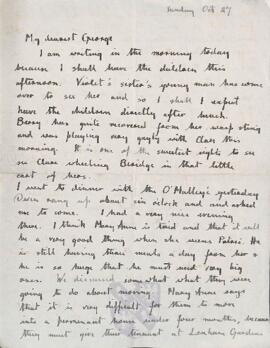
Full Transcript

Dearest Ruth,

I’m sitting in a café at a village on a main road which acts as our advanced base whither I have been sent on an errand to the Field Cashier. I can get this posted here, and have a few moments.

This also is part a foraging expedition and the driver luckily knew of a farmhouse where many things are sold – quite a number of farms hereabouts have become provision shops but the usual difficulty is that they have no provisions. Today we have been very lucky and I have somewhat prepared for goodness knows what future. I too am afraid that correspondence is going to be difficult but I think I may get letters from you at intervals of 3 or 4 days on the average. You see our lorries have to bring us provisions and ammunition at frequent intervals and the ordinary way is for the ration lorry to bring the mails. Of course I can’t guess what may happen. I don’t suppose we shall be in Berlin in a fortnight but its clear that life will be a very different affair for us if the Army continues digging in shallowed trenches and so on!

I think it would perhaps be a good plan to write to me every other day for the present. Will you try and tell me as much as you can about the people about you who seem to be very numerous just now. I am glad you should have the feeling towards baby that makes you want to have her to yourself all the time – but you won’t let her come too much in the way of other sides of life will you my dear? We’ve talked of that – still I think from your last letter that you seem to be almost too absorbed in Clare at the moment. Your letters vary very much (I expect mine do too) – sometimes more thoughtful than others so that I sometimes feel that your mind has control and sometimes the feelings have it all their own way. I do hope you haven’t many despairing moments.
I expect you keep pretty cheerful and interested too, that’s the main thing.

This must end. I have to fly.
All my love, your George.

Letter from George to Ruth Mallory, 1 July 1916
MCPP/GM/3/1/1916/41 · Item · 1 July 1916
Parte de College Personal Papers and Biographical Information

Letter to Ruth Mallory written from France during the Battle of the Somme, 'Saturday'

Full Transcript
This mere note to precede a very long letter I am in the course of writing in reply to two beautiful letters from you. We are depressed on this bit of the front. Nevertheless a fair number of prisoners drift by. We have been very busy. I am rather tired but very well. Great love to you dearest from your loving George.

Dispatch rider just off. A few moments more. I am sitting on the roadside other officers gazing at prisoners 100 yards off through glasses. ‘A damned seedy looking lot those!’ says Glen. The air is full of jars. Not much doing this evening. We are disgusted at not being allowed to fire more rds [rounds]. I hope the show has gone well elsewhere. The din this morning was terrific. I’m feeling tremendously excited – but I fear we shan’t go forward as soon as we hoped. The weather is v. fine which ought to help matters. It is extraordinary how little shelling the enemy has done here. All the damage to our men on this bit of front done by machine guns. Here goes my love again. Congratulate Mildred and Robert from me.

Letter from George to Ruth Mallory, 4 July 1916
MCPP/GM/3/1/1916/43 · Item · 4 July 1916
Parte de College Personal Papers and Biographical Information

Letter to Ruth Mallory written from France during the Battle of the Somme

Describes the build up to the beginning of the battle when they bombarded the German line and watched the Infantry arriving, and the first few day of battle - the din, firing rounds and watching the walking wounded and bands of prisoners pass by.

Letter from George to Ruth Mallory, 6 July 1916
MCPP/GM/3/1/1916/44 · Item · c. 6 July 1916
Parte de College Personal Papers and Biographical Information

Letter to Ruth Mallory written from France during the Battle of the Somme, [no date]

Full Transcript

Just a note dearest Ruth to let you know I am alright. I hoped to write you a proper letter this morning in time for posting but have been too busy. You’ve no need to be anxious and you shall have a proper letter written today.
I was distracted yesterday by many small troubles in my work here and that’s why I left it to this morning. The dispatch rider is waiting but for other things besides this note.

I wonder what folk in England are thinking about the fighting here. I suppose they must be generally disappointed – if they think of the initial success in Champagne last September so much greater than this. But the point is that we are pressing the Hun on all fronts and if it’s a slow business here the hope is that we shall make him fight to exhaustion. There’s good evidence of his lack of men and that must tell if we attack sufficiently. There’s every sign of such determination in these parts.

I didn’t see a French paper yesterday. There was a charming rumour which I met to cheer me in the course of a dismal expedition in a thunderstorm the day before. I’ll tell you if I hear any more of it – it concerned the French more than ourselves – they have done extremely well in their sector, reaching their objective very quickly with slight losses.

The feeling that we are supporting infantry in the most direct fashion makes a great difference to me now. One requires so intensely that all the shooting should be absolutely right. Life is strung up and there’s nothing slack about it now though there must necessarily be idle times.

My chief interest today is the starting of a canteen for the men - a dry canteen for selling cigarettes, tobacco, chocolate and biscuits – those things primarily. We ought to have arranged it before, but I suppose the feeling that we might at any moment be leaving here prevented us. Anyway the discovery of a large wholesale canteen, within reach has made the idea bear fruit and I have bought about 150 shillings worth of goods as a start. The men are rich as they have no opportunity of spending their pay here, so I expect the concern to prosper and be very welcome to the men – and no doubt my stocks will have to be increased enormously.

We have had wretched weather here the last two days. It was beautiful for the beginning of our attack but broke down badly the day before yesterday with a thunderstorm. It is cold now and I have no feeling of summer. Warm sunshine is so much a comfort in itself that it makes up for everything.

Now Goodbye. All my love dear one, George

Letter from George to Ruth Mallory, 6-8 July 1916
MCPP/GM/3/1/1916/45 · Item · 6-8 July 1916
Parte de College Personal Papers and Biographical Information

Letter to Ruth Mallory written from France during the Battle of the Somme

Full Transcript

My dearest Ruth, My ‘note’ of this morning turned out almost a letter nevertheless it seems that I owe you a great deal of information and this is a chance of supplying it. I am taking Quinn’s place at the guns for a very slow job, as, owing to certain rearrangements he is superintending some more digging work. It is now 3.15pm and we have to fire off 60 rounds or so by 9pm so you may imagine how slow I feel this job to be. I am sitting beside the one gun which is to fire.

How much have I told you already about the recent fighting? I have an idea that much remains to be said but I hardly know what. The conditions just here are very different from those when the scrap began. That day was one of suspense and excitement; a continuous flow of tales collected from wounded men walking from the road kept us informed of what was going on and one made out a story, partly true. But now the intense fighting is south of us and though we may still support the infantry as we did yesterday it is not apparently those on our immediate front and they don’t evacuate their wounded along this road – so we feel a trifle ‘out of it’. Possibly that state of affairs won’t last forever. And for us the salient fact is that we are no longer working out a prearranged plan matured perhaps months ago // but rather on plans formed in a day to fit the occasion consequently we have little warning and often have to open fire at a moment’s notice.

This is what you would expect but none the less a condition of action that makes severe demands on everyone; so many things have to be considered that for perfect accuracy there must always be a short delay before the figures worked out in the office from the map can be telephoned through to the guns; and then the ‘Nos. 1’ or ‘Gun Captains’ as they are called in coast defence have to be made to understand the figures and its wonderful how difficult that process seems to be in some cases and how often they make mistakes. And then before a gun can be fired it has often to be turned about in a confined space and on muddy ground – so that altogether you may imagine that when we are ordered to open fire at once on XYZ it requires a cool head to avoid agitation and that’s just what Lithgow hasn’t got – he has a clear head and can work quickly and accurately, but when he comes along in a tremendous fluster to inquire why the guns aren’t ready it requires some presence of mind to keep cool oneself. It must be added that Lithgow has been better in this respect during these last two days – and we have been quicker on the guns too. My impression is that our Nos. 1 are not a very adaptable lot and don’t easily send themselves to new conditions; also some of them haven’t had sufficient training and two are capable of any folly. We never let them fire the 1st round of a series without making certain that they have the right angles on the sights, so no serious mistakes can be made that way.

These remarks from the mark // are written on Saturday morning. I’m glad to say that during the incessant firing of yesterday all went well. I only had two guns to look after during the most exacting periods instead of four as often happens when I am on duty; it is a much better arrangement to have an Officer for each section when we have to fire all guns rapidly at an exacting target, and I find no difficulty in taking charge of them properly: but four in a space of 120 yards along that slippery bank and in the din of traffic and field gun fire are a handful.

Well my dearest one I had a pretty hard time before I turned in last night. My day off duty turned out more laborious than usual in the end from the time I stopped writing this letter, because the work on the guns suddenly ‘bucked up’. I hadn’t a moment’s rest till 4am when I lay down for an hour and a half. And then began a day beside which the 1st day of the offensive appears as a mere whiff of smoke – I refer only to our own experiences but so far as artillery is concerned the whole attack must have been far more vigorous. It certainly seemed to be so judging from what we heard here – that was partly because we heard so very much more than we liked of certain field guns which fired over our heads but there was far more big gun fire too in this sector. The infantry were to attack at 8.0; the bombardment began soon after 7.0 and this battery had to open fire at 7.20. Before that the guns had to be calibrated – i.e. to fire on a known point with the particular lot of cordite which each separate gun was to use – so as to get any correction for elevation or line which might be required and as there was a difficulty about communication from the observer’s position involving the use of signals – flag waving (known as the flapper) with morse code – we had to start that operation at 6am.

It's no use attempting a detailed description of yesterday. We were firing all day but the strenuous parts of the day were up till 11.0am and from about 3.30pm to 9.0pm I was on the guns all the time except when I was relieved for meals. The operations appear to have been successful and again we see groups of German prisoners passing periodically as a gunner remarked to me ‘a mixed lot like our own; some fine soldiers and some that look as if they could hardly hold a rifle – and they all look as though they were straight from prison!

I think I might have been very tired yesterday. I had such variable moods. Mostly I was very happy and in the slack time after lunch sitting on a pile of empty cartridge boxes rained on at intervals I had a notable idea for a book – really quite the most pleasing idea I have ever had – a form which would give me scope to say all that I wish to say about life, ethics and education quite pleasantly and humorously. I will tell you more about it if it occupies my thoughts any more. On the other hand I was very nervy.
I read your letter in bed last night and that was a great joy four of them and half of one of my own! I’m very glad you get your friends and mine down to Westbrook – it is very agreeable for them and good for your family too. Mildred seems to be delighted by Mary Ann and Ursula – our discovery has been embosomed. I should love to have to have seen your father write ‘The Professor’ - an appropriate nickname. It’s a great matter of luck and first impressions whether such meetings ‘come off’ but I’m not in the least surprised and I think its creditable to you father – there’s a good deal for an elderly man to put up with in Owen.

I am interested in your account of the meeting you attended. Please tell me exactly what you said in your brave speech. I’m delighted to hear that you spoke. But I’m altogether ‘assommé’ as the French say – knocked down by your calm assumption that I am not a Christian – this after how many months of married life? I‘m blowed if I’ve the energy to write you another philippic proving how good and Xian I am. I always thought your own standard a high one and couldn’t expect to live up to that but if it’s not high enough to let a poor humble gunner like me into the fold but must be damnably low and at all events I can say I’ve more respect than that for Christian teaching so there!

And I won’t write any more – not in this spasm perhaps later in the day. But will this letter ever reach you?
I suppose we shall meet again one of these days perhaps for a period things will be more quiet and then!! But is does seem distant.

Ever so much love – your loving George.

Letter from George to Ruth Mallory, 10 July 1916
MCPP/GM/3/1/1916/46 · Item · 10 July 1916
Parte de College Personal Papers and Biographical Information

Letter to Ruth Mallory written from France during the Battle of the Somme, 'July 10 1916'

Comments on where she is in the garden when she is writing to him and describes where he is writing from at the end of his night duty shift. Asks her to send a pound of butter as an experiment to see if it arrives fresh. Thanks her for the cake. He could get chocolate so not to bother sending that. Asks her to try and get 5 stone of new potatoes sent to them as getting vegetables, especially potatoes was difficult.

Yesterday and so far today had been peaceful and sunny.

Comments on the Holt and that he should try and write to some friends in the hope of getting good letters back. Asks what happened to the parts of his letters she copies out and thinks that others besides the family would like to see them. Would write to David. Mr Allen had written to say he might be coming our as a Chaplain.

Describes in detail where he lives (the offices and his dug out) and includes a sketch of the location of the map room. Tents were used but only in the cover of trees.

Letter from George to Ruth Mallory, c. 11 or 12 July 1916
MCPP/GM/3/1/1916/47 · Item · 11 July 1916
Parte de College Personal Papers and Biographical Information

Letter to Ruth Mallory written from France during the Battle of the Somme, 'July 1916'

Full Transcript

My dearest Ruth,

This is merely a note in advance chiefly to say that if you haven’t already bought the potatoes it will be better after all not to send them. We have discovered a way of getting them here.

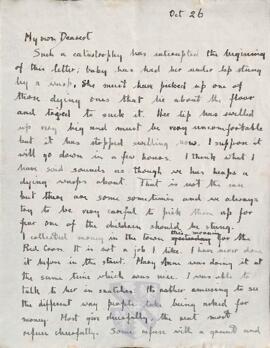
I have just had breakfast after firing for 3 hours. We are very busy and I feel rather tired – chiefly I expect because these field guns make such an offensive noise. I believe our operations are going as well as expected – it’s a hard life in which one has to be reasonable. Will you send along parcels of the Times 4 or 5 at a time. It so often happens that for some days I see nothing but the Daily Mail and the Harmsworth popular press disgusts me in its present stage of rampant jingoism over ‘the great push’ than at any previous period of the war. The government is very largely to blame for that e.g. for the official photos. A picture of one of our guns as it stands in the emplacement with its girdles on appeared in the Daily Mail of July 5. This is evidently the advertising centre. O God! O Montreal!

The car is to start now. So au revoir till I talk to you again later on.
Your loving George.

Letter from George to Ruth Mallory, 13 July 1916
MCPP/GM/3/1/1916/48 · Item · 13 July 1916
Parte de College Personal Papers and Biographical Information

Letter to Ruth Mallory written from France during the Battle of the Somme, 'Thursday July 13'

Full Transcript

My dearest Ruth,

Somewhat of a gap I’m afraid. I’m doing a spell in the O. P. [observation post]. I came up here on Tuesday evening – a lonely flat hill top with a wide view of bare rolling valley country intersected by the white lines of trenches and broken here and there by little woods. For companions two signallers Scotsmen. For comfort a bed of rabbit wire in a wet clay hole, a pipe, & a saucepan to brew my excellent French coffee over the Tommy’s cooker. The Hun is not much in evidence though I saw about 60 passing in small groups along a distant road – that was between 5 & 7 am. Now at 11 o’clock I have just finished registering one of our guns on a distant windmill. I enjoyed doing that; the gun did the unexpected & Lithgow was in a state of great incredulity owing to my large corrections for line – but I scored heavily by getting a hit with the last shot. The variable powered telescope which I have been using is an ingenious instrument & I had quite a good view of the windmill though its about 8,500 yards from here, & the holes in its well battered sides give me a queer mixture of pain & satisfaction.

I was rather depressed last night, a field gunner who visited this spot yesterday was telling me some unpleasant tales of what he had seen in the trenches. The pity of it all! Sometimes I have to think very hard about the Hun’s misdeeds to make up my mind to it. If the settlement of this business was in the hands of the German rank & file & our own I believe they would say at once let’s chuck it & not be such damned fools, any longer. It’s so hard to feel. I have horrid doubts too about our offensive with no particular reason. I do hope it is doing all it was expected to. Of course it’s a common place to observe that this is the great crisis of the war – but what a crisis!

What will be the fresh mental attitude of the German people when they are faced with something very unlike victory? And if they should resolve to fight to the last?

I hope I may have a letter from you today my dear one; the last reached me on Monday. In it you tell me about your visit to London. I am very glad you saw Mrs Reade. I am sure she is one of the best of women. You told her that I like the life out here & she was surprised by that. I wonder what she understood by it. It’s not a style of existence I particularly care about & I would never choose the soldier’s profession. Probably campaigning is more tolerable than the artificial peace time interest of the barracks – the hot-bed espirit de corps & diverse forms of puss blind eyewash. But No; I wouldn’t choose the life for its own sake even as I find it at its best out here. Like the life? I prefer to say that I like living; to be in a state of mind that won’t say so much is to be defeated & the most degrading condition of that defeat is boredom, it’s most usual companion ‘self pity’. No! I’m not bored & I don’t intend to be, nor have I the faintest degree of pity for myself who have so much more to be grateful for than the great dignity of men, though I believe I am capable of feeling some for the world at large – the world at war. It all comes, my dear Ruth, to what Hamlet says ‘There’s nothing good or evil in the world but thinking makes it so’ – in this sense, - that living is fashioned by Thought out of Circumstances & to fashion it well or ill is in the thinker’s choice. Far be it from me to say that it’s always easy to think life good.

The reflection that disgusts me most at this moment - & you’ll observe that it’s of universal application – is that we poor mortals are made of clay. Even so I’m sufficiently optimistic to entertain a healthy conviction that it wasn’t wet clay – my thoughts about that substance are too obscene to communicate, and so far as I recollect it was never stated that we are to return to clay. To dust – I am resigned to that thought because I shall spread so plentifully. To return to clay would indeed be a sort of immorality: but not one that I ambish – not if it were wet.

I am here for three days & this is the second. Truly I thank God that he held his beautiful hand yesterday & has wet me with only a cool shower or so this morning. A signaller sits by my side & we keep our eyes open. There are only two spots where one can hope to see the enemy in person; we watch them periodically – he more than I just now while I am so busy philosophising to you. Neither side seems active today – or I should have more to do – reporting enemy fire etc. Provided God is kind in the way I have indicated I quite like to be here for a change – its such a relief to get away from one’s companions isn’t it? I really quite half feel this but I don’t think it comes of misanthropy only that people interrupt thought so grievously.

I shall have done with this letter now. The signallers are relieved at 1.30, so I hope they’ll be in time to catch the dispatch rider before he starts at 2.0. I shall try & get a few letters or rather notes written to various neglected friends before I leave here tomorrow. This solitude suits the task. I do like to be alone.

Why do I talk about solitude when I have two companions? Because they haven’t the right of interruption – the first of the sight on man which makes the idea of liberty a Utopian dream.

Bless you dear Ruth. What’s the good of all this gas when I can’t kiss you. Please try to feel kisses & write & tell me what like it feels.
I notice that I never say that I want the time to come when …. perhaps I’m too proud; though you often speak of it. Perhaps because I almost feel that things taken for granted are communicated without speech even at this distance.

I understand from the papers that letters are not to be stopped so I’m happy to think that you’ll be receiving budgets from me.

Fare thee well beloved,

Your loving George

Letter from George to Ruth Mallory, 15 July 1916
MCPP/GM/3/1/1916/49 · Item · 15 July 1916
Parte de College Personal Papers and Biographical Information

Letter to Ruth Mallory written from France during the Battle of the Somme, 'Saturday July 15'

Comments on good news they had heard about the battle and his three days at the observation post where he didn’t see the cavalry go over because it was misty. Describes the sight of trenches on fire due to the use of a new French invention – flame throwers.

Wanted to hear her thought on his views on religious education. Planned to write a book about it.

Discusses his thoughts about how the war might end and the damage done to the French countryside.