Affichage de 6564 résultats

Description archivistique
2153 résultats avec objets numériques Afficher les résultats avec des objets numériques
MCPP/GM/3/1/1919/1 · Pièce · 1 January 1919
Fait partie de College Personal Papers

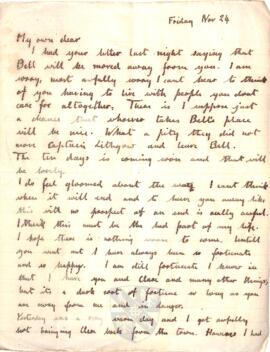
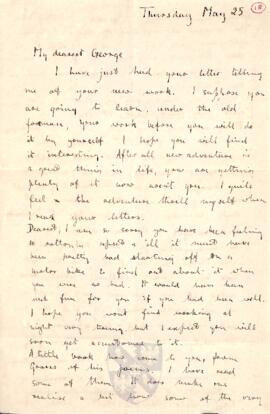
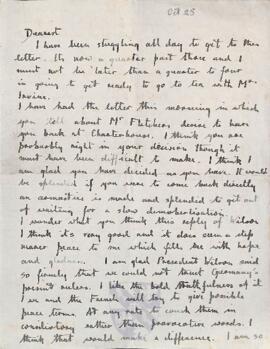
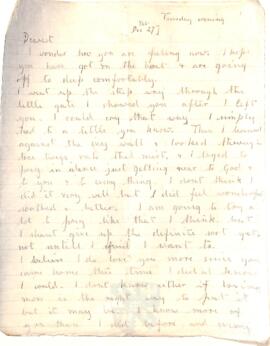
Letter from George to Ruth Mallory from France

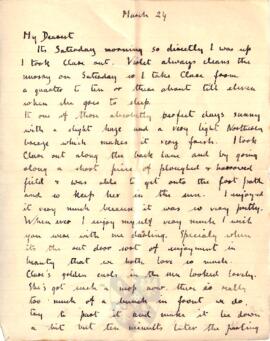
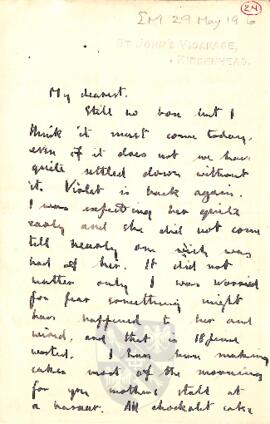
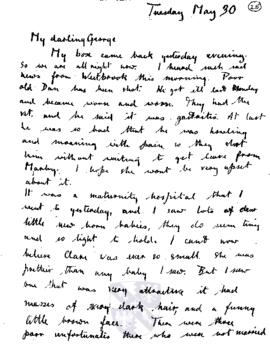
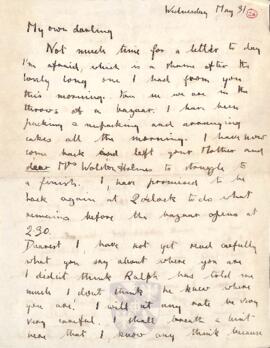
He had got to bed at 3.30am and slept until 11.30am. Had been feeling feeble but was much better today. Disappointed to still have heard nothing [about his return home]. Had not been writing over the last few days wilst he had the flu or whatever it was. Had to give a lecture on ‘Civics’ so would have to think of something to say as the Colonel and some other officers would be there.

Was sorry the return to the Holt had been delayed and supposed it was because of Owen’s flu.

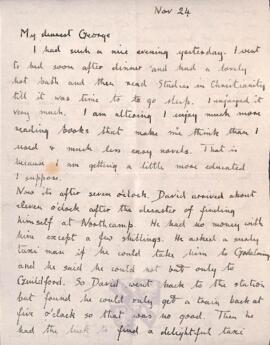
MCPP/GM/3/1/1919/2 · Pièce · 2 January 1919
Fait partie de College Personal Papers

Letter from George to Ruth Mallory written from France

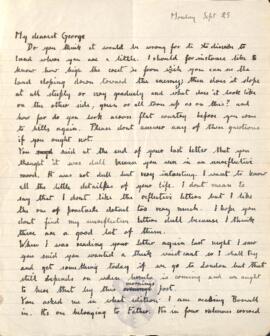
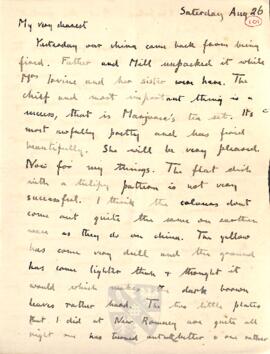
She was keeping up their correspondence better than him in the circumstances. He was still hoping every day for news of his release. Was trying to write his lecture [on civics] but it was too vast a subject. Was glad the Head Master had been to see her. He had heard from Allen who had no hopes for a speedy release and who said the Head Master showed no interest in the subject.

What plans did she have for moving into the Holt? Thinks he will need some bookcases. Had his case arrived from Paris?

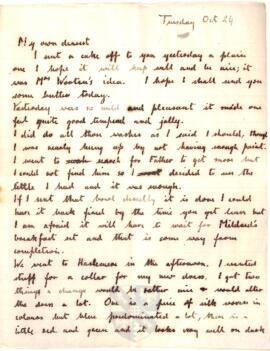
MCPP/GM/3/1/1919/3 · Pièce · 3 January 1919
Fait partie de College Personal Papers

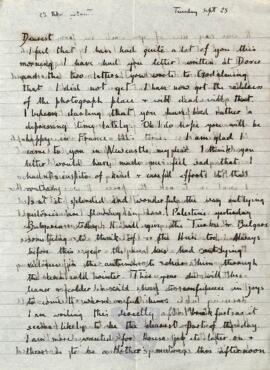
Letter from George to Ruth Mallory from France

Had just got back from a longish walk. His imagination had been wandering in idle leisure among the Alps and planning wonderful expeditions up great mountains. They would get there together next August.

He was feeling quite well again now. In former years they would have called it the flu but that had to be used for more a more violent illness now.

His lecture [on civics] had gone off quite well. The Colonel and other officers seemed quite pleased with it and had suggested other topics he could give further lectures on but he wasn’t keen to do this.

Would she be going to London for the sales? He needed things like civilian collars and shirts but he could get those in Godalming.

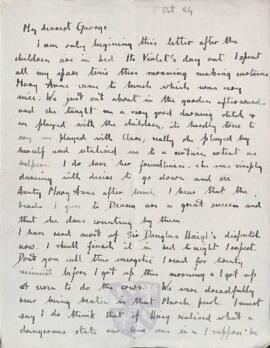
MCPP/GM/3/1/1919/4 · Pièce · 5 January 1919
Fait partie de College Personal Papers

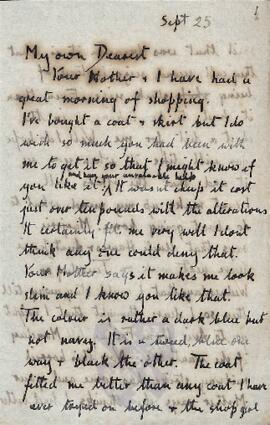
Letter from George to Ruth Mallory from France

He had put in for an allotment of leave which hadn’t been refused yet so he was hopeful he would be home soon.

He was busy writing more lectures on freedom and democracy and some economic aspects of history. Was enjoying teaching his French classes. Had succeeded in getting two books from the Y.M.C.A. in Calais. His mind was in a pitiful state anticipating his leave at any moment. He would be heartily glad to say goodbye to the officers of the Right Section.

MCPP/GM/3/1/1919/5 · Pièce · 7 January 1919
Fait partie de College Personal Papers

Letter from George to Ruth Mallory from France

It was only 10 days until term started and he still hadn’t got his release. When was she moving into the Holt? Was sure he would come in for the move. No move would be complete without him.

She mentioned Mr Brooke several times. Thought he had met him at Brooke Hall and expected him to be quite interesting. Did she see the Head Master’s speech at the Head Master’s conference in which he said they should aim for voluntary Chapel which seemed a very long step for him. Wonders if he had read Clutton-Brock’s book and if so what he thought of it. Thought he would offer to preach in Chapel as it was important to have religious teaching other than official Church teaching.

Thanks her for the parcel of chocolates which were very good. Was sorry about the bad news of Violet’s father’s leg. Was afraid this would not increase the chances of Violet staying with them.

Had prepared his lecture for that afternoon which was on the growth of freedom in England.

Was sorry Clare had been unwell and she was to give her his love and tell her Daddy said she must be gay and happy and not cross.

1921
MCPP/GM/3/1/1921 · Sous-série · April 1921 - 20 October 1921
Fait partie de College Personal Papers

Outline of 1921 Mount Everest Reconnaissance Expedition

The aims of the expedition were to explore how to get to the vicinity of Mount Everest, find possible routes to the summit, and if possible attempt the first ascent.

The expedition party consisted of: Charles Howard-Bury (leader), Harold Raeburn and Alexander Kellas (experienced mountaineers), George Mallory and Guy Bullock (younger and less experienced climbers), Sandy Wollaston (naturalist and doctor), Alexander Heron (geologist), Henry Morshead and Oliver Wheeler (surveyors seconded from the army).

During the expedition Kellas died and Raeburn fell ill and had to leave the expedition making Mallory the lead climber.

Bad weather meant they could not make an attempt on the summit.

The expedition succeeded in identifying the North Col as a feasible route to the summit.

April - George Mallory sailed from England to Calcutta in India on board the S.S. Sardinia
MCPP/GM/3/1/1921/1-8 - describes the voyage

May - Arrived in India and met up with other members of the expeditionary team at Government House, Darjeeling and began the trek to Everest
MCPP/GM/3/1/1921/9 - at Government House
MCPP/GM/3/1/1921/10-12 - trek to the vicinity of Mount Everest

June - Mallory’s first views of Everest and reconnaissance efforts
MCPP/GM/3/1/1921/13 - reports Dr Kellas’ death
MCPP/GM/3/1/1921/14 - first view of Mount Everest
MCPP/GM/3/1/1921/15 - ‘we are now in a county no European has previously visited’
MCPP/GM/3/1/1921/16 - ‘until incredibly higher in the sky than imagination had ventured to dream, the top of Everest itself appeared. We knew it to be Everest’
MCPP/GM/3/1/1921/17 - written from ‘1st Base Camp under Everest’

July - Reached 2nd Advanced Base Camp and 1st Base Camp Rongbuk Glacier, further reconnaissance efforts and climbing achievements
MCPP/GM/3/1/1921/18-23

August - Confirmed the existence of the North Col and therefore a passageway to Everest
MCPP/GM/3/1/1921/24-28

September - Bad weather meant they had to abandon plans to attempt to summit and they returned home
MCPP/GM/3/1/1921/29-31

October - return trip to England
MCPP/GM/3/1/1921/32 - written from ‘Benares’ on his way home via Marseilles where he met up with Ruth

MCPP/GM/3/1/1921/1 · Pièce · April 1921
Fait partie de College Personal Papers

Letter to Ruth Mallory, written onboard the S. S. Sardinia, on his way to India to unite with the other members of the Mount Everest Expedition.

He had suffered from the most acute depression after she left, not just because of her leaving but because he had lost a suitcase. He was very relieved when it had been found. He had been reading Queen Victoria and talking to three of his fellow passengers. He describes the man sitting next to him in the smoking room and his clothing. The ship was rolling quite a bit.

Diary Entries, 9-15 April 1921
MCPP/GM/3/1/1921/2 · Pièce · 9, 13, 15 April 1921
Fait partie de College Personal Papers

Pages from George Mallory's Diary, 9, 13, 15 April 1921, onboard the ship Sardine U A

Brief Summary
Covers daily life on board ship.

Detailed Summary

9 April - 13 times round the ship added up to 1 mile. Complains about other passengers and thanked god that he was alone in his cabin. Asks her not to send this page to anyone.

13 April - It was cold and they were passing Cape St. Vincent. He describes the deck, first class with only a third of the ship being reserved for first class folk, the smoking room [and bar], saloon, double staircase leading up from the dining room, and an upright piano. The smoking room had better company and he was most usually to be found there. His cabin was an escape from the windswept decks and fellow passengers. He describes the morning routine of the boat and what annoyed him, a nocturnal noise the boat made and it’s unchangingness despite the sea conditions. His cabin was his nest but wasn't a soothing place for sleep and compares it to his time in France [during the First World War]. His cabin was at its best in the afternoon when the passage was deserted and he could find a little peace.

15 April - He had found another retreat in the bows which was a part of the ship separate from the first class quarters. He desciribes the people that inhabited that space and how the place of the anchors could be used as a clothes line. Didn't like washed garments being publicly aired. The bows are a good place to sit where he could be alone. He describes approaching Cape St. Vincent and passing Gibraltar. The Mediterranean was like entering a world of pleasure. Saw Spain through clouds and had seen the African coast. Was surprised to be able to see snow mountains [the Atlas Mountains]. Thought they were off the coast of Tunis but would soon be out of sight of all land. Tomorrow they woudl be in Malta.

MCPP/GM/3/1/1921/3 · Pièce · 15 April 1921
Fait partie de College Personal Papers

Letter to Ruth Mallory, written onboard the S.S. Sardinia, ‘in the Mediterranean towards Malta’

Brief Summary
He was keeping a diary with detailed descriptions about the people and events on board ship. He hadn't enjoyed the first few days and was missing her. Lists what he was reading. Describes fellow passengers.

Detailed Summary
Was concerned about when she would receive his letter and hoped he would receive a letter from her once he arrived in Malta but he has his doubts. He wasn't going to write an elaborate account of his life on board ship at the moment as he was keeping a sort of diary which he would send to her at intervals. [See: MCPP/GM/3/1/1921/2, 7 and 26].

She must have been depressed after they parted but he admired her for being so cheerful and brave all the time. Asks her to think of him especially at the times she gave John [their son] his bottle. He had found the first days on the boat utterly hateful and longed to have her with him. He supposes the Morgan children were with her at the Holt. Asks about the garden listing six garden chores which she or Cheeseman could do. It was turning out to be a dull letter.

He had finished Queen Victoria, most of which he greatly enjoyed, and was also reading Martin Chuzzlewit and Santayana. He had been working on his Book of Geoffrey but had made little progress and felt depressed about it. At dinner he sat between Colonel Frazer and a very undistinguished man called Holyake. He describes the Colonel and his conversational skills, the seating plan, and fellow guests at the table. The intellectual life on the boat was lacking and the best person to talk to was the Auxiliary man who had travelled in the East but he was a bore. There were no organised athletics and they had only managed a dance for about 4 couples to the accompaniment of a gramophone. Wished there was more activity. Describes the beauty of the sunlit Mediterranean, the slow pace of travel, and sitting in the bows alone watching the wide sea. They had seen Gibraltar at dawn, the Sierra Nevada later in the day and then the African coast. Describes seeing the Atlas range which contained several fine peaks and rock faces which carried plenty of snow and went up to 10,000 or even 11,000ft.

He anticipated spending six hours in Malta.

Postscript - Wanted to hear about her domestic arrangements and how she liked her companions.

MCPP/GM/3/1/1921/4 · Pièce · 19 April 1921
Fait partie de College Personal Papers

Letter to Ruth Mallory, written aboard the S.S. Sardinia, 'Nearing Port Said’

Brief Summary
Describes the weather and motion of the sea. He had been sight seeing in Malta. Some uncertainty about end of voyage as there would be a delay in arriving at Calcutta. Due to arrive in Port Said the following day.

Detailed Summary
He had been very busy since they left Malta and the weather had been wet, muggy and windy. There had been a good deal of motion and quite a big sea the day before but he had not been seasick. There was something disturbing and restless about the motion of the sea which made it very difficult to concentrate on anything, it affected his head and produced a kind of dullness that made it impossible to write. Malta was a great joy, but he had been so busy seeing things he did not get newspapers or postcards and it was beyond him to describe Malta without the postcards as it had a very complicated harbour. There were several battleships in the harbour. Describes what he did during his four hours on shore including a visit to the church of St. John [the Knights of Malta] and seeing a very fine collection of armour at the Governors Palace.

He had completed one green rucksack and was happy about his equipment. Asks her to convey his welcome to the Holt and to their friends the Hodges who were visiting her. Asks her to return Hodge’s compass which he didn't need and would be sorry if it got lost. Asks her to send a copy of Robert Bridges Spirit of Man to V. J. Hamilton.

There was some uncertainty about the end of his voyage as the ship would have to stay at Madras unloading heavy cargo, delaying his arrival in Calcutta. Had written to Younghusband and Raeburn asking what he should do in Darjeeling. They were due to arrive in Port Said early the next day but he wouldn't receive her letter. He would try and send a postcard but it was unlikely as the mail steamer was short of coal. He thougth about her alot and had her photo in the book he was reading. He had received a jolly note from Rupert Thompson [a friend from the Pen y Pass climbing parties] and would write him a line of thanks.

MCPP/GM/3/1/1921/5 · Pièce · 25 April 1921
Fait partie de College Personal Papers

Letter to Ruth Mallory, written on board the S.S. Sardinia, on ‘P. & O.S.N. Co.’ letterhead

Brief Summary
Describes daily routine and exercise. Opinion of Port Said and Suez Canal.

Detailed Summary
It had been very hot since they had left Port Said and the air had been absolutely saturated until today when they had got out of the Red Sea. He was always moist and sticky and the nights especially seemed very stuffy.

Early morning was the most pleasant time of day. He had been doing gymnastic performances and a course of exercises prescribed by Muller. He tried to write before breakfast at 9am, and afterwards wrote in the smoking room. Before dinner at 7pm he pottered about with deck games. In the evening he generally played Bridge and had a stroll round the deck afterward. The time passed very easily and the only difficulty was getting sufficient sleep as it was too warm. The morning exercises were making a difference and he would arrive in India as fit as a fiddle. Doesn't think he will receive the mail delivered in Port Said at Aden and supposes he’ll receive mail at Darjeeling. If he could get out at Madras and take the train he could be in Darjeeling on the 9 May. They will soon arrive in Aden. Port Said was not in the least exciting and the Suez Canal was extremely dull. He had been bitten by mosquitos.

He couldn't send any Turkish Delight from Port Said because of some complication about a sugar duty.

MCPP/GM/3/1/1921/6 · Pièce · 2 May 1921
Fait partie de College Personal Papers

Letter to Ruth Mallory, written aboard the S.S. Sardinia, 'Approaching Colombo’

Brief Summary
Describes fellow passengers. Many on board had been ill. Describes the unquiet ocean. Recovered from a bad headache. They were approaching Colombo.

Detailed Summary
He had been thinking of her a great deal, particularly yesterday on the anniversary of their engagement. Wishes she had been on the voyage with him. He describes his fellow passengers including a ‘Black and Tan’ who worked in the Middle East, the Colonel and Mrs Frazer who were table companions, Mrs Vernon and two other ladies. There were also a number of unpleasant youths. Thought that the people in Second Class looked more interesting but there are obstacles preventing him making their acquaintance. Many on board, including the Captain, were ill but they were being cured with castor oil. He had mild symptoms and had been up in the night and had cut down on his consumption of food.

He had a sense of the nearness of disaster or danger as the sea was as deeply evil as it was attractive. The ocean was so calm at times so that you forgot the violence of which it was capable. He was interested in the contrast of the well behaved passengers on the boat and the ocean outside. It was a gloomy letter and he had not made much progress on his book Geoffrey. He was expecting it to be very hot at Colombo where they should arrive the next morning.

[letter continues later] - They were just reaching Colombo and he felt very cheerful after his splitting headache last night.

Diary Entries, 4 May 1921
MCPP/GM/3/1/1921/7 · Pièce · 4 May 1921
Fait partie de College Personal Papers

Brief Summary
Diary entry written on 4 May in which he describes recent events on board the S.S. Sardinia on the voyage from England to India. On 20 April they reached Port Said and travelled along the Suez Canal before entering the Red Sea and sailing towards India.

Detailed Summary
The Suez Canal was perfectly smooth which was a pleasant change after the boisterness Mediterranean. He was surprised to see ships prouder than them including a Japanese battleship. At Port Said the quayside was very smart and more like a sea-front than the sort of place where vessels were tied up in an English port with it’s background of warehouses. The scene was gay and impressive but did not make his heart rejoice. A few Egyptian men had a very graceful way of rowing - they stood up in the boat and faced the bows. He had spent two hours onshore at Port Said.

He had imagined the Suez Canal to be very big, about as wide as the Thames at Westminster, with a continuous stream of great ships moving in either direction, all under a blazing hot sun and deep blue sky between unbroken banks of yellow sand. But the canal wasn't very wide and there was a dull, almost grey atmosphere on the day they went through. He describes the housing along the banks of the Canal, as well as the landscape and towing path.

There were reminders of the recent war with a vast quantity of war material collected together in a camp which stretched several miles along the bank. There were signs of activity but the whole appearance of the vast dump was indescribably desolate.

He had been warned about the heat in the Red Sea. The weather was humid, the sky was overcast and the atmosphere very moist. He was surprised by the lowering and gloomy aspect of the clouds which the Captain said contained sand which was often blown to a great height and they were leaving a sand storm behind them which was a fortunate escape.

He could see small islands which rose very abruptly from the water. Their geological origin must be volcanic, they were very bare and rocky.

They spent three hours in Aden. The people there wore fewer clothes, especially the little boys of whom a great number approached him and his companion. On the verandah of a large hotel he saw a single man pulling on a rope which worked a ‘punkah’ [a series of rectangular sails about 4 ft x 2 ft hanging from a frame] with a flapping motion. It was a pleasure to walk a mile or so on land.

On entering the Indian Ocean the change was immediately perceptible. There was a long gentle swell and for six days the ship was heaving. The heat was mild as they approached Ceylon.

He saw monsoon clouds for the first time and expected bad weather. What particularly interested him in observing these clouds was the effect of the immense size in the whole arch of the sky which he compared to the Fenlands in England. The sky in the Indian Ocean was vaster than any he had seen at home.

They entered the harbour of Colombo which, unlike Port Said had an air of modesty. Long low red and yellow houses could be seen through the trees. Colombo, looked at from the harbour, was like a town that happened in a forest and from the inside it looked like a town lying in a garden.

He could see forests which were were moist and brilliant green. The various palm trees which predominated were garden rather than forest trees. He describes the trees, shrubs, and flowers he’s observed, mentioning Poinciana Regina, which flowered very freely with a cluster of brilliant scarlet blossoms, the temple tree, and a hibiscus, which was used as everybody’s garden hedge and had a large scarlet like flower. Many trees had red or yellow blooms and the air was laden with their heavy scent.

He spent an enjoyable time in Colombo with Captain Forbes. They met an acquaintance of Captain Forbes and drank brandy and ginger ale together before being joined by another Englishman.

He took a car to Mount Lavinia which was a moving experience as that was the first time he had seen the East.

He will write more about the East in another chapter. The S.S. Sardinia had to hurry up and get to Calcutta. No more economy of coal. Tomorrow they should be in Madras and on the 10th in Calcutta - five days sooner than the Captain estimated.

The diary entry ends as they were steaming up to the Bay of Bengal.

MCPP/GM/3/1/1921/8 · Pièce · 9 May 1921
Fait partie de College Personal Papers

Letter to Ruth Mallory, written aboard the S.S. Sardinia, ‘Approaching Calcutta'

Brief Summary
Would think of her on her birthday. Had sent a parcel including beads, lace collars for the children and a seed necklace. Had spend 48 hours with the Vernon's in Madras. Describes first impressions of life in India. No-one had met him at Calcutta. Made arrangements to travel to Darjeeling that evening to meet up wit the rest of the party (except Dr Kellas).

Detailed Summary
Hopes the letter would reach Ruth in time for her birthday and would think of her on that day. He had sent a parcel from Colombo and he wants her to keep what she’d like but wasn't sure whether she would like the beads. He had sent three lace collars for the children and a seed necklace for Beridge. The other object in the parcel was a garland presented by some of the natives to Mrs Vernon which he thought Franz might have.

They had spent 48 hrs in Madras where he stayed with the Vernons. It had been a great comfort to get ashore [encloses a photo of the house]. Describes the house in detail which was typical of the better houses. He was delighted by his first sight of Indian life, which he intended describing in his journal. Madras was flat like a garden and it was very hot. He hadn’t been feeling fully well but now was feeling quite fit again. He had walked by himself through the native quarters of Madras which had been thrilling. They were within eight miles of Calcutta and so should be well up the river tonight and at their place of dis-embarkment in the morning.

The voyage had been detestable relieved by occasional moments which he wouldn’t have missed for anything. He had done his Muller exercises that morning. He could never forget how brave, unselfish and loving she had been about the project. Asks after John and wants their children to know he often thought of them. Would it be worthwhile having the leaves from his journal typed as he feared they were difficult.

[Postscript] - Contrary to expectation no one had met him in Calcutta despite having received a letter on board ship from Howard-Bury saying arrangements had been made. He was also told that he must act independently at the same time. He contacted a survey officer and walked two miles through the docks in the heat of the day to square the customs. He was due to start for Darjeeling that evening [18 hour train ride from Calcutta to Darjeeling]. He was to stay with the Governor of Bengal but wasn't looking forward to official circles. The rest of the group were at Darjeeling except Kellas who was last heard of as having climbed a mountain on 5 April and Raeburn was anxious about him.

MCPP/GM/3/1/1921/9 · Pièce · 17 May 1921
Fait partie de College Personal Papers

Letter to Ruth Mallory, written from Government House, Darjeeling

Brief Summary
Had attended a dinner party given in honour of the Expedition Party. Describes his first impressions of members of the expedition party. Describes Darjeeling, the journey on the mountain railway and the disappointing views of the mountains due to the weather.

Detailed Summary
Had received news of her up to 27 April [almost three weeks prior] and was glad she had received his letters from Port Said. He knows there is a coal strike in England. Her letters gave him joy and it was very nice to feel that the children thought of him. He was sending Clare beads sent on to him from Calcutta. He was having a restful time staying in the Guest House, but they had not escaped the pomp and circumstance. He attended a dinner party given for the Expedition by the Ambassador.

They would be two days late when they started the next day. He describes Wollaston, Howard-Bury, Wheeler, Morshead [a very nice man], Heron and Kellas [who he loved already]. He had drawn the outline of Kellas’ head. Howard-Bury seemed to be quite good at the organisation and got on with Raeburn who was very dictatorial.

Darjeeling was a wonderfully beautiful place. The journey on the mountain railway was lovely with very steep foothills, densely wooded except where cultivated. The train wound among the ridges and hillsides and continually gave them great views over the plains opening through the forest. What most delighted him was the forest itself.

The views of the mountains had been disappointing. The mules which they were to follow later were loaded up and there were torrents of rain overnight. He expected to start forth rather a grotesque figure. He lists his equipment together with a silk cover, rucksack, and sun umbrella. There would be fairly frequent news updates and tells her to take the Geographical Journal.

Was concerned for her in relation to the coal strike. Sends his love to the Clutton-Brocks. Left it to her to decide about sending round anything he wrote.

MCPP/GM/3/1/1921/10 · Pièce · 22 May 1921
Fait partie de College Personal Papers

Letter to Ruth Mallory, written from Rongli Bridge, Sikkim. [First letter written on ‘Mount Everest Expedition’ Letterhead]

The weather had been very bad, monsoon clouds had been blown up from the south on the day of their departure and there had been very heavy rainstorms. The rain clouds were spoiling his views. There were difficulties with transport, muddy paths, and trouble with the mules, which were not accustomed to going down steep hills. All the misfortunes had brought them to a halt in a warm valley bottom. He had nailed a pair of climbing boots greatly to his satisfaction. He describes Sikkim [a state in northwest India] - the hillsides, valleys, the cultivated land he sees on the higher slopes, the rich green growth, and the considerable variety of lilies which made the air fragrant. Wollaston could only name a few of the trees but did know a good deal about tropical things. One of the best moments on their last march was sitting on a bridge waiting for ther ponies and seeing gorgeous butterflies circling about like gently mooring birds.

MCPP/GM/3/1/1921/11 · Pièce · 24 May 1921
Fait partie de College Personal Papers

Letter to Ruth Mallory, written from Gnatong, on ‘Mount Everest Expedition’ Letterhead

His journal was a scholarly effort and his letters were more personal. The expedition had experienced problems with the mules carrying the expedition equipment, despite a day’s rest in Kanhi [village], and so local ponies were hired. He was happy to leave Darjeeling as Government House was rather trying.

He didn't get on with Howard-Bury and had difficulties with him and Raeburn. Marching was a slow business. Describes his daily routines. He often found himself with Wollaston admiring their surroundings. Had given a sick man a ride on his pony and gives details of the journey up the valley. Describes the flowers and the differences he observes as they rise in elevation. He compares what he is seeing to the environment of the Alps. Describes heavenly meadows 'indescribably desirable’ as they travel upwards, and his negative observations of town of Gnatong. For the first time it was cold and fresh and he was delighted to meet the cool air. As he walked up the last 3,000 ft he felt very slightly the effects of the height which pleased him as it seemed like the real thing. They were leaving the last village in Sikkim and were soon to cross the Jelep La into Tibet.

MCPP/GM/3/1/1921/12 · Pièce · 29 May 1921
Fait partie de College Personal Papers

Letter to Ruth Mallory, written from Phari, on ‘Mount Everest Expedition’ Letterhead.

He had received Ruth's letter from one month prior noting it took about three days for the mail to get from Darjeeling. He was looking up at the mountains as he was writing to her. There had been a change in scenery from the valley and flowers to a wide flat basin, occurring within three hours as they trekked to Phari. Chumolhari was a single snow peak as high above them as the Matterhorn. Phari was a fort squarely built of stone. There were no roofs. Asks after Mrs Hodge, and wonders about letting the house.

They had spent the day crossing the Jelep La in bad weather. He had a nasty headache and was feeling weak folowing rises in elevation. It had been too rough to ride a pony until they got down onto the Chumbi Valley. The descent onto the Tibet side of the Jelep river was beautiful with many blooming flowers and had been surprised to see four enormous vultures. They had spent time at a bungalow hosted by a political officer and his family. The expedition had been living on the country and Wollaston and Wheeler had both been unwell.

[Letter continues later] - Describes weary walks and being affected by the heights. Other members of the party had arrived and together they were to head towards Kampa Dzong and then to Tinki, with ponies and yaks. It was cold and they had experienced dust storms. He slept in a tent with Bullock. Wollaston and Kellas had not yet arrived. Accounts of the expedition written by Howard-Bury would be published in The Times, wired from Bombay and perhaps three weeks ahead of his letters. Howard-Bury was not a kind man, Wheeler had a colonial fashion, and Heron seemed jolly today.

MCPP/GM/3/1/1921/13 · Pièce · 5 June 1921
Fait partie de College Personal Papers

Letter to Ruth Mallory, written from ‘Kampa Dzong’ on ‘Mount Everest Expedition’ Letterhead

Brief Summary
Describes events of 1- 5 June and the difficulties faced on their journey, culminating with the death of Dr Kellas.

Detailed Summary
Dr Kellas had died that afternoon after his condition had worsened. Describes events leading up to his death including being carried from Phari, telling of his, Bullock, Heron and Wollaston’s efforts to aid and comfort Dr Kellas and plans for burial the next morning.

Describes his own fitness and that they had reached 17,500 ft in elevation, describing the views and the wind. Shares a tent with Bullock and was sleeping well.

[Letter continues later] - provides a recap of the last few days, 1-5 June. They are in the tableland of Tibet and the first stage of their journey was done. Sikkim was a formidable country to travel in. The government mules performed poorley so they had hired Tibetan mules. He describes crossing the Jelep La where he was mountain sick despite all his Alpine experience, the Chumbi Valley, the change of scenery from a tropical to a drier climate, the flowers which covered the hillsides, and seeing Tibetans and houses, as well as stopping at the English trading station at the village of Yatung. Describes the plains and mountain valleys, and of being surprised by the sight of a steep snow mountain traversing up alone at an incredible distance away. Phari proved they had come to a new world. Describes the town, its shops and animal inhabitants, its living arrangements at close quarters and how he slept in a bungalow outside the town.

When leaving Phari the real difficulties of transport began as they turned westward to Kampa Dzong and had to haggle with local herdsman for donkeys. The next stage of travel was dreary, yet he felt fortunate there was a snow mountain to be looked at. Mentions his thoughts on the appearance of Chomolhari (about 24,000 ft). The country was beautiful, but their great enemy was the wind.

No one would give much for their chances of getting up Mount Everest. He evaluates the physical conditions of those in the party, including Dr Kellas [written before his death], Wheeler, Raeburn, Heron, Howard-Bury, Bullock, Wollaston, reporting they had all been better since they had opened their stores at Phari. They planned to meet Moreshead at Kompa Dzong on about 5 June.

MCPP/GM/3/1/1921/14 · Pièce · 8 June 1921
Fait partie de College Personal Papers

Letter to Ruth Mallory, written from ‘Kampa Dzong’ on ‘Mount Everest Expedition’ Letterhead

Brief Description
Dr Kellas had been buried. Raeburn was declared unfit and had returned to Sikkim and so there was no-one left with experience of climbing in the Himalayas. Describes Bullock, Wheeler and Herron and outlines their plans. Talks about the food they eat. Describes his first view of Everest from 100 miles away.

Detailed Summary
Dr Kellas had been buried in sight of the three great peaks he had climbed Pahonri [Pauhunri], Kinchenjan [Kinchenjhau] and Chomiomo [Chomo Yummo]. Raeburn had been pronounced unfit to proceed and Wollaston had taken him to a place in Sikkim to recover. Wollaston had then returned to reach Tinki Dzong. This was a disaster as they were are now left without anyone who had experience in the Himalayas. Morshead had limited experience and Mallory had criticisms of Raeburn. They planned to see the N.E. side of Everest and hoped to see the N.W. side to solve a big problem of topography. He was still hopeful of attacking Everest that year with Bullock and Morshead, but that goal seemed a very long way off. Evaluates Bullock, Wheeler, and Herron. Kampa Dzong had been pleasant change. They had supplemented their food with sheep, gazelle, gammon, goose, fish, and half-cooked vegetables. Hoped to find eggs at their high elevation of about 15,000 ft.

He was feeling extraordinarily fit and was much moved by the prospect of a nearer approach to Everest. He describes his first view of the mountain from 100 miles away, ‘It is colossal even at this distance - a great blunty pointed snow peak…with a much steeper north face than people have made out’. He thinks that the N.W. side of the mountain, facing the Arun river, up which the monsoon cloud came had the bigger snowfall. He describes the landscape of the Arun valley and that he was sorry they wouldn’t see the east side of the mountain.

[Letter continues later] - It had been a jolly day. He now had a better mule after giving his up to Raeburn. He and Bullock were surveying the country.

MCPP/GM/3/1/1921/15 · Pièce · 9 June 1921
Fait partie de College Personal Papers

Letter to Ruth Mallory, written from Trenkye [Tinki] Dzong, on ‘Mount Everest Expedition’ Letterhead

Responds to contents in her letters from 6-10 May mentioning the Hodges, Clare, Bridget’s son, Mary Ann and Stephen. He was feeling happier. He had been nailing the porter's boots. He had planned a two day expedition with Bullock to climb up to about 20,000 ft and see the N. E. face of Everest and had avoided telling Howard-Bury. Morshead had now joined the group. Describes a hill walk and a fragrant flower which he enclosed in the letter hoping it still had some of its scent.

He planned to take photos of the mountain range as they were now in a country which no European had previously visited. The rest of the party were quite cheerful. The food provisions were not proving expensive. Tells her not to be hopeless about the expedition as they may yet do very well. He would think of her on her birthday tomorrow.

MCPP/GM/3/1/1921/16 · Pièce · 15, 20, 22 June 1921
Fait partie de College Personal Papers

Letter to Ruth Mallory written on ‘Mount Everest Expedition’ letterhead

Brief Summary
Describes their continued trek, the food, the views of Everest, and taking photos.

Detailed Summary
15 June - Left early from Trenkye [Tinki]. Had climbed and taken photos, was disappointed by mist blocking the views of the mountains, and joined with Morshead and his surveyors. Morshead was outwalking him as neither Guy [Bullock] or him were feeling well. Next day they followed the river, were entertained by the brother of the Phari Dzongpen [governor], complained of the curious food. On following day's march he rode ahead with Bullock, following the river whose course was unmapped.

20 June - They forded a river, entering the southward valley Arun proper, between the Sikkim peaks and Makalu. They were penetrating a secret as no European had been there before. They continued their march and he looked westward from Kampa Dzong seeing that Makalu and Everest had peeped over the top in the distance. Complains of the cloud coverage. They were in suspense waiting for a good view of Everest when ‘suddenly our eyes caught a glint of snow through the clouds and gradually, very gradually…visions of the great mountain sides and glaciers and ridges…appeared through the floating rifts and had meaning for us…for we had seen the whole mountain-range… until incredibly higher in the sky than imagination had ventured to dream, the top of Everest itself appeared. We knew it to be Everest’. Describes the shape of Everest and the connecting cols dividing the great mountain from its neighbours. They were reunited with the porters and the greater party who were shivering in their tents, while sunset brought views of Everest to the south.

22 June - It was a great joy to see Everest and he had taken photos. Everest had become more than a fantastic vision, it haunted his mind.

Discusses photography and problems with a telephotographic lens. He had taken a photo of camp. Describes fording the Arun River with Bullock, a sudden immersion, the fear of quicksand, and manoeuvring their beasts up a sand cliff, which was far from easy. He describes the view, mentioning Makalu, the Arun gorge, Tinki Dzong, the North of Everest, the steep ascent during the sunset, and seeing some animal tracks. He and Bullock had struggled with their ponies.

[Letter continues in the evening] - gives facts about his reconnaissance trip with Bullock, and how when fording the river his pony was nearly drowned, he lost his mackintosh cape and waterlogged his glasses. He had a glorious view of Everest and was very pleased with his physical condition. He had a plan to explore the N.W. faces of the mountain with Bullock and 10 porters. He was worried about the monsoon. They had stayed in an old Chinese fort. Wollaston re-joined the group, but they were still waiting for the mail and he hoped to get another letter from her. The photographs were developed and he was greatly delighted that 5 rolls of his taken with a small kodak were very successful. Wet days were expected and he intended to fix a base camp and a further high camp at about 20,000 ft.

MCPP/GM/3/1/1921/17 · Pièce · 28 June 1921
Fait partie de College Personal Papers

Letter to Ruth Mallory, written from '1st Base Camp under Everest’ on ‘Mount Everest Expedition’ Letterhead

He had been busy finishing despatches to Howard-Bury. Describes the journey across the plain with 18 porters, being purposely mislead, and a miscommunication. The second day’s journey was uneventful, and he had climbed with Bullock.

Describes the following morning’s first view of Everest. They were not completely cut off from civilisation as there was a monastery nearby. Supplies were bought up for the monks and they could arrange to get fuel there.

He gives a detailed description of the previous day’s first mountaineering expedition, with Bullock and five porters, mentioning crossing glaciers, pinnacles over 50 ft high, and having to cut steps which was good training but tiring. They discovered a camping ground and had two good wettings in ideal bathing places. He was feeling more tired than he had ever felt in the Alps but was pleased with himself from a physical point of view.

He explains plans for the next day’s advanced camp. 'I can’t tell you how it possesses me and what a prospect it is. And the beauty of it all!’.

He had received another letter from her and was sorry about her troubles. Wishes she was lying where Guy Bullock was so he could kiss her.

MCPP/GM/3/1/1921/18 · Pièce · 2 July 1921
Fait partie de College Personal Papers

Letter to Captain [J. P.] Farrar [copied by Ruth from George's original letter]

Everest was a colossal rock peak plastered with snow with faces as steep as he had ever seen.

He and Bullock were at 1st Advanced Base Camp and he describes the North ridge, the glacier and the slopes of the first peak beyond the col which were impossibly steep. He describes the west side of the cwm, and the difficulty in reading his and Bullock’s aneroid heights, giving a reading of 18,650 ft. He thinks the face of the mountain may be completely unassailable.

He describes the summit as rock at a moderately easy angle, and further details possible access points from different directions. He had the dimmest hope of reaching the top, but they would proceed as though they meant to get there.

He estimates his own fitness as well as that of Morshead, Bullock and others. They couldn't pretend they can go on as they did in the Alps. He had found the descents difficult and had been forced to adopt a deep breathing system going down as well as up. Any exertion beyond an even, balanced pace demanded more of one’s organs than they were inclined to give. Wondered how well they could acclimate at elevation. Sets out the plans for the following day and describes the sight of the glacier.

[Letter seems to end abruptly. There may have been another page which is not in the Archive]

MCPP/GM/3/1/1921/19 · Pièce · 6 July 1921
Fait partie de College Personal Papers

Letter to Ruth Mallory, written on ‘Mount Everest Expedition’ Letterhead [first page missing, reference to a hand drawn map in the surviving letter which may have been on the first page]

Brief Summary
Outlines plans for reconnaissance with Bullock including setting up an advanced camp. Describes Everest. Had taken photos of Everest with Bullock. Howard-Bury and Herron had arrived at Base Camp. Had been cutting steps. Climbed to what they believed was the 2nd highest peak ever climbed (23,500ft). The tent and bedding were uncomfortable and it was cold. Describes what he wears to keep warm.

Detailed Summary
They planned to explore westwards to the W.N.W. cwm and refers to a hand drawn map [missing]. They planned to make advanced camp with Mummery tents where only two peaks had been mapped or observed before. They had to explore eastward for a view of the great east arete of Everest. He describes the general shape of Everest assessing the possibilities of climbing it - in the south was a fierce rock arete, the snow col, the west cwm, the summit ridge, the east face had steep hanging glaciers and from a distant view looked impossible. Describes the East and North aretes and concludes that the approach to the col from the west looked bad and they would have to explore the other side. The N.W. arete looked very formidable with much steep rock about 23,000 ft. Unless the face on the other side provided easy ways to turn the difficulties they didn't have much hope here. The west face had very steep rocks towards the summit.

Everest was immeasurably bigger and higher than any mountain he had seen in the Alps. From a mountaineer’s point of view no more appalling sight could be imagined. He reports on the reconnaissance so far and of establishing the camp. He followed a clean stream and wanted to go further in their search for water and then saw a little lake’. They crossed a glacier the next day [again referencing a map, perhaps on the missing first page]. He had an interesting expedition with Bullock and the porters. It was remarkable that the descent was always very tiring.

The next day he tried to get high up on a ridge and take photos with Bullock, reaching their maximum heights. He had been cutting steps at 21,000 ft. The following day's plans were interrupted when they received news that Howard-Bury and Heron had arrived at Base Camp. They had enjoyed a pleasant slack day and made plans to select a main camp location. He and Bullock took photographs of Everest and some of its neighbours. He describes the challenges of climbing, and cutting steps in the ice. They reached the top registering 23,500 ft. They thought this was he second highest peak which had been climbed. He refers to the climbing records of [Tom] Longstaff and the Duke of Abruzzi. When they were better acclimatised and could start from a higher camp they would be able to go a great deal higher.

[The letter continues later] - All the driving power came from him. The tent was cramped, the bedding was uncomfortable and the evenings were cold. Describes his clothing in detail. He kept warm enough. He was looking forward to the trek back to Darjeeling and drawing nearer to her. He was not depressed as it was an exhilarating life on the whole and he was wonderfully fit. There would be something to be told even if they didn't climb Everest, which he didn't think they would.

MCPP/GM/3/1/1921/20 · Pièce · 12 July 1921
Fait partie de College Personal Papers

Letter to Ruth Mallory, written from 2nd Advanced Camp on ‘Mount Everest Expedition’ Letterhead

Brief Summary
1st Advanced Base Camp had become a dump for stores. He was strong but Bullock was tired. They had taken photos and cut steps. It was cold, ground hard and stoves didn't work very well. Lists food eaten.

Detailed Summary
They had been having a rather hard time with bad weather and nothing done in the way of reconnaissance and 1st Advanced Base Camp had become a dump for stores. They had had a late start that day and misjudged the crossing of a glacier, which gave the porters practice cutting steps but cost more time and cloud coverage spoiled their views of the W.N.W. cwm. They would try again early tomorrow if it was fine.

He was still going strong but Bullock was tired. Hoped Bullock would get properly fit before long. Their specially adapted high-climbing Primus stoves were useless and they would have to adapt at higher camps. They were at nearly 19,000 ft, the nights were cold and the ground was like iron but the views of the peaks to the west of Everest were glorious. They were currently on a good shelf above the N. [North] bank and had taken photographs in the clearing light last evening.

They planned to start on the way to Tingri the next morning. His first night at 2nd Advanced Camp was miserable with only two Mummery tents and no cook to look after them. He had been struggling with the Primus stoves and a substance called Kampite but they had excellent tinned food, listing Davies Oxford Sausages, sliced bacon, porridge, potatoes. They again had their cook, who in spite of his dirty hands, was rather a treasure.

Next morning he planned to take a selected 4 porters and the sirdar [sardar]. The ground was hard to sleep on but he made himself comfortable enough with his bed socks. Sometimes he was appalled by the mere length of the undertaking and wished it could be shorter.

MCPP/GM/3/1/1921/21 · Pièce · 12 July 1921
Fait partie de College Personal Papers

Letter to Rupert Thompson, written from 2nd Advanced Camp, on ‘Mount Everest Expedition’ Letterhead

Thanks Rupert for helping with Franz. He thinks Rupert may be able to tell him why he embarked on this adventure. Describes the scene in his tent as he and Bullock wrote letters. Sometimes thought that the expedition was a fraud invented by the wild enthusiasm of one man - Younghusband – puffed up by the would be wisdom of certain pundits in the A.C. [Alpine Club] and imposed on the youthful ardour of himself.

He describes a precipice nearly 10,000 ft high and the prospect of an ascent in any direction was almost nil. He had to endure the discomforts of a camp at 19,000 ft and had trouble understanding the porters. He looked forward to his return home.

He planned to start at dawn with 250 ft of rope ready to slide down on the side of a great ice pinnacle. He had his compass, glasses, aneroid, alarm watch, and bed socks. He hoped the snow was a passing shower and that the peaks would be clear and glorious in the morning.

He wishes Rupert and David [Pye?], love and good stomachs for strange diets. Asks him to breathe a prayer of goog luck for them as they planned the great assault.

MCPP/GM/3/1/1921/22 · Pièce · 13-15, 18, 20 July 1921
Fait partie de College Personal Papers

Letter to Ruth Mallory, written on ‘Mount Everest Expedition’ Letterhead [First page is missing]

Brief Summary
Exploring and taking photographs with Bullock. Outlines plans for reconnaisance which he anticipated would take a week to day days but had been hampered by a shortage of rations and the weather which was crucial for the success of the expedition. Hoped to ascend a high peak of 23,000ft. They planned to start final campaign by mid August and be returning to Darjeeling by mid September. A route to the west was impassible so they abandoned it and made plans to explore to the east.

Detailed Summary
14 July - He and Bullock started late (6am) to explore the glacier to the west and southwest and after a fine morning he had stayed to take photographs. Refers to a hand drawn map [possibly on the missing first page]. He got one or two good photographs while Bullock looked along a glacier for a south west pass into Nepal.

15 July - He started early (2.30am) and got up the small peak by 5.30am. The clear dawn and the mountain views were indescribably wonderful. Everest itself blocked out all sun and the cwm remained a cold dark hollow behind the brightly lit snows. He took photos all round. They knew about the shape and position of the cwm but it remained to be explored. They didn't know how it ran up the col between Everest and the peak to the south. They would have to get into it and some way up it. They planned to force a way over the col and down into the cwm, taking Mummery tents. Arrangements had gone wrong and they were short of rations. There were no hopes of the weather tomorrow - it was too warm; the snow didn't lie.

18 July - The right weather was essential foor the success of the expedition. Complains of idle days. He anticipated a desolating experience in the Mummery tents. They aimed to finish the reconnaissance of the west side of the mountain which was very unlikely to offer a possibility of ascent. Then they would concentrate on the north-west aretes. He estimated a week or ten day’s reconnaissance and the ascent of a high peak (over 23,000 ft) which he was very keen to accomplish. Made plans to move down to the new Headquarters and hoped to start on a final campaign by the middle of August. He planned to have failed or succeeded by the middle of September at the latest, and then head to Darjeeling. Plans subject to the weather. .

20 July - They failed to get into the great cwm because it is unapproachable. This finished their reconnaissance on the west side. He must get down to Base Camp that day. He was organising an expedition to the east which ought to be very interesting. Howard-Bury would be moving on 24 July to join his new Base Camp in a valley to the east.

MCPP/GM/3/1/1921/23 · Pièce · 22, 28, 31 July 1921
Fait partie de College Personal Papers

Letter to Ruth Mallory, written from 1st Base Camp, Rongbuk Glacier on ‘Mount Everest Expedition’ Letterhead

Brief Summary
Was disappointed that all the photographs he had taken had not come out. Will go back to their old camps to re take them. Longs for home. Liked walking round camp collecting flowers. Had been having bad weather. Had enjoyed beautiful views from their highest camp. Had called one of the mountains 'Mount Clare' after their daughter. Describes their explorations and other members of the group.

Detailed Summary
Had received three of her letters and was pleased she liked his parcel from Colombo. All the photographs he had with the ¼ plate had not come out [He had put the plates in the wrong way round and blamed instructions given to him by Heron]. He had taken enormous trouble setting up the photographs, many of them were taken at sunrise from places neither he nor anyone else may go again. Was determined to go back to one of their old camps so he could replace the photographs. He had hoped to show them on a future lecture tour and to her. The weather was bad, but they were much more comfortable in their eighty-pound tent.

He was sorry he hadn't been sharing enough of his feelings with her [in her letter Ruth had asked him to share more] but he had been occupied with what they had to do. He longed for home but remained cheerful even though the moments of real enjoyment were rare. He liked walking round camp collecting flowers but the bad weather stopped him. They had to stay in the tents due to the bad weather and he played piquet with Bullock to pass the time.

He had greatly enjoyed their highest camp the night before their attempt on the W. cwm because of the beautiful views. One mountain in particular was singularly lovely and he called it Mount Clare [the name of his eldest daughter. Mount Clare is now called Pumori, meaning 'mountain daughter']. They had done very little climbing and it was a slow and tiresome business crossing the glacier.

The mountains were rather unfriendly compared to the scenery of the Alps. They hadn't seen a tree in Tibet!

Comments on the contents of her letters.

28 July - Woke up to snow on the ground at Base Camp and the weather clearing. He lead a march with six porters and two mummery tents going up about 3,000 ft from Base Camp. Then raced down to join Bullock half an hour short of 2nd Advanced Camp. Passed a comfortable night, though it was freezing. His alarm clock failed to go off, and later they set out in the moonlight, Bullock with two porters up into the N. cwm and him with two others to the little peak. There was a blanket of cloud a few hundred feet above their heads but they went on and he was able to get a clear view for about 30 seconds of Mount Clare [Pumori]. He was able to take ten photographs, and some of Everest, predicting they would turn out well. He had photographed the West Peak feeling that he had repaired a good detail of the damage [referencing his earlier photography mishaps].

Changing weather and thunderstorms had made them abandon their plan due to thick snow. He and Bullock were later reunited with Howard-Bury’s party. Wheeler arrived later the same evening after making his photographic surveys to the west. Wheeler had been doing much of what they had done but alone. It was rather silly that they couldn’t have joined forces. After three days trekking they had arrived at Kharta and the new Expedition Base Camp. He describes the changing scenery, coming down to Cholo.

They were nearer to the Arun Valley and had crossed two passes and were sleeping near clear bubbling streams. Seeing the snow mountains had been full of interest but to see things grow again had been a real joy. Describes a sweet mountain valley and the flowers saying he might have been in the Highlands. Describes camping and being delighted by a particular flower that especially reminding him of her. They were in the Arun Valley before it went down into a narrow and fearsome gorge to Nepal and India. He planned four days’ rest.

31 July - Mail had arrived and he was busy printing photographs which were more successful. He was enjoying the quiet days but at the same time was looking forward to the next stage of their reconnaissance. They planned to follow a big glacier stream which he presumed came from Everest. The great question was the approach to the North col and feasible line of attack. He hoped to find it easier.

He hoped some of the others would join them as it had been disappointing to see so little of Wollaston and Morshead. Shares his current feelings towards Bullock. Refers to poor Wollaston and Raeburn’s absence for medical reasons and that they had no further news about him.

[Postscript] - he enclosed a few earlier photos.

MCPP/GM/3/1/1921/24 · Pièce · 9 August 1921
Fait partie de College Personal Papers

Letter to Ruth Mallory, written on ‘Mount Everest Expedition’ Letterhead

Brief Summary
Describes his and Bullock's reconnaisance. Initial misunderstanding about he two Chomolingas. Describes troubles with rations, taking photographs and the landscape and flowers.

Detailed Summary
There would be reports in The Times about the expedition which had been extraordinarily exciting and interesting in the last week. Their idea was to follow a great valley north of Everest where they saw the pass of their desire between Everest and the first peak to the North, but after three days travelling in the clouds they found they were cut off from the north col by an impassable barrier. They were disappointed. They were retracing their steps and this misadventure was part of the reconnaissance.

Describes their first day’s march, getting rations at a village, and being told by locals that the way to Chomolungma [Tibetan name for Everest] was to the left but they soon made disconcerting observations that they were not going the correct way. On the second days march they went up 4,000 ft seeing lovely flowers, two pretty lakes and grazing ground for yaks.

Then headed south west but from Kharta their direction should have been due west. Their local guide told them there were two Chomolungas, they guessed the other was Makalu. Explained they wanted to go to the one which was to the right. On the following morning's march there was a steep valley bed, a stream, a rickety bridge, lovely meadows, the end of a glacier, and a steep hillside running up to a tremendous cliff. They were following a valley from Makalu to Everest.

Reports on rain, Tibetan tents, and feeling baffled as they wanted to be to the north of the east or north east ridge. There was another valley running east and west ending in the col between Everest and the North Peak.

They saw the great east face of Everest and assessed that all the lower slopes were impossible from a climber’s point of view. Describes the east ridge and landscape. The following day they pushed on toward an advance camp to about 18,000 ft in poor weather.

Woke on 7 August to a cloudless starry sky. Describes the colours of the mountains. The whole range of peaks far exceeded any mountain scenery that he ever saw before.

He waited to take photos at sunrise and if they didn't come out well he would cry. Their objective was to get up a pass and a big glacier that blocked their view to the north col. Had a hurried breakfast, took more photographs and pushed toward the third peak from the east ridge of Everest.

They could see clearly that Everest joined other peaks and wanted to see more. Bullock thought the next section would prove impossible and it was stiff work. Whilst the party lay down and slept he took photographs and examined the north peak. As the desired view was still hidden he took two volunteers to the top with him. It was only a matter of 500 ft, but the snow was very deep and lying at a terribly steep angle and they had a struggle. They got to the summit of that peak and he could see a high snow cwm under the north east face of Everest. The next objective was to find the outlet.

The next day’s march would take them through an undiscovered country. For the first time he was not feeling perfectly well. The glands of his throat and most of the muscles were affected but that could be nothing to do with the exertions of climbing.

There had been trouble about the porters' rations. Wollaston and Morshead were at Kharta and Wheeler was not expected for another fortnight. Describes the flowers he had recently seen and thought they might be a new discovery. Was disappointed when Howard-Bury told him Wollaston had made an earlier discovery.

Was sorry he couldn't share his photographs with her. The bad ones were hardly worth sending and Howard-Bury had sent some photos home to the Royal Geographical Society. Suggests she find a way of seeing them there.