Affichage de 113 résultats

Description archivistique
113 résultats avec objets numériques Afficher les résultats avec des objets numériques
MCPP/GM/3/1/1917/41 · Pièce · 2 May 1917
Fait partie de College Personal Papers and Biographical Information

Letter to Ruth Mallory written from France on 'May 2 1917'

He supposed he had been in the country for a year now. Holidays weren’t so frequent now as they used to be. It wouldn’t be so bad to get a month’s leave. Supposing he were to come home suddenly and walk into the orchard and find her lying under the trees. Or she could join him in the wood and see the flowers. Yesterday when of all days they should have been together he was condemned to sit all day in a trench and she was no doubt sewing in the nursery.

Life wasn’t very exciting, they were having a slack time and enjoying the sunshine. Dunbar’s absence had a soothing effect. He had finished Well’s book on the war which was very interesting but the end part on European civilisation was not very satisfactory to him and explains why giving his opinion on having religion without churches.

Thanks her for her parcel of sausages, potted meat and camp pie. Was amused to hear about Marjorie’s last place and interested in Clutton Brock’s views on the war. Thinks they need to put things right outside Germany by having self governing states in place of various oppressed members of the Austro Hungarian Empire, breaking down German power in Turkey and Bulgaria. If only they could go on until they could put matters straight but they could only go on until it was evident that they couldn’t.

MCPP/GM/3/1/1918/30 · Pièce · 5 December 1918
Fait partie de College Personal Papers and Biographical Information

Letter to Ruth Mallory written from France

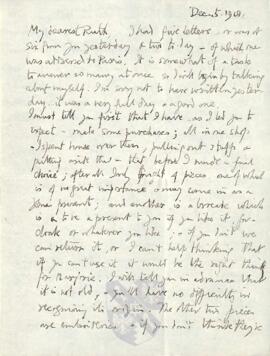
Describes the purchases he had spent a long time over choosing which included embroideries for the Holt and some books. Describes the bookshops he had been into. Hopes she doesn’t think he has been extravagent.

Had been to the library and held with indescribeable emotion the manuscript of Figaro from which Beaumarchais had read out his play. It had many corrections. It was a genuine sense of wonder and enthusiasm to hold such a document in his hand and more than interesting to see the trials of authorship were the same as they were for him.

Answers her question about opera and explains how it is founded upon well known stories and the libretto was written by a composer.

Had been to the Comédie Française which was a good piece but not one of the very best.

Was sorry he couldn’t stay longer in Paris but was more sorry that he hadn’t received a telegram giving him leave to return to England.

MCPP/GM/3/1/1918/31 · Pièce · 8 December 1918
Fait partie de College Personal Papers and Biographical Information

Letter to Ruth Mallory written from France

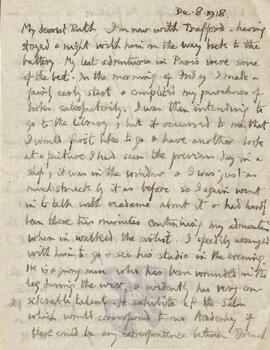
Was staying with Trafford on his was back from Paris. He had completed his purchases of books and was on the way to the library when he went back to look at a picture in a shop he had seen the day before. The artist arrived while he was still in the shop. He was a young man injured in the leg during the war and he arranged to go and visit his studio. Describes the painting and whether they should buy it. Asked the artist to paint Clare if were to come to England.

MCPP/GM/3/1/1918/34 · Pièce · 19-20 December 1918
Fait partie de College Personal Papers and Biographical Information

Letter to Ruth Mallory written from France

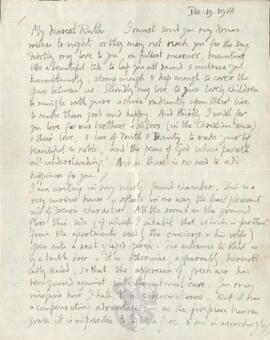
Sends his Christmas wishes for her and describes the new room he has moved into a short distance from the mess. He would be able to spend a great deal of time there except for occasional duties as orderly officer and a French class he was going to start for a few of the men.

Morning - the bed was comfortable. He was busy writing Xmas letters and would write to Mary and Mary Ann. He was annoyed they had rushed them out of the Holt but it wasn’t their fault. He thought it was Fletcher’s fault as he should have found out that demobilisation would be taken out of the hands of the War Office as soon as the armistace was signed and so applied for his release before the armistace and then let him refuse if the war had continued. He should have let them know at once that the arrangements had fallen through.

Was glad she was getting on well about servants. £35 sounded a lot for wages but supposed paying extra was worth it for good servants. Hadn’t heard if he had secured the purchase of the painting in Paris. What would she do about labour for the garden at the Holt? It might take 9 months to get demobilised but might not take that long.

Had two photos of her and Clare on his mantlepiece. Sends his love to her father, Mildred and Marjorie, the Lawrence Turners and the Haves Turners.

MCPP/GM/3/1/1921/23 · Pièce · 22, 28, 31 July 1921
Fait partie de College Personal Papers and Biographical Information

Letter to Ruth Mallory, written from 1st Base Camp, Rongbuk Glacier on ‘Mount Everest Expedition’ Letterhead

Brief Summary
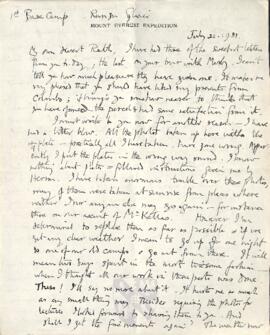
Was disappointed that all the photographs he had taken had not come out. Will go back to their old camps to re take them. Longs for home. Liked walking round camp collecting flowers. Had been having bad weather. Had enjoyed beautiful views from their highest camp. Had called one of the mountains 'Mount Clare' after their daughter. Describes their explorations and other members of the group.

Detailed Summary
Had received three of her letters and was pleased she liked his parcel from Colombo. All the photographs he had with the ¼ plate had not come out [He had put the plates in the wrong way round and blamed instructions given to him by Heron]. He had taken enormous trouble setting up the photographs, many of them were taken at sunrise from places neither he nor anyone else may go again. Was determined to go back to one of their old camps so he could replace the photographs. He had hoped to show them on a future lecture tour and to her. The weather was bad, but they were much more comfortable in their eighty-pound tent.

He was sorry he hadn't been sharing enough of his feelings with her [in her letter Ruth had asked him to share more] but he had been occupied with what they had to do. He longed for home but remained cheerful even though the moments of real enjoyment were rare. He liked walking round camp collecting flowers but the bad weather stopped him. They had to stay in the tents due to the bad weather and he played piquet with Bullock to pass the time.

He had greatly enjoyed their highest camp the night before their attempt on the W. cwm because of the beautiful views. One mountain in particular was singularly lovely and he called it Mount Clare [the name of his eldest daughter. Mount Clare is now called Pumori, meaning 'mountain daughter']. They had done very little climbing and it was a slow and tiresome business crossing the glacier.

The mountains were rather unfriendly compared to the scenery of the Alps. They hadn't seen a tree in Tibet!

Comments on the contents of her letters.

28 July - Woke up to snow on the ground at Base Camp and the weather clearing. He lead a march with six porters and two mummery tents going up about 3,000 ft from Base Camp. Then raced down to join Bullock half an hour short of 2nd Advanced Camp. Passed a comfortable night, though it was freezing. His alarm clock failed to go off, and later they set out in the moonlight, Bullock with two porters up into the N. cwm and him with two others to the little peak. There was a blanket of cloud a few hundred feet above their heads but they went on and he was able to get a clear view for about 30 seconds of Mount Clare [Pumori]. He was able to take ten photographs, and some of Everest, predicting they would turn out well. He had photographed the West Peak feeling that he had repaired a good detail of the damage [referencing his earlier photography mishaps].

Changing weather and thunderstorms had made them abandon their plan due to thick snow. He and Bullock were later reunited with Howard-Bury’s party. Wheeler arrived later the same evening after making his photographic surveys to the west. Wheeler had been doing much of what they had done but alone. It was rather silly that they couldn’t have joined forces. After three days trekking they had arrived at Kharta and the new Expedition Base Camp. He describes the changing scenery, coming down to Cholo.

They were nearer to the Arun Valley and had crossed two passes and were sleeping near clear bubbling streams. Seeing the snow mountains had been full of interest but to see things grow again had been a real joy. Describes a sweet mountain valley and the flowers saying he might have been in the Highlands. Describes camping and being delighted by a particular flower that especially reminding him of her. They were in the Arun Valley before it went down into a narrow and fearsome gorge to Nepal and India. He planned four days’ rest.

31 July - Mail had arrived and he was busy printing photographs which were more successful. He was enjoying the quiet days but at the same time was looking forward to the next stage of their reconnaissance. They planned to follow a big glacier stream which he presumed came from Everest. The great question was the approach to the North col and feasible line of attack. He hoped to find it easier.

He hoped some of the others would join them as it had been disappointing to see so little of Wollaston and Morshead. Shares his current feelings towards Bullock. Refers to poor Wollaston and Raeburn’s absence for medical reasons and that they had no further news about him.

[Postscript] - he enclosed a few earlier photos.

MCPP/GM/3/1/1922/17 · Pièce · 9 June 1922
Fait partie de College Personal Papers and Biographical Information

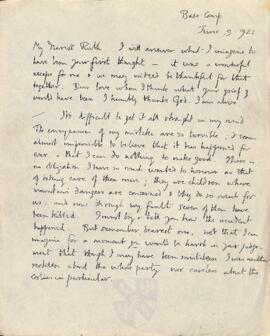
Letter to Ruth Mallory describing the Avalanche in which 7 porters were killed.

Full Transcript

My dearest Ruth, I will answer what I imagine to be your first thought - it was a wonderful escape for me & we may indeed be thankful for that together. Dear love when I think what your grief would have been I humbly thank God I am alive.

/ It’s difficult to get it all straight in my mind. The consequences of my mistake are so terrible; it seems almost impossible to believe that it has happened for ever & that I can do nothing to make good. There is no obligation I have so much wanted to honour as that of taking care of these men; they are children where mountain dangers are concerned & they do so much for us; and now through my fault seven of them have been killed. I must try to tell you how the accident happened. But remember dearest one, not that I can imagine for a moment you would be harsh in your judgement that though I may have been mistaken I was neither reckless about the whole party nor careless about the coolies in particular.

When we started from the Base Camp on June 3 the clouds were thickening & it was evident that very soon the monsoon would be upon us; but none can say how soon in such circumstances the monsoon will make climbing impossible. I walked up half despondently with Finch to No 1 Camp; he was clearly quite unfit & could barely reach the camp. Next morning he went back to the Base leaving Somervell & me for the high climbing with Wakefield and Crawford to be back us up.

During the night of the 3rd snow fell heavily & continued on the 4th. We spent a cold day in the poor shelter at Camp 1, a little hut with walls about 3 ft 6 in high built of the stones that lay about there & roofed with the outer fly of Whymper tent. The white snow dust blew in through the chink & one wondered naturally, Isn’t it mere foolishness to be attempting Everest now that the snow has come? It was clear that if we were to give up the attempt at once no one would have a word to say against our decision. But it seemed to me too early to turn back & too easy - we should not be satisfied afterwards. It would not be unreasonable to expect a spell of fair weather after the first snow as there was last year; this might give us our chance at last, a calm day in the balance between the prevailing west wind & the south east monsoon current. And if we were to fail how much better I thought to be turned back by a definite danger or difficulty on the mountain itself.

On the 5th will too [many crossed through] much cloud still hanging about the glacier we went up in one long march to Camp 3 - a wet walk in the melting snow & with some snow falling. At the camp not less than a foot of snow covered everything. The tents which had been struck but not packed up contained a mixture of ice, snow, & water; more than one was badly rent in putting it up. The prospects were not very hopeful.

There was no question of doing anything on the 6th, the best we asked for was a warm day’s rest. We had a clear day of brilliant sunshine, the warmest by far that any of us remembered at camp 3. The snow solidified with amazing rapidity; the rocks began to appear about our camp; and though the side of Everest facing us looked cold & white we had the satisfaction of observing during the greater part of the day a cloud of snow blown from the North Ridge. It would not be long at that rate before it was fit to climb.
The heavy snow of the 4th & 5th affected our plans in two ways. As we should have to expect heavier work high up we should have hardly a chance of reaching the top without oxygen, & in spite of Finch’s absence with his expert knowledge we decided to carry up ten cylinders with the two apparatus used by Finch and G. Bruce to our old camp established on the first attempt at 25,000 ft; so far we should go without oxygen; in taking up the camp (one of the 2 Mummery tents & the sleeping sacks) another 1000 ft we might find it advisable to use each one cylinder; in any case we should have 4 cylinders each to carry on with us next day.

Our chief anxiety was to provide for the safety of the [‘coolies’ crossed out] porters. We hoped the conditions might be good enough to send them down by themselves to the North Col; & it was arranged that Crawford should meet them at the foot of the ridge to conduct them properly roped over the crevasses to Camp 4; there they would remain until we came back from the higher camp & all would go down together. Crawford was also to arrange for the conduct of certain superfluous porters who were to come up to Camp 4 but not stay there across the steep slope below the camp, the one place which in the new conditions might prove dangerous. With these plans we thought we might move up from Camp IV on the 4th day of fine weather should the weather hold, & still bring down the party safely whatever the monsoon might do. A change of weather was to be feared sooner or later, but we were confident we could descend the North Ridge from our high camp in bad weather if necessary, & three of us, or if Wakefield came up, four, would then be available to shepherd the coolies down from the North Col.

But the North Col has first to be reached. With the new snow to contend with we should have hard work; perhaps it would take us more than one day; the steep final slope might be dangerous; we should perhaps find it prudent to leave our loads below it & come up easily enough in our frozen tracks another day.
We set out from Camp 3, Somervell Crawford, & I with 14 porters at 8 a.m. on the 7th. A party including four of the strongest porters were selected to lead the way over the glacier. They did splendid work trudging the snow with loads on their backs; but it took us two hours to the foot of the great snow wall & it was 10.15 a.m. when Somervell, I, one porter, & Crawford, roped up in that order, began the ascent. We found no traces at first of our previous tracks, & were soon crossing a steep ice slope covered with snow. It was remarkable that the snow adhered so well to this slope, where we had found bare ice before, that we were able to get up without cutting steps. In this harmless place we had tested the snow & were more than satisfied.
Higher up the angle eases off & we had formally walked up at comparatively gently angels in the old snow until it was necessary to cross the final step slope below Camp 4.

Now we had to content with snow up to our knees. Crawford relieved Somervell & then I took a turn. About 1.30 p.m. I halted & the porters following in three parties came up with us. Somervell who was the least tired among us now went ahead continuing in our old line & still on gentle slopes about 200 ft below some blocks of fallen ice which mark the final traverse to the left over steeper ground. I was following up in the steps last on our rope of four when at 1.50, I heard a noise not unlike an explosion of untamped gunpowder. I had never before been [knew crossed out] near an avalanche of snow: but I knew the meaning of that noise as though I were accustomed to hear it every day. In a moment I observed the snow’s surface broken only a few yards away to the right & instinctively moved in that direction. And then I was moving downward. Somehow I managed to turn out from the slope so as to avoid being pushed headlong & backwards down it. For the briefest moment my chances seemed good as I went quietly sliding down, with the snow, Then the rope at my waist tightened & held me back. A wave of snow came over me. I supposed that the matter was settled. However I thrust out my arms to keep them above the snow & at the same time tried to raise by back, with the result that when after a few seconds the motion stopped I felt little pressure from the snow & found myself on the surface.
The rope was still tight about my waist & I imagined that the porter tied on next one must be deeply buried; but he quickly emerged near me no worse off than myself. Somervell & Crawford too were quite close to me & soon extricated themselves, apparently their experiences were much the same as mine. And where were the [rest crossed through] porters, we asked? Looking down over the broken snow we saw one group some distance below us. Presumably the rest must be buried somewhere between us & them. No sign of them appeared; and those we saw turned out to be the group who had been immediately behind us. Somehow they must have been caught in a more rapid stream & carried down a hundred feet further than us. They pointed below them; the others were down there.

It became only too plain as we hurried down that the men we saw were standing only a little way above a formidable drop. The others had been carried over. We found the ice cliff to be from 40 ft to 60 ft high, the crevasse below it was filled up with the avalanche snow & these signs enough to show us that the two missing parties of four & five were buried under it. From the first we entertained little hope of saving them. The fall alone must have killed the majority, & such proved to be the case as we dug out the bodies. Two men were rescued alive & were subsequently found to have sustained no severe injuries; the remaining seven lost their lives /.

There is the narrative - the bare facts, on separate sheets for your convenience - not my letter to you but a more impersonal account explaining our plans & their fatal conclusion. I hope it will suffice to let you understand what we were about. You may read between the lines how anxious I was about the venture. S. [Somervell] & I knew enough about Mount Everest not to treat so formidable a mountain contemptuously. But it was not a desperate game, I thought, with the plans we made. Perhaps with the habit of dealing with certain kinds of danger one becomes accustomed to measuring some that are best left unmeasured & untried. But in the end I come back to my ignorance; one generalises from too few observations & what a lifetime it requires to know all about it! I suppose if we had known a little more about conditions of snow here we should not have tried those slopes – [but crossed through] and not knowing we supposed too much from the only experience we had. The three of us were deceived; there wasn’t an inkling of danger among us. //

Writes again on ‘June 14’ [one week after avalanche] – In the interval since I began writing we have packed up our traps and are on our way down - actually I am sitting in a sheltered nook above that little patch of vegetation by the stream above Chobu [village], & it is raining softly which many account for some curious mark on the paper. I don’t want you to think dearest that I am in perpetual gloom over the accident. One has to wear a cheerful face & be sociable in a company such as we are. But my mind does go back very often to the terrible consequences of our attempt with great sadness.

I think it would be a good thing to send a copy of my narrative to a few climbing friends. Claude, to show to his climbing party, David & Herbert Reade. It won’t be of great interest to people who aren’t climbers I should suppose, but one might be circulated to my family too if you think they would like it. I have written to my father & to Geoffrey Young, Younghusband (very briefly) & Frank Fletcher. Please also send the account to Farrar asking him to read it and send it back to you (I don’t much want it to become an official document in the A.C., or at least not yet). And in circulating the narrative you will quote my remarks on p. 7 between marks //.

I don’t know whether you will have got the hang of our plans & arrangements. The reason for going to Kharta is really that the General wants to see that part of the country; the excuse that we want to collect flowers & birds & beasts. I had the chance of going back straight from here, but the chance of seeing the early flowers over the other side was too good to be missed & I’m still hoping to get back after a week or ten days there by a short cut through the corner of Nepal which would be a very interesting journey though extremely wet & should land me in Darjeeling before the middle of July. However that depends much on transport arrangements & I want to get someone to come with me who understands these lingos- perhaps Norton. My possible dates for leaving Bombay are 22nd, 29th July and 1st and 5th of Aug. I shall avoid the 29th if possible as it is a small boat P&O & I would sooner take the Trieste boat on the 1st & come overland. The 22nd is too early in all probability & the 5th (also P&O) is the best boat they have which is a consideration when meeting the monsoon. If I come by P&O I shall probably come to London; anyway I’ll wire giving simply a date (i.e. that of leaving Bombay) and write or wire again from Marseilles or Venice. I’ve been thinking much since your last letter dated April 22 etc. what we would like best to do in early autumn. PyP [Pen-y-Pass] is always attractive & it would be a very pleasant little party; I think we must wait to fix that if we feel like it. Prima facie I’m more in favour of breaking new ground & Richmond in early September might be perfect if Mill [Ruth's sister Mildred?] wants us. I suppose Bob has a job at Catterick; lucky man; he might teach me to fish in those dale streams. I’ve always wanted to go to Richmond.
I’m glad you like the book on botany & find it helpful; we shall be too late to make much use of it together this year, but it’s a thing we must do together sometime – I mean to learn much more about flowers for our children’s sake if for no other reason. But there is another reason; - there is a little shrub in front of me now most prettily blooming with a pink flower, not unlike a rather stiff & thorny rosemary, only the flower is more chartered - which I should much like to introduce into our garden but I can’t tell it’s species.

We are in much reduced company now - Strutt, Longstaff, Finch, & Morshead went off to Darjeeling retracing our steps, about a week ago, & Norton, G. Bruce to Kharta, where we shall rejoin them. I’m much distressed about Morshead’s hands. I fear he’s certain to lose at least the tips (i.e. 1st joints) of 3 fingers on the right hand; & he had a good deal of pain too. G.B. [G. Bruce] writes that his toes are troublesome, but no great harm was done there, & Norton, who was quite knocked out by our climb & a dispirited man after it he has now discovered that what he thought were bruises in the soles of his feet are really frostbite & bad enough to prevent him walking seriously. My finger has almost recovered except for a black nail, so I got off very lightly.
I must finish this off for a mail which is to go off at once. Please give my love to your Father & Marby [written up the side margin:] and make the understand as far as possible about the accident. Many hugs and kisses to the children and endless love to you dearest one. Your Loving, George.

MCPP/GM/3/1/1922/20 · Pièce · 1 July 1922
Fait partie de College Personal Papers and Biographical Information

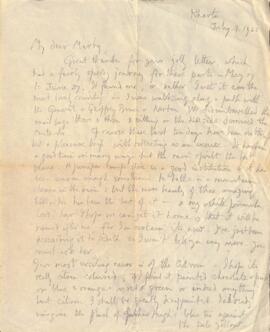
Letter to Marjorie Turner [his sister-in-law], from Kharta

Thanks her for her jolly letter which she had written on 17 May and which he had received on 27 June. He was in lovely countryside walking with the General and Geoffrey Bruce and Norton when he received it. The last ten days had been a pleasure trip with collecting as an excuse. It had been a good time but the rain had spoilt the best plans. He describes the countryside and flowers including a white primula he had found which he hoped they could bring back and name after him.

Replies to the contents of her letter. He was looking forward to getting back to England at the end of August. He planned to go to Westbrook to eat fruit. Doesn't think he would collect much more on his way back but that day he had got a fine Tibetan fox-skin for Ruth although she would probably say she couldn't wear it. Hoped he would find waiting for him in Darjeeling some small square Tibetan mats for chairs.

MCPP/GM/3/1/1923/13 · Pièce · 18 October 1923
Fait partie de College Personal Papers and Biographical Information

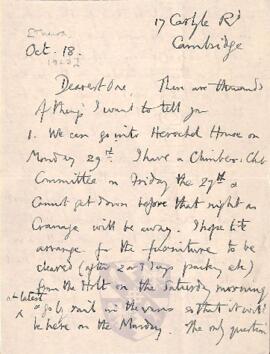
Letter to Ruth Mallory from ’17 Carlyle Rd, Cambridge’

Brief Summary
George left America after this lecture tour in March 1923. This letter is written in October to Ruth ahead of their move into Herschel House in Cambridge, where Ruth would receive news of George’s death 8 moths later.

Most of this letter concerns plans for moving into Herschel House, including logistics and decorating and furniture choices. The end of the letter is about plans for another expedition to Mount Everest in 1924.

Detailed Summary
They could get into Herschel House on Monday 29th after he had been to a Climbers Club Committee meeting. He had arranged for furniture from the Holt to be cleared on the Saturday morning. Wondered if he should be there for the packing but doubts if it was worthwhile. If he went by car he could take a few plants if there were any she hadn’t already taken.

They would have to wait to make decisions about getting more paper from Jeffries’ for the hall etc.

He had seen Uncle Lawrence and arranged not to have the mantlepiece at present. He had the address of a firm who supplied Dutch blue tiles but he wanted the address of the firm her father had recommended.

He would make out a list of plants he wanted for her guidance and asks if she will inform Westbrook when they would want the stuff from there.

The sale at Herschel House would be on Tuesday 30th in a tent in the garden but there was so little it wouldn’t interfere with their moving in but wondered if they should go to the Elliot’s until it was over. There would be a good new bed in the sale and thought her bargain with Marby [Ruth’s sister Marjorie] wasn’t a good one as it would mean an extra mattress but he would leave it to her.

He would write to Alex Turner to ask their advice about what fixtures they could take from the Holt such as electric light fittings and curtain rods.

They would wait to decide about curtains although he inclined to the new zig zag stuff for the study.

Sealing wax paint couldn’t be used. Could they do a design in a simple colour, white or yellow or umber on the doors and some simple affair on the staircase? He was veering toward brown stain again. As they weren’t going to spend money on the drawing room mantlepiece they could spend more on the staircase.

[Letter continues later] – he had a very tiring drive back last night with a lot of mist. The committee meeting had been long but good. Farrar wouldn’t turn up as he was angry about turning down Finch. Bruce had been in a hotel in Switzerland where Finch had been and was asked whether it was he who was helping Finch to arrange the next expedition [to Mount Everest].

They had to contradict tales about a shortage of funds. Longstaff had heard of it and thought it was very wrong of Farrar as it wasn’t true. Had dinner with Longstaff. Hinks had written to Cranage about his going and he brought up the question with Longstaff although Hinks’ letter hadn’t turned up. He had not turned it down definitely, but he didn’t think they would hear of this going. It would be a big sacrifice for him either way.

It was wretched not being able to talk to her about. She must tell him if she couldn't bear the idea of him going again and that would settle it.

MCPP/GM/3/1/1924/7 · Pièce · 2 April 1924
Fait partie de College Personal Papers and Biographical Information

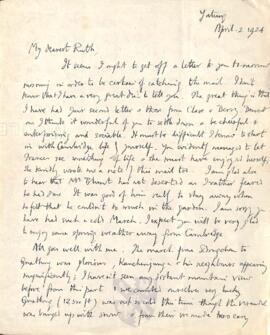
Letter from George Mallory to Ruth from Yatung

Full Transcript

My dearest Ruth,

It seems I ought to get off a letter to you tomorrow morning in order to be certain of catching the mail. I don’t know that I have a very great deal to tell you. The great thing is that I have had your second letter & those from Clare & Berry. Dearest one I think it wonderful of you to settle down & be cheerful & enterprising and sociable. It must be difficult I know to start in with Cambridge life by yourself. You evidently managed to let Frances see something of life & she must have enjoyed herself; she kindly wrote me a note by this mail too. I am glad also to hear that Mr Blunt has not deserted as I rather feared he had done. It was good of him really to stay away when he felt that he couldn’t do much in the garden. I am sorry you have had such a cold March. I expect you will be very glad to enjoy some spring weather away from Cambridge.

All goes well with me. The march from Sedongchen to Gnathong [Gnatong] was glorious, Kanchenjunga & his neighbour appearing magnificently; I haven’t seen any distant mountain view before from this part & we counted ourselves very lucky. Gnathong [Gnatong] (12,500 ft) was not so cold this time, though the veranda was bunged up with snow, & from their [there] we made two easy stages here, stopping the night in a little rest house an hour down this side of Jelap La. Norton & I walked up to the pass (14,500 ft) together & were pleased to think that we felt fitter than last year. I certainly am feeling very fit now. I sleep long & well & can walk as fast as anyone.

We have had a few good signs of Spring – on the Sikkim side a most lovely little primula flourishing from 9,000 to 11,000 ft, with the habit of our English primrose only somewhat smaller & neater, and of a delicious crimson colour; and Rhododendron Falconeri, a big bright red fellow was flowering freely a bit lower. On this side we have another primula, denticulata, paler in colour & of the polyanthus type, very freely scattered over the meadows; & we have our old friend Daphne, I know not what species. The conifers too in this valley are all showing green.

It has been a wonderfully pleasant journey so far, with bright sun & pleasant conditions altogether. And it has been a very jolly company. We found the first contingent here no less happy than ourselves. The General (entrenous) has not been quite well & has stayed here today while Norton takes on the first party. The slack day here has been very pleasant. I have had a long ramble with Irvine.

I shall wish you Good Night & send this off brief as it is. Remember me to all my friends – but I forget you won’t be seeing them at present. I wonder where this letter will find you. It should reach you near about the 1st of May. Perhaps you have forgotten the significance of that date - will you think of me very specially on May 1 & may it be as good a day as it was in 1914.
Please thank Clare & Berry very much for their letters which I much enjoyed; & I liked the cards with flower pictures. It will be sometime yet before John can write me letters!

Now farewell dearest love. I waive you many kisses & see you smiling & happy & resolved so to be even during the month of May.

Ever your loving George.

I address this to Westbrook as I should like it to find you there & if you are with them will you please give my love to father Hugh & Marjorie; & in case you meet them remember me to Allen & Scott & the Fletchers. I shall be writing to Evelyn I hope. I am sorry for what you say about Alan, but a very young man’s view is generally exaggerated. I wish myself that A. would look tidier; I don’t know that it matters about his working provided he uses his mind somehow as he clearly does. My love to him when you see him.

MCPP/GM/3/2/1915/8 · Pièce · c. August 1915
Fait partie de College Personal Papers and Biographical Information

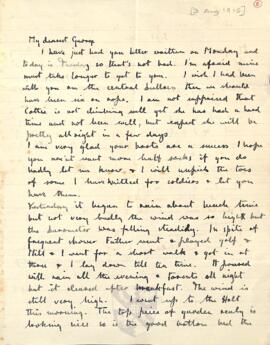
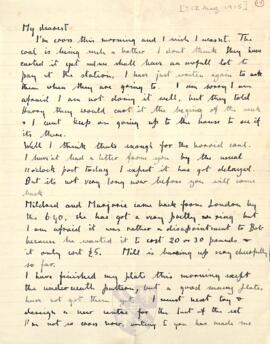
She is glad his boots are a success and that he is having a good time. Offers to send him socks originally knitted for soldiers. Tells him of the weather and their activities that day. Informs him of Marjorie's arrival and how well she is looking. Tells him that Captain Morgan was successful in obtaining leave and she expects him to arrive that Thursday. Requests to have the essays of Jane Harrison.

MCPP/GM/3/2/1915/10 · Pièce · c. August 1915
Fait partie de College Personal Papers and Biographical Information

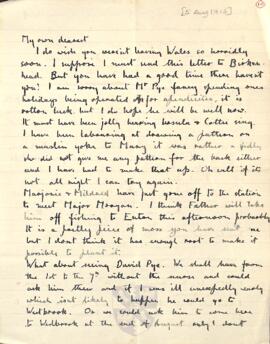
She hopes he has had a good time in Wales. Is sorry to hear of Mr Pye's recent appendix operation. Tells him of the work she has been doing making up patterns. Major Morgan is expected and is being met by Marjorie and Mildred at the station. Asks him if they could ask David Pye to visit. Hopes that he will have a good time in Yorkshire with his father and Trafford and tells him not to feel blue when at Birkenhead.

MCPP/GM/3/2/1915/14 · Pièce · 9 August 1915
Fait partie de College Personal Papers and Biographical Information

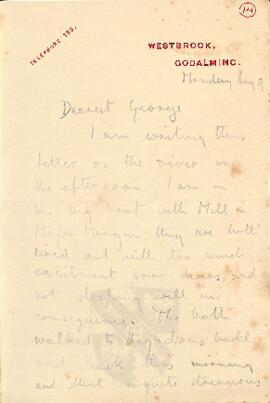
Describes her morning on the boat with Major Morgan and Mildred. Tells him of going to the Holt and organising her parcels for her confinement. She hopes to hear from him soon. Tells him of Major Morgan and Mildred's plans to stay in France after the war. Tells him of her guests Alison, Marby [Marjorie] and Helen.

MCPP/GM/3/2/1915/16 · Pièce · 11 August 1915
Fait partie de College Personal Papers and Biographical Information

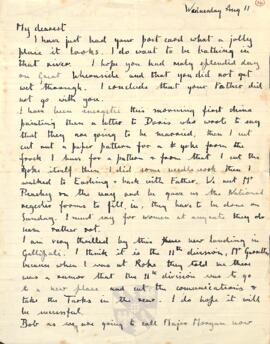
Hopes he had a nice time at Great Whernside. Describes her morning activities: china painting, letter writing, sewing, and walking to Eashing. She has received the National Register forms. Discusses the forthcoming landing at Gallipoli and hopes it will be successful. Mildred and Major Morgan have left to by an engagement ring. She expects a visit from Marjorie Waterhouse [old school friend, they attended Prior's Field School]. Tells him how much she misses him. Encloses a letter he received from Cottie, which she had read.

MCPP/GM/3/2/1915/23 · Pièce · c. 26 December 1915
Fait partie de College Personal Papers and Biographical Information

Hopes he had a nice Christmas and tells him what she received from Marjorie, Mildred, Bob [Major Robert Morgan, husband of Ruth sister Mildred], and her father. She has not gone to church due to feeling unwell. Discusses her book The Meaning of Good. Explains that the house is busy so she will seek quiet in the nursery with the baby. Asks for the Pen y Pass address.

MCPP/GM/3/2/1916/24 · Pièce · 24 May 1916
Fait partie de College Personal Papers and Biographical Information

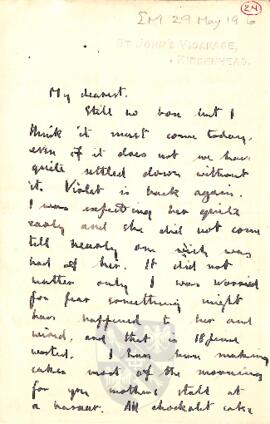
Informs him her box is still missing and Violet has arrived back from her trip. Tells him of the cakes she has made for his mother’s bazaar stall. Describes her activities with Clare in Birkenhead. Discusses her opinions on the sermon his father gave in Church and the National Mission of Repentance and Hope. Wonders how his boots are holding up with all the walking. Asks him what Captain Matheson is like and how his work is going. Tells him she misses him and informs him she intends to see Marjorie that day.

MCPP/GM/3/2/1916/25 · Pièce · 30 May 1916
Fait partie de College Personal Papers and Biographical Information

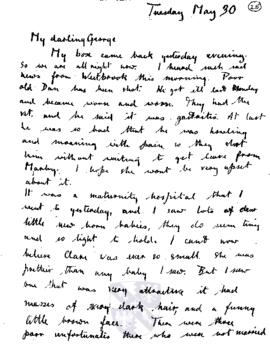
Her box has arrived at Birkenhead. She delivers the news that the dog has passed away and hopes Marjorie won't be too upset. Tells him about her experience volunteering at the maternity hospital and describes the situation of some of the mothers. Expresses her wish to help people in need. Informs him she intends to make copies of his letters to send to Mary, Avie and Trafford. She encloses a letter from Mr Rendall regarding his pamphlet.

MCPP/GM/3/2/1916/26 · Pièce · 31 May 1916
Fait partie de College Personal Papers and Biographical Information

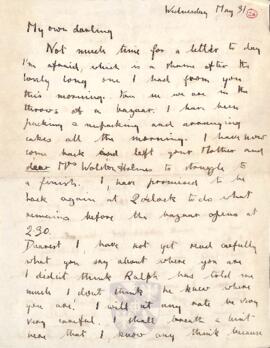
She is busy helping his mother with the bazaar. Tells him she will be careful not to hint at his location in her letters and will not let his mother know, but will inform his father, Mildred and Marjorie. Lets him know she has sent him some tea and chocolate. Describes life at the vicarage with his mother. Hopes the war will end soon.

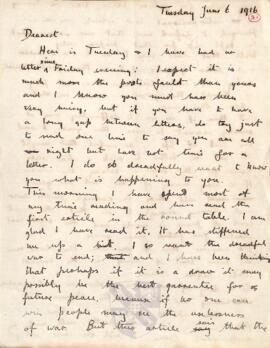
MCPP/GM/3/2/1916/31 · Pièce · 6 June 1916
Fait partie de College Personal Papers and Biographical Information

Hopes that he is well as she has not heard from him in a few days. She has been reading the Round Table. Expresses her views on how the war could come to an end through the application of an international law. Asks for his opinion about the end of the war. Describes her feelings towards Polly. Tells him about the tea service she is making. Describes her evening activities, singing and playing the piano. Expresses her wish to buy a new piano for the Holt after Polly takes the one there when she leaves. She has asked for clothes for her birthday present. Asks him if he knows Sibel Cropper, an old school friend of Marjorie’s. Recounts the story of Sibel refusing to marry Geoffrey Young and asks if he discusses Geoffrey’s love affairs with Mr Reade.

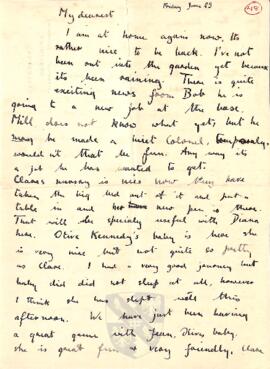
MCPP/GM/3/2/1916/48 · Pièce · 23 June 1916
Fait partie de College Personal Papers and Biographical Information

She is home at Westbrook with Diana and Olive Kennedy. Informs him that Bob is to be made a temporary Lieutenant Colonel. Describes how the children play together. Expresses her wish to see him and hopes his conditions are not too bad. Asks for his opinions on war and discusses her thoughts on when the right time to attack would be. Asks if he would like a Christmas pudding sent to him. Requests that he tell her the name of his new Major. Marjorie and Mary Anne are coming to stay and brining their own sugar. Informs him they have made £50 from the sale of 80 trees sold by her father. Her father intends to clear the common of trees.

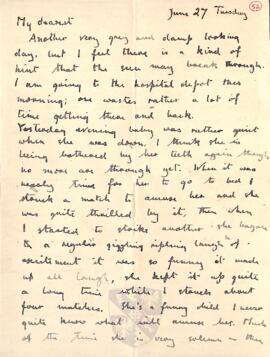
MCPP/GM/3/2/1916/52 · Pièce · 27 June 1916
Fait partie de College Personal Papers and Biographical Information

Intends to visit the hospital depot. Describes Clare's character and expresses how much the servants adore her. Compares Clare to Jean and Diana. She has not had a letter from him. Informs him that she intends to go to London with Marjorie to talk about helping on a farm. Tells him that Bob has secured a new job, possibly in Rouen that will make him a temporary Lieutenant Colonel. She has made him anti vermin pants. Describes her father's relationship with Diana. Is glad the Italians are doing well in the war.

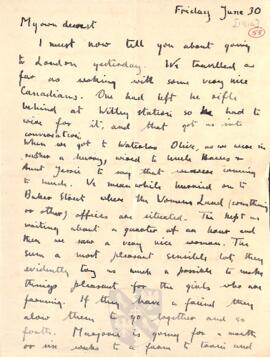
MCPP/GM/3/2/1916/55 · Pièce · 30 June 1916
Fait partie de College Personal Papers and Biographical Information

Morning - Describes her journey to London and tells a story about a Canadian leaving his rifle behind. Describes the women at the Women’s Land offices where Marjorie applied for farm work. Informs him Marjorie has been assigned to a farm owned by Olive’s brother and will stay for 4-6 weeks.

Afternoon – Describes her conversation with Uncle Hawes and Aunt Jessie about their visit to Ogwen Lake. Describes her activities in London; shopping at Wedgwood and Oxford Circus for clothes, tea with Mrs Reade. Describes the relationship between Mr Reade and Owen and expresses her own opinions on the matter. Intends to send Mrs Reade his letters to read. She will thank Mr Clutton-Brock for the book he sent.

MCPP/GM/3/2/1916/57 · Pièce · 2 July 1916
Fait partie de College Personal Papers and Biographical Information

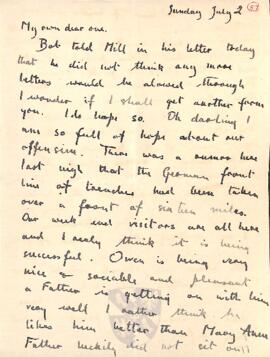
Discusses the progress of the German trenches. Describes her father's relationship with Owen and Mary Anne. Describes the servants annoyance at having to move guests about the house. Talks about her domestic duties. Hopes that her letters will still get through to him. Discusses her feelings about soldiers being wounded and sent home. Is enjoying having Clare to herself. Wonders how domestic duties will be allocated when Marjorie leaves. Tells him she misses him.

MCPP/GM/3/2/1916/58 · Pièce · 3 July 1916
Fait partie de College Personal Papers and Biographical Information

Expresses her anxiety over the war and hopes he is safe. Informs him that Olive's husband is being sent back to the trenches. Describes her activities that week; visit from Owen, Playing with the children in the garden, picking strawberries with Mary Anne and Marjorie and going for walks. Describes the weather and asks him about the weather in France. Tells him she misses his company. She is planning a skiing holiday with Owen and Mary Anne. Informs him they have made £50 from the sale of her father's fir trees from the common. Informs him she has received his letter.

MCPP/GM/3/2/1916/59 · Pièce · c. 3 July 1916
Fait partie de College Personal Papers and Biographical Information

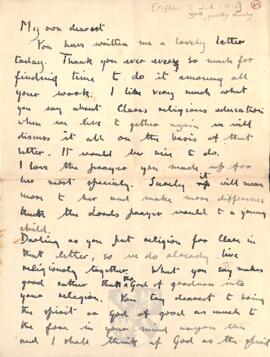
Thanks him for his letter and expresses her happiness to hear his thoughts on Clare’s religious education. Discusses her thoughts on religion in relation to the war and how to raise Clare. Expresses her thoughts on life after death and hopes they can discuss these matters together. Discusses the progress of the war. Describes her conversation with Aunt Agnes and Uncle Peter at Roke and discusses their relationship. Hopes that they can make their life perfect. Intends to take tea with Marjorie and Clare at Mrs Brock’s house.

MCPP/GM/3/2/1916/67 · Pièce · 15 July 1916
Fait partie de College Personal Papers and Biographical Information

Morning - Describes her morning activities; feeding Clare, breakfast, helping Marjorie with the Church flowers. Describes dress shopping with Marjorie.

Afternoon – Informs him that Bob has been made temporary Lieutenant Colonel, earning extra money. Describes Clare playing. Describes Constance Mussen’s visit and compares her baby to Clare. Tells him she thinks Clare will make a good climber. Discusses going on a climbing holiday to Wales with Ursula and Mary Anne. Apologises for sending the potatoes before she received his letter saying don’t send them. Describes Harry’s experience of the war. Discusses the progress of the war and the opinion of Mr Powell regarding open warfare. Discusses the use of gas and a rumour of a reviving substance. Informs him Trafford has been sent to France. Expresses her wish to have a son. Asks him about his location. Tells him she loves and misses him.

MCPP/GM/3/2/1916/73 · Pièce · 24 - 25 July 1916
Fait partie de College Personal Papers and Biographical Information

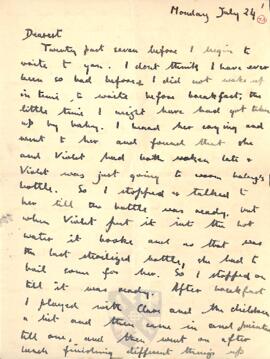
Monday 24 July - Describes her morning on waking up late and her activities for the day. Tells him she has packed up the plates and bowls she has made for Nancy Warr. Describes a trip down the river with the Cockerells. Expresses that she misses him. Discusses the characters of Mr Cockerell’s and the Brock’s children and their upbringing. Expresses her anxiety over the war. Mr Pilsbury has come to dinner.

Tuesday 25 July – Wonders how is doing. Discusses the expense of the war. Discusses her views on religion and on the application of Clutton-Brocks’s theory from his book, The Ultimate Belief, into everyday life. Marjorie is leaving for her farming work and wonders how she will get on. Tells him she is to attend Highdon’s Ball that evening. Mentions the progress of the war.

MCPP/GM/3/2/1916/74 · Pièce · 26 July 1916
Fait partie de College Personal Papers and Biographical Information

Expresses her frustration at the lack of news about the war and for his safety. Discusses the progress of the war. Tells him of the struggles with the new gardener Mr Lewington due to him being a ‘rheumatic fever and shell shock case’ and describes the difficulties between him and the previous gardener. Updates him on Clare’s progress. Informs him she has taken on the responsibility of the chickens from Marjorie. Discusses his letter telling her he has been sent to the front trenches and asks him for more information. Encloses her letter from Mr Cockerell.

MCPP/GM/3/2/1916/77 · Pièce · 29 July 1916
Fait partie de College Personal Papers and Biographical Information

Describes the weather. Expresses her anxiety over the danger he is in and discusses her thoughts on his happiness in adventure. Discusses the details of his previous letter and reassures him about his feelings towards their own troops being shelled by their own guns being his fault. Discusses the issue of men and work. Describes a trip to the river that her father and Mildred made with Clare and the Cockerell children. Describes a letter she received from Marjorie about life on the farm. Tells him her father was amused by his retort regarding potatoes.

MCPP/GM/3/2/1916/90 · Pièce · 13 August 1916
Fait partie de College Personal Papers and Biographical Information

Describes the weather. Discusses their future trips to the Alps and how many children she would like. Discusses his lust for adventure. Informs him she has had Clare photographed at Adrian Harding and updates him on her progress. Describes the progress of her bowl. Expresses her wish for the war to be over and for them to be together at The Holt. Hopes that he will get leave soon and describes the photographs she has of him in frames. Intends to go on holiday by the 26 August. Asks him what he intends to do on leave. Discusses the living arrangements between her father, Marjorie and Mildred after the war. Discusses the cost of the post.