Showing 177 results

Archivistische beschrijving
177 results with digital objects Show results with digital objects
MCPP/GM/3/1/1918/24 · Stuk · 24 November 1918
Part of College Personal Papers

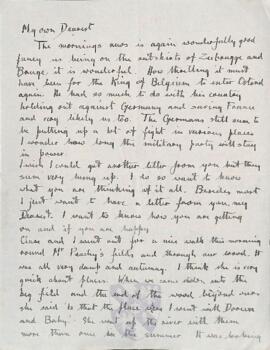
Letter to Ruth Mallory written from France

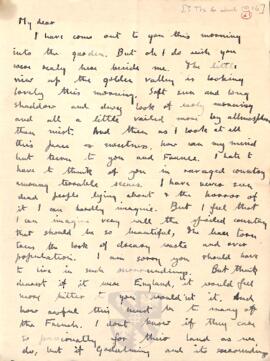
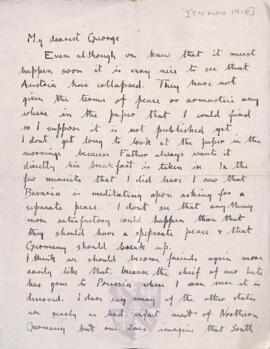
Was glad she was recovering [from pneumonia]. Wishes he could be home with her. The King was going to Paris on 29th which was the same day he would go if he got leave.

He had a heavy cold yesterday so hadn’t written to her as he was too tired after dinner. Looked forward to living with her and being happy in their home. She must be patient with him and they would learn to live with one another and be happy.

They had not yet moved but he expected they would that day. They had to give up most of their trucks which would be very annoying.

He was delighted her father had begun to walk again. Hopes he will be strong again.

He was reading Tess of the d’Urbevilles which had wonderful descriptions of dairy farms in the Frome Valley and she would love it although it was another tragedy.

It was still very cold but bright and he had walked into Arras to buy stuff for the mess. The car was out of action as the rear axle was broken. When it broke the wheel came off and careered down the road nearly upsetting a despatch rider.

MCPP/GM/3/1/1918/34 · Stuk · 19-20 December 1918
Part of College Personal Papers

Letter to Ruth Mallory written from France

Sends his Christmas wishes for her and describes the new room he has moved into a short distance from the mess. He would be able to spend a great deal of time there except for occasional duties as orderly officer and a French class he was going to start for a few of the men.

Morning - the bed was comfortable. He was busy writing Xmas letters and would write to Mary and Mary Ann. He was annoyed they had rushed them out of the Holt but it wasn’t their fault. He thought it was Fletcher’s fault as he should have found out that demobilisation would be taken out of the hands of the War Office as soon as the armistace was signed and so applied for his release before the armistace and then let him refuse if the war had continued. He should have let them know at once that the arrangements had fallen through.

Was glad she was getting on well about servants. £35 sounded a lot for wages but supposed paying extra was worth it for good servants. Hadn’t heard if he had secured the purchase of the painting in Paris. What would she do about labour for the garden at the Holt? It might take 9 months to get demobilised but might not take that long.

Had two photos of her and Clare on his mantlepiece. Sends his love to her father, Mildred and Marjorie, the Lawrence Turners and the Haves Turners.

MCPP/GM/3/1/1922/17 · Stuk · 9 June 1922
Part of College Personal Papers

Letter to Ruth Mallory describing the Avalanche in which 7 porters were killed.

Full Transcript

My dearest Ruth, I will answer what I imagine to be your first thought - it was a wonderful escape for me & we may indeed be thankful for that together. Dear love when I think what your grief would have been I humbly thank God I am alive.

/ It’s difficult to get it all straight in my mind. The consequences of my mistake are so terrible; it seems almost impossible to believe that it has happened for ever & that I can do nothing to make good. There is no obligation I have so much wanted to honour as that of taking care of these men; they are children where mountain dangers are concerned & they do so much for us; and now through my fault seven of them have been killed. I must try to tell you how the accident happened. But remember dearest one, not that I can imagine for a moment you would be harsh in your judgement that though I may have been mistaken I was neither reckless about the whole party nor careless about the coolies in particular.

When we started from the Base Camp on June 3 the clouds were thickening & it was evident that very soon the monsoon would be upon us; but none can say how soon in such circumstances the monsoon will make climbing impossible. I walked up half despondently with Finch to No 1 Camp; he was clearly quite unfit & could barely reach the camp. Next morning he went back to the Base leaving Somervell & me for the high climbing with Wakefield and Crawford to be back us up.

During the night of the 3rd snow fell heavily & continued on the 4th. We spent a cold day in the poor shelter at Camp 1, a little hut with walls about 3 ft 6 in high built of the stones that lay about there & roofed with the outer fly of Whymper tent. The white snow dust blew in through the chink & one wondered naturally, Isn’t it mere foolishness to be attempting Everest now that the snow has come? It was clear that if we were to give up the attempt at once no one would have a word to say against our decision. But it seemed to me too early to turn back & too easy - we should not be satisfied afterwards. It would not be unreasonable to expect a spell of fair weather after the first snow as there was last year; this might give us our chance at last, a calm day in the balance between the prevailing west wind & the south east monsoon current. And if we were to fail how much better I thought to be turned back by a definite danger or difficulty on the mountain itself.

On the 5th will too [many crossed through] much cloud still hanging about the glacier we went up in one long march to Camp 3 - a wet walk in the melting snow & with some snow falling. At the camp not less than a foot of snow covered everything. The tents which had been struck but not packed up contained a mixture of ice, snow, & water; more than one was badly rent in putting it up. The prospects were not very hopeful.

There was no question of doing anything on the 6th, the best we asked for was a warm day’s rest. We had a clear day of brilliant sunshine, the warmest by far that any of us remembered at camp 3. The snow solidified with amazing rapidity; the rocks began to appear about our camp; and though the side of Everest facing us looked cold & white we had the satisfaction of observing during the greater part of the day a cloud of snow blown from the North Ridge. It would not be long at that rate before it was fit to climb.
The heavy snow of the 4th & 5th affected our plans in two ways. As we should have to expect heavier work high up we should have hardly a chance of reaching the top without oxygen, & in spite of Finch’s absence with his expert knowledge we decided to carry up ten cylinders with the two apparatus used by Finch and G. Bruce to our old camp established on the first attempt at 25,000 ft; so far we should go without oxygen; in taking up the camp (one of the 2 Mummery tents & the sleeping sacks) another 1000 ft we might find it advisable to use each one cylinder; in any case we should have 4 cylinders each to carry on with us next day.

Our chief anxiety was to provide for the safety of the [‘coolies’ crossed out] porters. We hoped the conditions might be good enough to send them down by themselves to the North Col; & it was arranged that Crawford should meet them at the foot of the ridge to conduct them properly roped over the crevasses to Camp 4; there they would remain until we came back from the higher camp & all would go down together. Crawford was also to arrange for the conduct of certain superfluous porters who were to come up to Camp 4 but not stay there across the steep slope below the camp, the one place which in the new conditions might prove dangerous. With these plans we thought we might move up from Camp IV on the 4th day of fine weather should the weather hold, & still bring down the party safely whatever the monsoon might do. A change of weather was to be feared sooner or later, but we were confident we could descend the North Ridge from our high camp in bad weather if necessary, & three of us, or if Wakefield came up, four, would then be available to shepherd the coolies down from the North Col.

But the North Col has first to be reached. With the new snow to contend with we should have hard work; perhaps it would take us more than one day; the steep final slope might be dangerous; we should perhaps find it prudent to leave our loads below it & come up easily enough in our frozen tracks another day.
We set out from Camp 3, Somervell Crawford, & I with 14 porters at 8 a.m. on the 7th. A party including four of the strongest porters were selected to lead the way over the glacier. They did splendid work trudging the snow with loads on their backs; but it took us two hours to the foot of the great snow wall & it was 10.15 a.m. when Somervell, I, one porter, & Crawford, roped up in that order, began the ascent. We found no traces at first of our previous tracks, & were soon crossing a steep ice slope covered with snow. It was remarkable that the snow adhered so well to this slope, where we had found bare ice before, that we were able to get up without cutting steps. In this harmless place we had tested the snow & were more than satisfied.
Higher up the angle eases off & we had formally walked up at comparatively gently angels in the old snow until it was necessary to cross the final step slope below Camp 4.

Now we had to content with snow up to our knees. Crawford relieved Somervell & then I took a turn. About 1.30 p.m. I halted & the porters following in three parties came up with us. Somervell who was the least tired among us now went ahead continuing in our old line & still on gentle slopes about 200 ft below some blocks of fallen ice which mark the final traverse to the left over steeper ground. I was following up in the steps last on our rope of four when at 1.50, I heard a noise not unlike an explosion of untamped gunpowder. I had never before been [knew crossed out] near an avalanche of snow: but I knew the meaning of that noise as though I were accustomed to hear it every day. In a moment I observed the snow’s surface broken only a few yards away to the right & instinctively moved in that direction. And then I was moving downward. Somehow I managed to turn out from the slope so as to avoid being pushed headlong & backwards down it. For the briefest moment my chances seemed good as I went quietly sliding down, with the snow, Then the rope at my waist tightened & held me back. A wave of snow came over me. I supposed that the matter was settled. However I thrust out my arms to keep them above the snow & at the same time tried to raise by back, with the result that when after a few seconds the motion stopped I felt little pressure from the snow & found myself on the surface.
The rope was still tight about my waist & I imagined that the porter tied on next one must be deeply buried; but he quickly emerged near me no worse off than myself. Somervell & Crawford too were quite close to me & soon extricated themselves, apparently their experiences were much the same as mine. And where were the [rest crossed through] porters, we asked? Looking down over the broken snow we saw one group some distance below us. Presumably the rest must be buried somewhere between us & them. No sign of them appeared; and those we saw turned out to be the group who had been immediately behind us. Somehow they must have been caught in a more rapid stream & carried down a hundred feet further than us. They pointed below them; the others were down there.

It became only too plain as we hurried down that the men we saw were standing only a little way above a formidable drop. The others had been carried over. We found the ice cliff to be from 40 ft to 60 ft high, the crevasse below it was filled up with the avalanche snow & these signs enough to show us that the two missing parties of four & five were buried under it. From the first we entertained little hope of saving them. The fall alone must have killed the majority, & such proved to be the case as we dug out the bodies. Two men were rescued alive & were subsequently found to have sustained no severe injuries; the remaining seven lost their lives /.

There is the narrative - the bare facts, on separate sheets for your convenience - not my letter to you but a more impersonal account explaining our plans & their fatal conclusion. I hope it will suffice to let you understand what we were about. You may read between the lines how anxious I was about the venture. S. [Somervell] & I knew enough about Mount Everest not to treat so formidable a mountain contemptuously. But it was not a desperate game, I thought, with the plans we made. Perhaps with the habit of dealing with certain kinds of danger one becomes accustomed to measuring some that are best left unmeasured & untried. But in the end I come back to my ignorance; one generalises from too few observations & what a lifetime it requires to know all about it! I suppose if we had known a little more about conditions of snow here we should not have tried those slopes – [but crossed through] and not knowing we supposed too much from the only experience we had. The three of us were deceived; there wasn’t an inkling of danger among us. //

Writes again on ‘June 14’ [one week after avalanche] – In the interval since I began writing we have packed up our traps and are on our way down - actually I am sitting in a sheltered nook above that little patch of vegetation by the stream above Chobu [village], & it is raining softly which many account for some curious mark on the paper. I don’t want you to think dearest that I am in perpetual gloom over the accident. One has to wear a cheerful face & be sociable in a company such as we are. But my mind does go back very often to the terrible consequences of our attempt with great sadness.

I think it would be a good thing to send a copy of my narrative to a few climbing friends. Claude, to show to his climbing party, David & Herbert Reade. It won’t be of great interest to people who aren’t climbers I should suppose, but one might be circulated to my family too if you think they would like it. I have written to my father & to Geoffrey Young, Younghusband (very briefly) & Frank Fletcher. Please also send the account to Farrar asking him to read it and send it back to you (I don’t much want it to become an official document in the A.C., or at least not yet). And in circulating the narrative you will quote my remarks on p. 7 between marks //.

I don’t know whether you will have got the hang of our plans & arrangements. The reason for going to Kharta is really that the General wants to see that part of the country; the excuse that we want to collect flowers & birds & beasts. I had the chance of going back straight from here, but the chance of seeing the early flowers over the other side was too good to be missed & I’m still hoping to get back after a week or ten days there by a short cut through the corner of Nepal which would be a very interesting journey though extremely wet & should land me in Darjeeling before the middle of July. However that depends much on transport arrangements & I want to get someone to come with me who understands these lingos- perhaps Norton. My possible dates for leaving Bombay are 22nd, 29th July and 1st and 5th of Aug. I shall avoid the 29th if possible as it is a small boat P&O & I would sooner take the Trieste boat on the 1st & come overland. The 22nd is too early in all probability & the 5th (also P&O) is the best boat they have which is a consideration when meeting the monsoon. If I come by P&O I shall probably come to London; anyway I’ll wire giving simply a date (i.e. that of leaving Bombay) and write or wire again from Marseilles or Venice. I’ve been thinking much since your last letter dated April 22 etc. what we would like best to do in early autumn. PyP [Pen-y-Pass] is always attractive & it would be a very pleasant little party; I think we must wait to fix that if we feel like it. Prima facie I’m more in favour of breaking new ground & Richmond in early September might be perfect if Mill [Ruth's sister Mildred?] wants us. I suppose Bob has a job at Catterick; lucky man; he might teach me to fish in those dale streams. I’ve always wanted to go to Richmond.
I’m glad you like the book on botany & find it helpful; we shall be too late to make much use of it together this year, but it’s a thing we must do together sometime – I mean to learn much more about flowers for our children’s sake if for no other reason. But there is another reason; - there is a little shrub in front of me now most prettily blooming with a pink flower, not unlike a rather stiff & thorny rosemary, only the flower is more chartered - which I should much like to introduce into our garden but I can’t tell it’s species.

We are in much reduced company now - Strutt, Longstaff, Finch, & Morshead went off to Darjeeling retracing our steps, about a week ago, & Norton, G. Bruce to Kharta, where we shall rejoin them. I’m much distressed about Morshead’s hands. I fear he’s certain to lose at least the tips (i.e. 1st joints) of 3 fingers on the right hand; & he had a good deal of pain too. G.B. [G. Bruce] writes that his toes are troublesome, but no great harm was done there, & Norton, who was quite knocked out by our climb & a dispirited man after it he has now discovered that what he thought were bruises in the soles of his feet are really frostbite & bad enough to prevent him walking seriously. My finger has almost recovered except for a black nail, so I got off very lightly.
I must finish this off for a mail which is to go off at once. Please give my love to your Father & Marby [written up the side margin:] and make the understand as far as possible about the accident. Many hugs and kisses to the children and endless love to you dearest one. Your Loving, George.

MCPP/GM/3/1/1922/20 · Stuk · 1 July 1922
Part of College Personal Papers

Letter to Marjorie Turner [his sister-in-law], from Kharta

Thanks her for her jolly letter which she had written on 17 May and which he had received on 27 June. He was in lovely countryside walking with the General and Geoffrey Bruce and Norton when he received it. The last ten days had been a pleasure trip with collecting as an excuse. It had been a good time but the rain had spoilt the best plans. He describes the countryside and flowers including a white primula he had found which he hoped they could bring back and name after him.

Replies to the contents of her letter. He was looking forward to getting back to England at the end of August. He planned to go to Westbrook to eat fruit. Doesn't think he would collect much more on his way back but that day he had got a fine Tibetan fox-skin for Ruth although she would probably say she couldn't wear it. Hoped he would find waiting for him in Darjeeling some small square Tibetan mats for chairs.

MCPP/GM/3/1/1924/7 · Stuk · 2 April 1924
Part of College Personal Papers

Letter from George Mallory to Ruth from Yatung

Full Transcript

My dearest Ruth,

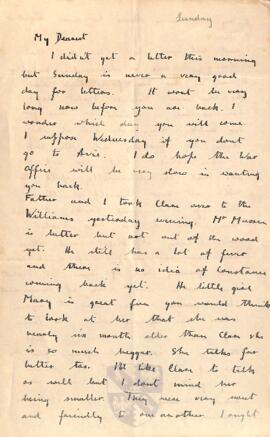
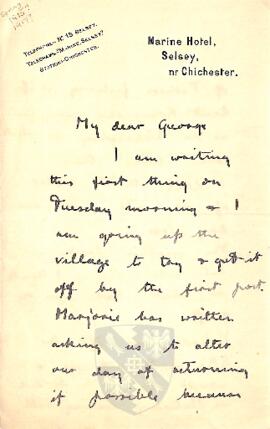
It seems I ought to get off a letter to you tomorrow morning in order to be certain of catching the mail. I don’t know that I have a very great deal to tell you. The great thing is that I have had your second letter & those from Clare & Berry. Dearest one I think it wonderful of you to settle down & be cheerful & enterprising and sociable. It must be difficult I know to start in with Cambridge life by yourself. You evidently managed to let Frances see something of life & she must have enjoyed herself; she kindly wrote me a note by this mail too. I am glad also to hear that Mr Blunt has not deserted as I rather feared he had done. It was good of him really to stay away when he felt that he couldn’t do much in the garden. I am sorry you have had such a cold March. I expect you will be very glad to enjoy some spring weather away from Cambridge.

All goes well with me. The march from Sedongchen to Gnathong [Gnatong] was glorious, Kanchenjunga & his neighbour appearing magnificently; I haven’t seen any distant mountain view before from this part & we counted ourselves very lucky. Gnathong [Gnatong] (12,500 ft) was not so cold this time, though the veranda was bunged up with snow, & from their [there] we made two easy stages here, stopping the night in a little rest house an hour down this side of Jelap La. Norton & I walked up to the pass (14,500 ft) together & were pleased to think that we felt fitter than last year. I certainly am feeling very fit now. I sleep long & well & can walk as fast as anyone.

We have had a few good signs of Spring – on the Sikkim side a most lovely little primula flourishing from 9,000 to 11,000 ft, with the habit of our English primrose only somewhat smaller & neater, and of a delicious crimson colour; and Rhododendron Falconeri, a big bright red fellow was flowering freely a bit lower. On this side we have another primula, denticulata, paler in colour & of the polyanthus type, very freely scattered over the meadows; & we have our old friend Daphne, I know not what species. The conifers too in this valley are all showing green.

It has been a wonderfully pleasant journey so far, with bright sun & pleasant conditions altogether. And it has been a very jolly company. We found the first contingent here no less happy than ourselves. The General (entrenous) has not been quite well & has stayed here today while Norton takes on the first party. The slack day here has been very pleasant. I have had a long ramble with Irvine.

I shall wish you Good Night & send this off brief as it is. Remember me to all my friends – but I forget you won’t be seeing them at present. I wonder where this letter will find you. It should reach you near about the 1st of May. Perhaps you have forgotten the significance of that date - will you think of me very specially on May 1 & may it be as good a day as it was in 1914.
Please thank Clare & Berry very much for their letters which I much enjoyed; & I liked the cards with flower pictures. It will be sometime yet before John can write me letters!

Now farewell dearest love. I waive you many kisses & see you smiling & happy & resolved so to be even during the month of May.

Ever your loving George.

I address this to Westbrook as I should like it to find you there & if you are with them will you please give my love to father Hugh & Marjorie; & in case you meet them remember me to Allen & Scott & the Fletchers. I shall be writing to Evelyn I hope. I am sorry for what you say about Alan, but a very young man’s view is generally exaggerated. I wish myself that A. would look tidier; I don’t know that it matters about his working provided he uses his mind somehow as he clearly does. My love to him when you see him.

MCPP/GM/3/2/1915/5 · Stuk · 31 July 1915
Part of College Personal Papers

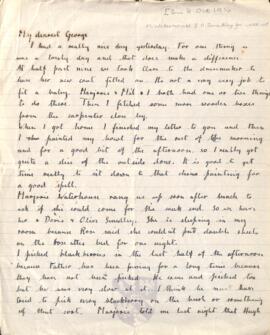
Informs him that she has arrived at Westbrook and expects her father and Mildred later that day. Describes how she left their home. Tells him she has heard from Major Morgan and that he has asked for leave. Expresses her concern over the longevity of the war. Describes life at Westbrook so far. Tells him of her plans for the day.

MCPP/GM/3/2/1915/6 · Stuk · c. 1 August 1915
Part of College Personal Papers

Discusses the timing of the post. Tells him that her father and Mildred arrived late and explains why. Informs him that she is not attending church and will go for a walk in Eashing instead. Hopes that Ursula is getting on well with the climb. Mentions that photographs of her father's garden has appeared in Country Life. Asks for Mr Pye's address.

MCPP/GM/3/2/1915/13 · Stuk · 8 August 1915
Part of College Personal Papers

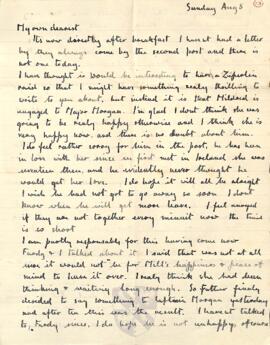
Informs him of Mildred's engagement to Major Morgan and hopes that the right decision has been made. Discusses the future between Major Morgan and her father. Hopes that Major Morgan will be kept safe in the war. Tells him of her sleepless nights and hopes he will return soon.

MCPP/GM/3/2/1915/15 · Stuk · c. 10 August 1915
Part of College Personal Papers

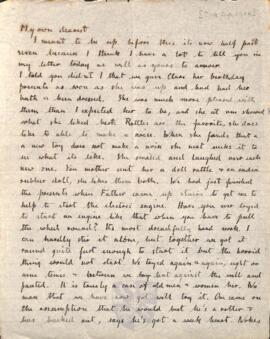
Praises the quick postal service and hopes he is having a nice time with his father, despite the bad weather. Expresses her wish to be there. Encourages him to stay longer and look for a present for Marjorie’s birthday. Tells him of her morning activities; having her hair washed and china painting. Asks about the date for Trafford’s wedding. Discusses how they intend to educate their children. Tells him her father, Mildred and Major Morgan have gone fishing at Eut

MCPP/GM/3/2/1915/23 · Stuk · c. 26 December 1915
Part of College Personal Papers

Hopes he had a nice Christmas and tells him what she received from Marjorie, Mildred, Bob [Major Robert Morgan, husband of Ruth sister Mildred], and her father. She has not gone to church due to feeling unwell. Discusses her book The Meaning of Good. Explains that the house is busy so she will seek quiet in the nursery with the baby. Asks for the Pen y Pass address.

MCPP/GM/3/2/1916/6 · Stuk · 14 May 1916
Part of College Personal Papers

Describes Miss Jekyll's garden. Tells him of a feud between her father and Aunt Theodora over the cutting of some trees on Highdon's Ball. Hopes he is not staying anywhere infested with rats. Discusses what she has been reading in Vanity Fair. Is glad that he is going to tell her more details of the war. She intends to have the Clutton-Brocks over to stay. Wishes him luck with his new Battery.

MCPP/GM/3/2/1916/35 · Stuk · 10 June 1916
Part of College Personal Papers

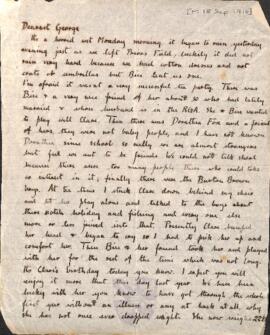
Is happy to have had a letter from him on her birthday and asks if he is happy. Tells him she will send him soup tablets and a cake as requested. Describes fishing with her father. Is happy that they are both receiving letters successfully. She intends to to take tea with the Huxley's brother who is a doctor. Informs him of Mr Kendall's headmastership. Tells him she went to visit Mrs Irvine and Mrs Radcliffe and describes the conversations she had. Asks him if he is happy to receive her letters everyday. Hopes that he will receive his watch cover in the post.

MCPP/GM/3/2/1916/48 · Stuk · 23 June 1916
Part of College Personal Papers

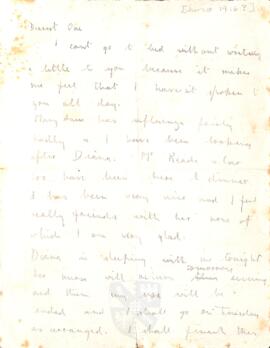
She is home at Westbrook with Diana and Olive Kennedy. Informs him that Bob is to be made a temporary Lieutenant Colonel. Describes how the children play together. Expresses her wish to see him and hopes his conditions are not too bad. Asks for his opinions on war and discusses her thoughts on when the right time to attack would be. Asks if he would like a Christmas pudding sent to him. Requests that he tell her the name of his new Major. Marjorie and Mary Anne are coming to stay and brining their own sugar. Informs him they have made £50 from the sale of 80 trees sold by her father. Her father intends to clear the common of trees.

MCPP/GM/3/2/1916/51 · Stuk · 26 June 1916
Part of College Personal Papers

Tells him she plans to make butter while Mildred goes fishing with father. Describes Mary Anne spending time with her father. Discusses in depth her thoughts and beliefs on religion. Expresses her wish to develop her own faith either separately or together with him. Sends her first letter back to him.

MCPP/GM/3/2/1916/52 · Stuk · 27 June 1916
Part of College Personal Papers

Intends to visit the hospital depot. Describes Clare's character and expresses how much the servants adore her. Compares Clare to Jean and Diana. She has not had a letter from him. Informs him that she intends to go to London with Marjorie to talk about helping on a farm. Tells him that Bob has secured a new job, possibly in Rouen that will make him a temporary Lieutenant Colonel. She has made him anti vermin pants. Describes her father's relationship with Diana. Is glad the Italians are doing well in the war.

MCPP/GM/3/2/1916/53 · Stuk · 28 June 1916
Part of College Personal Papers

Tells him about her dream. Asks him about the frequency of firing. Is glad to receive his letters and is happy he has a new cook. Asks him if he likes his new Major and how he is getting on with his tent. Hopes that her previous letter about religion didn’t bother him. Discusses the progress of the war. Describes her visit to the national mission meeting with her father. Discusses Mr Pilcher's speech about religion. Describes her father and Mr Kendall’s speeches. Tells him how she gave a talk about Sunday school and expresses her nervousness. Informs him Violet intends to go on holiday. Talks about dealing with shy children.

MCPP/GM/3/2/1916/58 · Stuk · 3 July 1916
Part of College Personal Papers

Expresses her anxiety over the war and hopes he is safe. Informs him that Olive's husband is being sent back to the trenches. Describes her activities that week; visit from Owen, Playing with the children in the garden, picking strawberries with Mary Anne and Marjorie and going for walks. Describes the weather and asks him about the weather in France. Tells him she misses his company. She is planning a skiing holiday with Owen and Mary Anne. Informs him they have made £50 from the sale of her father's fir trees from the common. Informs him she has received his letter.

MCPP/GM/3/2/1916/61 · Stuk · c. 6 July 1916
Part of College Personal Papers

Describes the garden and compares her surroundings to his in France. Tells him she misses him. Expresses her worry about what life might be like after the war and talks of how things should change for the better. Tells him how Violet is ashamed of her tanned skin on return from her holiday. Describes her intended activities; painting china, going to golf with her father. Describes to him Bob’s ill feelings towards his requests for parcels and his opinion of his regiment as a tiresome and difficult one.

MCPP/GM/3/2/1916/65 · Stuk · 12 July 1916
Part of College Personal Papers

Thanks him for his letters and for answering her questions. Is happy that he is planning a plot for a book. Discusses the recent action in the war. Tells him about the meeting of the National Mission and expresses her opinion about appropriate dress in Church. Discusses his opinions on Christianity. Describes her disagreements with Violet over the best way to feed Clare and tells him how Clare wakes up in the mornings. Describes tea with her father and Mrs Green. Revises her opinion of Mrs Green. Informs him she wishes to buy them a piano with the £50 from the sale of the trees from the common. Discusses the trenches in Germany.

MCPP/GM/3/2/1916/70 · Stuk · 20-21 July 1916
Part of College Personal Papers

Thursday 20 July - Describes her surroundings as she writes. Describes golfing with her father and Mr Raxworthy. Discusses Clare’s lack of musical talent, her progress and her education, including learning French at a young age.

Friday 21 July – Informs him she has sent his food parcels. Apologises for her carelessness with spelling. Informs him of the death of Mr Tompson, killed in action and wonders about the safety of Mr Willet. Asks him to inform her about how much danger he is in. Informs him about the premature birth of Mrs Irvine’s son. Expects a visit from Bridget. Discusses how the war has made them grow up. Is happy that he is keeping joyful.

MCPP/GM/3/2/1916/76 · Stuk · 28 July 1916
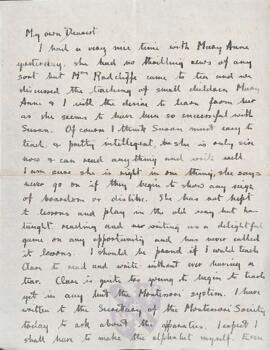
Part of College Personal Papers

Describes the weather and the garden. Reminisces about previous travels through England and asks him if he likes to imagine other places. Intends to plant seeds in the garden at the Holt. Informs him of Mr Cockerell’s opinion of his pamphlet. Asks him if he intends to write after the war. Discusses making a new dress. Describes her visit to tea with Constance Mussen and compares Clare to Reneé. Discusses her options of a holiday with Uncle Lawerence and informs him that her father, Mildred, and Bob are going to Scotland. She has taken responsibility for the ferrets who always escape.

MCPP/GM/3/2/1916/77 · Stuk · 29 July 1916
Part of College Personal Papers

Describes the weather. Expresses her anxiety over the danger he is in and discusses her thoughts on his happiness in adventure. Discusses the details of his previous letter and reassures him about his feelings towards their own troops being shelled by their own guns being his fault. Discusses the issue of men and work. Describes a trip to the river that her father and Mildred made with Clare and the Cockerell children. Describes a letter she received from Marjorie about life on the farm. Tells him her father was amused by his retort regarding potatoes.

MCPP/GM/3/2/1916/79 · Stuk · 31 July - 1 August 1916
Part of College Personal Papers

Monday 31 July - Expresses her wish to have him home and how much she misses him. Relays a conversation she had with a girl at the depot in Guildford about volunteer work. Describes the bowl she is designing. Describes the trip she had with her father and Mildred to hire a washerwoman and discusses Mildred’s reluctance to talk to poor people.

Tuesday 1 August – Tells him she came on her period and describes her morning activities. Informs him she has sent him a parcel and took tea with Mrs Trew. Discusses her ideas for the garden at the Holt. Describes her tea with Mrs Trew. Expresses her strong opinions on the conduct of Mr Allen towards his newly pregnant wife, Elenor. Discusses Shakespeare’s Hamlet and King Lear. Discusses his answer to her opinions on Mr Clutton-Brock's book. Discusses Stanley Washerman’s account of the Russian offensive.

MCPP/GM/3/2/1916/80 · Stuk · 2 August 1916
Part of College Personal Papers

Is sorry to hear of the death of his companions and urges him to stay safe. Describes the contents of the parcel she has sent him. Informs him that Bridget’s daughter has mumps and will not be visiting. Discusses the design of her bowl. Describes her train journey from Guildford. Discusses Mildred and her father’s organisation. Hopes he will have leave soon. Discusses the progress of the war. Tells him that Constance Mussen’s husband is in the field artillery. Is enclosing a dividend warrant for him to sign. Apologises that her letter has not been interesting and expresses her anxiety over his safety. Intends to be her father’s caddy at the golf course.

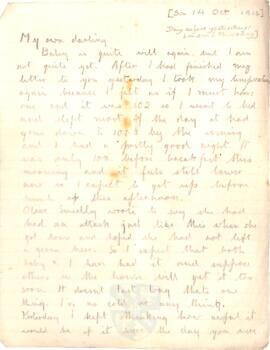
MCPP/GM/3/2/1916/81 · Stuk · 3 August 1916
Part of College Personal Papers

Strongly expresses how much she misses him and worries about his safety. Expresses how she wished she could talk to his friends about him. Describes being her father’s caddy at the golf course. Intends to have tea with Mrs Irvine. Discusses Shakespeare’s Hamlet. She will not send him any butter because of the heat.

MCPP/GM/3/2/1916/82 · Stuk · 4 August 1916
Part of College Personal Papers

Describes the weather and her trip to Mrs Irvine. Updates him on the progress of Mrs Irvine's baby. Describes her father, Mildred and the Greens playing with Clare in the garden. Discusses her opinions of Mr and Mrs Green. Describes the activities she has planned for the day. Tells him she has been instructed to find rooms at Felixstowe for Uncle Lawrence and themselves. Updates him on Clare's progress. Discusses Hamlet. Informs him the electric light is broken. Hopes to get his next letter quickly.

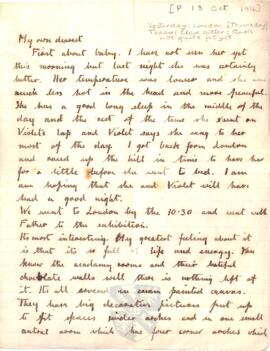
MCPP/GM/3/2/1916/85 · Stuk · 7 August 1916
Part of College Personal Papers

Discusses the postal service. Describes the weather. Informs him Mildred’s girl, Sylvia Turner, is staying and discusses her opinions of her character. Describes the painting for her bowl. Tells him about her dream. Expresses her feelings about having no visitors. Discusses a conversation she had with her father and Mr Williams about the government keeping information hidden about the war. Describes what she has read in the paper regarding the victory at the Suez Canal. Discusses the progress of the war. Expresses her opinions about Sylvia Turner’s lack of interest in the war. Tells him she is sending him a parcel containing soup tablets and lavender.

MCPP/GM/3/2/1916/86 · Stuk · 8 August 1916
Part of College Personal Papers

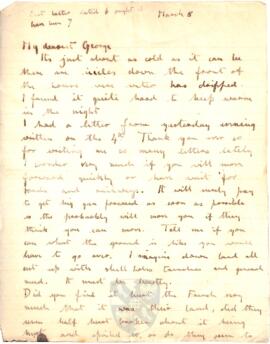
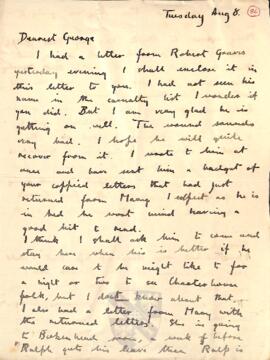
Informs him that Robert Graves has been wounded and she intends to ask him to visit. Tells him that Ralph is to get leave and will go to Birkenhead with Mary. Describes her intended activities for the day. Asks him if he would like some apples to be sent out. Expresses her love for him. Intends to go to Alborough to find lodgings and will start at 8.30 and not get back until after 9.. Updates him on her father's trouble with male staff. Intends to have tea with Mrs Kendell.

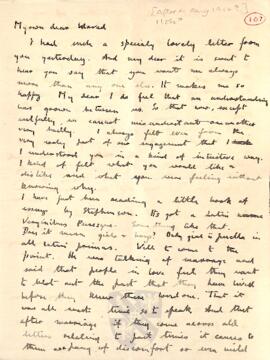
MCPP/GM/3/2/1916/88 · Stuk · c. 11 August 1916
Part of College Personal Papers

Expresses her feelings on their relationship. Discusses the Little Book of Essays by Stephenson. Expresses her opinions about jealousy in marriage. She has had a letter from Robert Graves and discusses its contents. Gives her opinion about deep thinking and encourages him to keep writing. Describes her morning activities. Discusses sending him apples and vegetables. Tells him about how busy she is and that she will send him a ginger cake. Discusses her father’s article on planning gardens. Assures him she won’t allow him to become lazy. Updates him on Clare’s progress.

MCPP/GM/3/2/1916/89 · Stuk · 12 August 1916
Part of College Personal Papers

Describes the weather and a visit to Eleanor Allen. Tells him his mother has asked her not to go to the East coast on holiday for safety reasons. Expresses her feelings that she is capable of the same tasks as the men and the war won't stop her from doing what she wants. Tells him his father has had an accident on his bicycle. Hopes he will soon get leave. Discusses the weight regulations for parcels to France. Tells him she has received his letters and will order his fruit saline. Is happy he is writing to other people. Asks him to send her letters back to her when he has read them so they can be preserved after the war.